

A rare ant from Japan is distinctive as the only known species without female workers and males; all its offspring mature into parasitic queens aiming to seize control of other colonies.
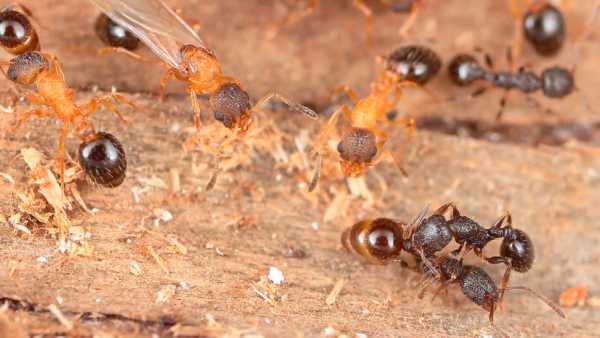
Nest of T. kinomurai containing young, winged gynomorphic and wingless intermorphic queens of T. kinomurai (light brown) and dark brown T. makora host workers.(Image credit: Hamaguchi et al., Current Biology, 2026. CC BY 4.0)Subscribe to our newsletter
Scientists have discovered a rare ant species in Japan that possesses no males or workers—only queens. These ant queens adopt a parasitic lifestyle within the nests of another ant species, reproducing asexually to generate clone queens that subsequently take over additional nests.
The parasitic ant, identified as Temnothorax kinomurai, is described as the “first known species with only queens” by Jürgen Heinze, a biologist at the University of Regensburg in Germany and co-author of a recent study detailing these findings.
Conversely, some parasitic queens infiltrate the colonies of different species, assuming control and often compelling the resident workers to attend to them and nurture their offspring until their own brood dominates.
Keiko Hamaguchi, a biologist at the Kansai Research Center in Kyoto, Japan, along with her research team, has been investigating T. kinomurai, a species observed in only nine locations across Japan. It was previously suspected that this ant species operated uniquely, producing exclusively queens without any workers or males, though this remained unconfirmed.
Young T. kinomurai queens initiate invasions into the nests of a related species, Temnothorax makora. They incapacitate the host queen and neutralize the most aggressive workers attempting to thwart the takeover. If the usurpation is successful, the remaining workers then rear the offspring of the invading queen.
“T. kinomurai relies on the host workers for foraging and raising its young; it cannot reproduce without them,” Heinze explained via email to Live Science.
To ascertain the reproductive dynamics, Hamaguchi’s group gathered six colonies managed by T. kinomurai queens and maintained them in laboratory nest boxes. From these colonies, they successfully reared 43 offspring. Examination of their reproductive organs revealed that none were males, and they were not smaller workers. All were identified as queens.
When introduced to new potential host T. makora colonies, seven of the 43 offspring, which had not yet mated, managed to execute successful takeover attempts. This outcome aligns with the generally high failure rate associated with the precarious endeavor of establishing a parasitic colony. The seven queens subsequently produced a combined total of 57 offspring, all of whom were also queens. These groundbreaking findings were published on February 23rd in the journal Current Biology.
Queens of certain ant species possess the ability to reproduce themselves asexually through a process known as parthenogenesis. Other ant species engage in social parasitism, commandeering the labor force of unrelated colonies to nurture their own progeny.
“However, until this point, no species had been documented to combine both strategies, despite the logical evolutionary rationale for such a fusion,” Jonathan Romiguier, an evolutionary biologist at the University of Montpellier in France, who was not involved in the research, stated via email to Live Science.
“Considering that there are over 15,000 known ant species, this finding is quite remarkable,” commented Daniel Kronauer, a biologist at The Rockefeller University in New York, who also did not participate in the study.
The advantages of sexual versus asexual reproduction are typically maintained in a delicate equilibrium, he elaborated. Asexual reproduction enables an organism to maximize its genetic contribution to subsequent generations by producing genetically identical female offspring, and species reproducing asexually can frequently outperform their sexual counterparts due to the absence of energy and resource expenditure on finding mates and generating males.
Conversely, sexual reproduction results in genetically diverse workers, which can confer advantages to an ant colony regarding disease resistance and specialization of tasks.
Nevertheless, given that T. kinomurai queens no longer produce workers, these benefits are rendered obsolete, Kronauer informed Live Science. “This situation could potentially tip the scales in favor of asexual reproduction, leading ultimately to the elimination of males,” he concluded.