

Speculative theories have circulated regarding 3I/ATLAS being an artificial entity. However, the extraterrestrial hypothesis, while intriguing, tends to foster inaccuracies and diverts attention from scientific inquiry.
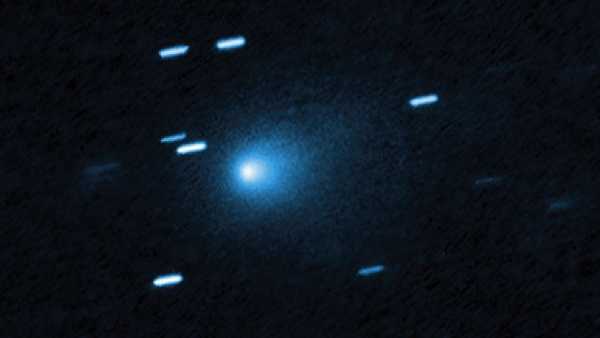
The interstellar comet 3I/ATLAS, as observed by NASA’s Hubble Space Telescope on July 21, 2025. (Image credit: NASA, ESA, David Jewitt (UCLA); Image Processing: Joseph DePasquale (STScI))Subscribe to our newsletter
Comet 3I/ATLAS achieved its closest approach to the sun on October 29.
This point, termed perihelion, occurred approximately 210 million kilometers from the sun, equating to 1.4 times the distance between the sun and Earth. It was positioned on the opposing side of the sun from Earth, meaning the sun obscured the comet from our terrestrial vantage point. Consequently, ground-based telescopes are now resuming their observations.
Upon its initial detection on July 1, 2025, by the Asteroid Terrestrial Last Alert System (or “ATLAS”), one of the immediate inquiries posed was whether it might be of extraterrestrial origin.
This is not the first instance of the alien question arising in connection with a novel astronomical finding. However, while potentially entertaining, such speculation can detract from genuine scientific pursuits and propagate unfounded information.
A long history of speculation
Similar conjectures about alien life emerged following the discovery of the first two interstellar objects: 1I/2017 U1 ‘Oumuamua and Comet 2I/Borisov.
Such discussions are not confined solely to interstellar objects.
In 2019, I authored my inaugural public article detailing a discovery made during my doctoral studies. I identified radio emissions originating from a binary star system, marking the first object detected by the MeerKAT telescope exhibiting fluctuations in brightness over time. Despite its complete lack of connection to extraterrestrial life, the editor requested the inclusion of speculative remarks regarding aliens.
In 1967, Jocelyn Bell Burnell, then a postgraduate researcher, detected a rapidly pulsing radio signal.
As a jest, she designated it LGM 1, standing for “Little Green Men.” However, the collaborating astronomers did not seriously entertain the notion of discovering extraterrestrial beings. They were, nevertheless, concerned that media coverage focusing on potential alien involvement might sensationalize the discovery and impede their scientific investigations.
A 7 billion-year-old visitor
This apprehension persists among astronomers today.
Comet 3I/ATLAS is potentially the most ancient object ever observed within our Solar System. Our Solar System originated 4.6 billion years ago, whereas recent investigations suggest that Comet 3I/ATLAS may be over 7 billion years old.
It has traversed the cosmos for a significant portion of its existence, only to spend a brief period within our Solar System. Upon reaching perihelion, the comet likely experienced its closest stellar proximity in at least millions of years.
Research indicates that the comet’s outer layers contain a higher concentration of carbon dioxide than observed in most comets within our Solar System. Furthermore, it exhibits a greater ratio of nickel to other elements compared to local comets.
These chemical indicators provide a unique glimpse into the elemental makeup of the gaseous cloud from which the comet’s originating solar system formed.
This constitutes a primary rationale for reserving discussions of alien life until all other explanations have been thoroughly explored. Prioritizing the extraterrestrial hypothesis can potentially lead to the overlooking of invaluable scientific data.
As astronomer Carl Sagan remarked (rephrasing a principle by French mathematician Pierre-Simon Laplace), “extraordinary claims demand extraordinary evidence.” While we may not yet fully comprehend every aspect of the comet, our incomplete understanding does not serve as evidence for alien origins.
Interstellar Visitor is Fastest Comet Ever Recorded – YouTube
Watch On Embrace the uncertainties
Engaging in discussions about aliens also creates fertile ground for the dissemination of misinformation.
For instance, claims have surfaced regarding trajectory alterations and the comet 3I/ATLAS “concealing itself” behind the sun. Despite a lack of supporting evidence, I received numerous inquiries of this nature when I discussed the comet online. This highlights the ease with which misinformation can be generated and propagated when the topic of “aliens” is introduced.
Alternative methods exist for observing the comet when it is on the far side of the sun. For example, the European Space Agency intends to monitor the comet utilizing the Mars Express, ExoMars Trace Gas Orbiter, and the Jupiter Icy Moons Explorer.
Additionally, resources are available for tracking the trajectory of Comet 3I/ATLAS and determining its current location.
Poetic insights might offer valuable perspective here. The Romantic poet John Keats described a concept known as “negative capability,” which, despite its unusual name, pertains to the capacity to tolerate “uncertainties, mysteries, and doubts” without discomfort.
There remains a considerable amount of the unknown concerning Comet 3I/ATLAS and the broader universe. The field of astronomy would lose its appeal if all questions were already answered. However, when confronted with the unknown, humanity tends to seek explanations.
In the realm of astronomical mysteries, this explanatory gap is frequently filled by speculation about extraterrestrial life. Nevertheless, the absence of complete answers is not indicative of alien presence; it merely signifies the ongoing need for scientific investigation.
This revised article is republished from The Conversation under a Creative Commons license. Read the original article.
TOPICS
Sourse: www.livescience.com