

A comprehensive investigation by scientists in China has been undertaken to detect extraterrestrial radio transmissions originating from the nearby TRAPPIST-1 system, a region potentially harboring planets akin to Earth.

Trappist-1, depicted here in an illustration alongside our Sun for scale, has been the focus of the search for signals from beyond our world.(Image credit: CactiStaccingCrane)Subscribe to our newsletter
TRAPPIST-1 is a stellar object of the red dwarf type, situated approximately 40 light-years distant, which hosts a collection of seven rocky planets comparable in size to Earth. At least three of these celestial bodies orbit within the habitable zone, the region where liquid water could potentially exist. This characteristic positions it as one of the exoplanetary systems most resembling our own Solar System discovered to date, with TRAPPIST-1e being regarded as one of the most promising potentially habitable exoplanets. The system’s relative closeness and the presence of multiple worlds with the potential for habitability render it an optimal candidate for the search for advanced civilizations.
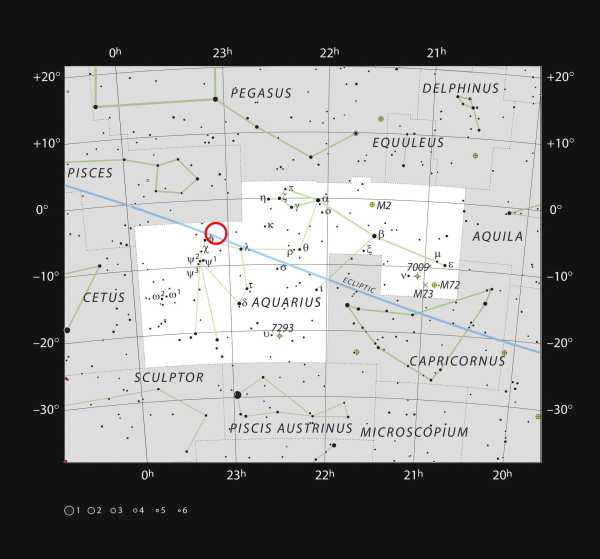
The red circle delineates the position of TRAPPIST-1 within the Aquarius constellation. (Image credit: ESO/IAU and Sky & Telescope)
Led by Guang-Yuan Song from Dezhou University in China, the group specifically sought out radio frequencies exhibiting precise characteristics that would gradually shift over time due to planetary movement.
Such transmissions would be exceptionally difficult to generate through natural processes and would strongly indicate an artificial origin from a sophisticated civilization. Given the specifications of FAST, the researchers possessed the capability to detect radio signals as feeble as 2.04×10^10 watts, surpassing the sensitivity of any prior investigations. Should any alien species be regularly broadcasting radio signals on a specific frequency, this research would have a higher probability of detecting them compared to earlier attempts.
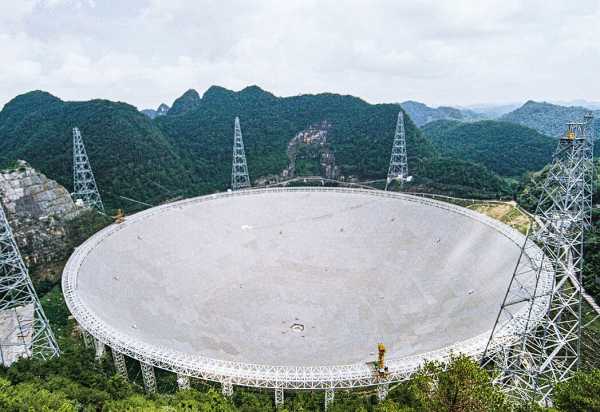
The 500m Aperture Spherical Radio Telescope, situated in China’s Guizhou Province.(Image credit: SCJiang)
Regrettably, the investigation did not yield any conclusive evidence of alien technology. However, far from being a source of disappointment, this outcome still imparts valuable scientific insights. It establishes upper boundaries for the existence of specific categories of extraterrestrial transmitters within the TRAPPIST-1 system and underscores the impressive capabilities of contemporary SETI (Search for Extraterrestrial Intelligence) initiatives.
It may take several years, or even decades, before we can definitively preclude the possibility of life within the TRAPPIST-1 system. Nevertheless, for the time being, it continues to be a captivating target for future SETI endeavors. The research team intends to broaden their search to encompass other signal types, including periodic or transient transmissions that might elude current detection methods.
The quest for extraterrestrial intelligence remains among our most profound scientific undertakings, possessing the potential to fundamentally reshape our comprehension of our position within the cosmos. As we persist in observing the expanse of space with ever-increasing accuracy, we are not solely seeking alien life but are embarking on the initial phases toward what could be the most significant moment in human history.
Sourse: www.livescience.com