

Recent observations reveal that the sungrazer comet C/2026 A1 (MAPS) did not withstand its close passage by our star. Instead, the celestial body briefly transformed into a “headless wonder” before completely disintegrating.
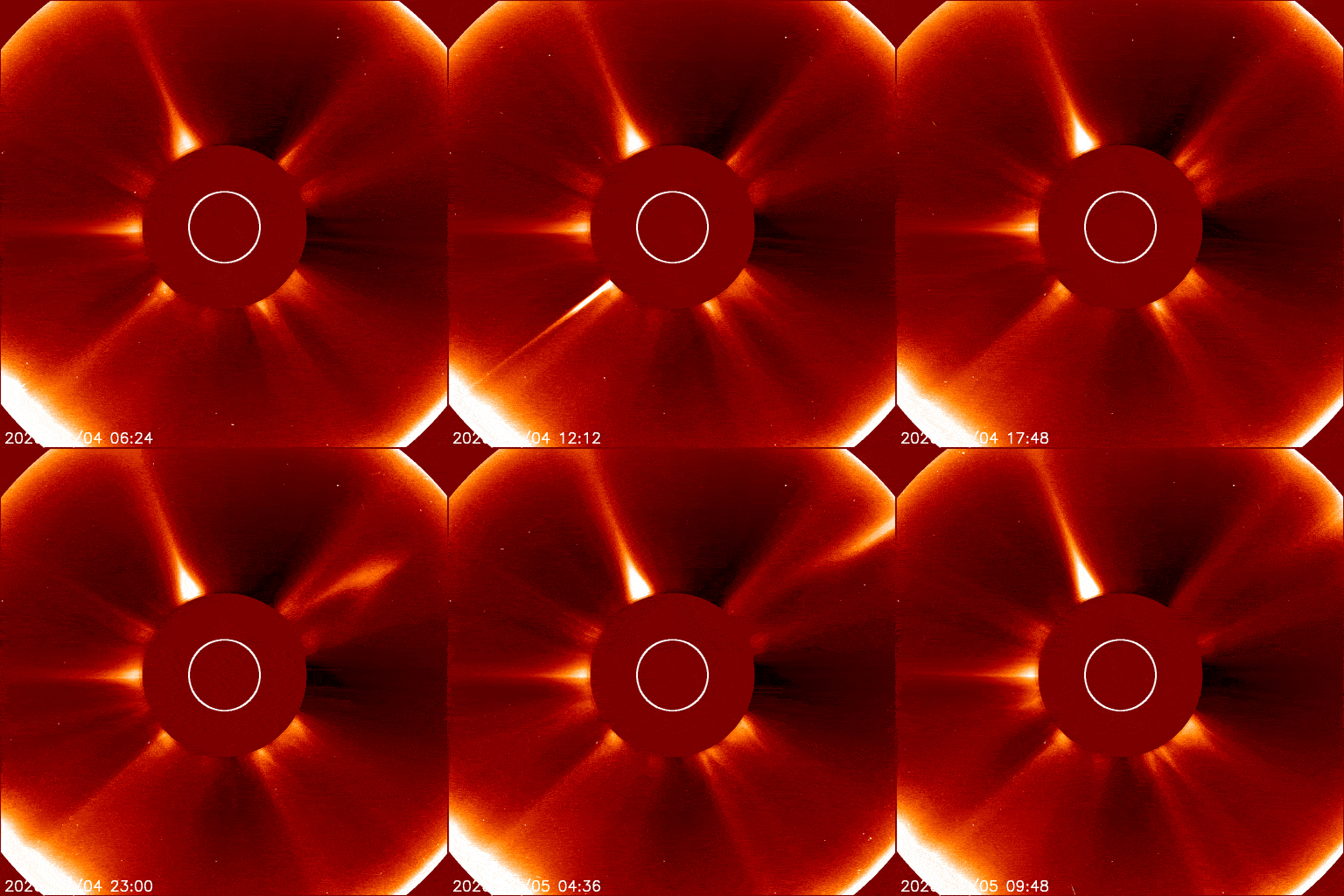
The SOHO satellite documented comet MAPS entering the sun’s atmosphere (left) and then emerging on the other side as a debris cloud.(Image credit: NASA/ESA/SOHO)Subscribe to our newsletter
A highly anticipated “sungrazer” comet has ceased to exist. Many anticipated that this comet would achieve such brilliance that it would be visible during daylight. However, the unfortunate object was fractured by an exceptionally close “death dive” with our star, which momentarily turned it into a “headless wonder” — a comet without a nucleus, possessing only a spectral tail — as astonishing footage demonstrates.
The comet, designated C/2026 A1 (MAPS), belonged to the Kreutz sungrazers category – a collection of comets, likely remnants of a massive exploded comet, that orbit extremely close to the sun. Researchers identified the comet in January and initially estimated its width to be approximately 1.5 miles (2.4 kilometers); however, subsequent images captured by the James Webb Space Telescope indicated it was merely about 0.25 miles (0.4 km) in diameter.
On Saturday, April 4, comet MAPS achieved its closest proximity to the sun, known as perihelion, plunging into the sun’s outer atmosphere, or corona, at a distance of merely 100,000 miles (160,000 km) from the solar surface – approximately half the separation between Earth and the moon. This intimate encounter was obscured from astrophotographers due to the comet’s proximity to our star. Nevertheless, several space-based observatories documented the solar flyby.
It rapidly became evident that comet MAPS did not survive its solar passage. Time-lapse imagery recorded by the Solar and Heliospheric Observatory (SOHO) shows the luminous comet hurtling towards the sun and subsequently emerging from behind the obscured solar disk as a dispersion of dust and gas – essentially, nothing more than a tail.
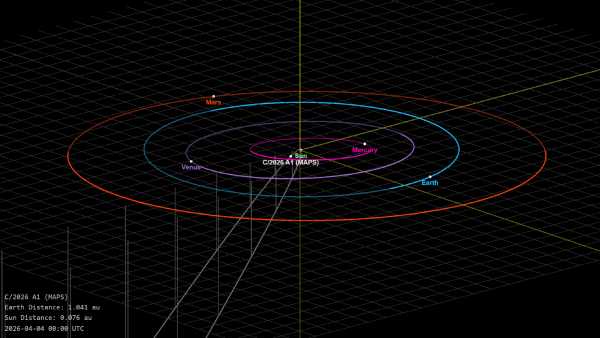
Comet MAPS reached its closest point to the sun, or perihelion, on April 4 and came within 100,000 miles (160,000 km) of the solar surface. (Image credit: NASA/JPL/Small-Body Database Lookup)
The comet likely succumbed to the extreme thermal stress exerted on its icy shell, or nucleus, as well as the powerful gravitational forces encountered during its journey at approximately 1 million mph (1.6 million km/h), according to Spaceweather.com.
“The comet entered, but only a cloud of debris emerged,” Spaceweather.com representatives stated regarding the SOHO video footage. “RIP, comet MAPS.”
The remnants left by comet MAPS, identified as striae, briefly shimmered as a headless wonder. However, the debris quickly dispersed, leaving no visible trace of comet MAPS, as reported by Live Science’s sister publication, Space.com.
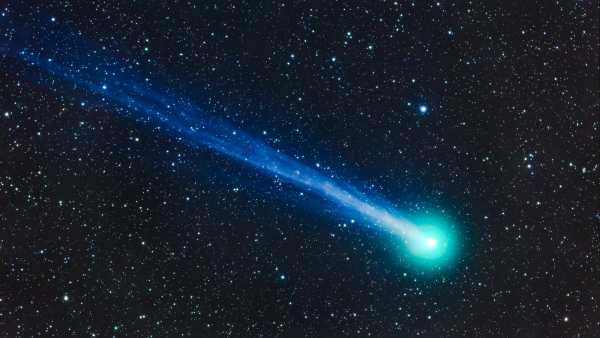
Experts had hoped comet MAPS would put on a spectacular post-perihelion display, similar to Comet Lovejoy (photographed) in 2011. (Image credit: Alan Dyer /VW PICS/Universal Images Group via Getty Images)
Fortunately, comet MAPS is not the sole highly anticipated comet that may be observable in April.
Later this month, another comet, C/2025 R3 (PanSTARRS), is predicted to shine brilliantly as it reaches its perihelion on April 19. However, unlike comet MAPS, this object will maintain a considerably greater distance from the sun – approximately 46.4 million miles (74.6 million km) – rendering it a far more dependable target for celestial observers equipped with a suitable telescope or a pair of stargazing binoculars. The optimal viewing period will be a few days prior to its closest solar approach, when the new moon ensures a dark sky.
Several experts had previously posited that comet PanSTARRS could qualify as the “Great Comet of 2026.” Given the demise of comet MAPS, this assertion now appears increasingly plausible.
Sourse: www.livescience.com