

A colossal communal spiderweb in a sulfurous cavern on the Greece-Albania border might be the most extensive ever documented—and it was constructed by arachnids previously unknown to aggregate in such numbers.
Subscribe to our newsletter
Scientists have identified over 111,000 spiders flourishing in what is presumed to be the planet’s largest spiderweb, deep within a lightless cave system straddling the Albanian-Greek frontier.
This represents the initial confirmation of communal living among two prevalent spider species and is likely the world’s most substantial spiderweb, stated the study’s lead author, István Urák, an associate professor of biology at Sapientia Hungarian University of Transylvania in Romania.
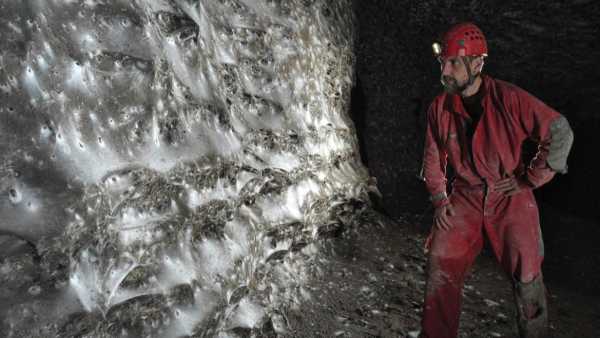
A cave-dwelling spider colony has constructed what appears to be the largest spiderweb ever discovered. (Image credit: Urak et al. 2025, Subterranean Biology (CC BY 4.0))
“The natural world continues to present us with countless astonishments,” Urák conveyed to Live Science via email. “If I were to endeavor to articulate all the sentiments that arose within me [upon observing the web], I would emphasize awe, reverence, and appreciation. One must personally experience it to fully grasp the sensation.”
This spider metropolis is situated in Sulfur Cave, a geological formation shaped by sulfuric acid resulting from the oxidation of hydrogen sulfide in subterranean water. While the researchers unveiled intriguing new details about Sulfur Cave’s spider community, they were not the initial discoverers of the immense web. Explorers from the Czech Speleological Society encountered it in 2022 during an expedition in the Vromoner Canyon. Subsequently, a scientific contingent visited the cave in 2024, collecting specimens from the web, which Urák then analyzed before embarking on his own expedition to Sulfur Cave.
This examination revealed the presence of two spider species within the community: *Tegenaria domestica*, commonly known as the barn funnel weaver or domestic house spider, and *Prinerigone vagans*. During their visit to the cave, Urák and his colleagues estimated the population comprised approximately 69,000 *T. domestica* and over 42,000 *P. vagans* individuals. DNA analyses conducted for the recent research also corroborated that these are the predominant species in the colony, Urák affirmed.
Sulfur Cave’s spider aggregation is among the most extensive ever recorded, and the involved species were not previously known for assembling and cooperating in this manner, Urák stated. *T. domestica* and *P. vagans* are widely distributed near human settlements, but this colony represents “a singular instance of two species coexisting within the same web structure in these enormous quantities,” he remarked.
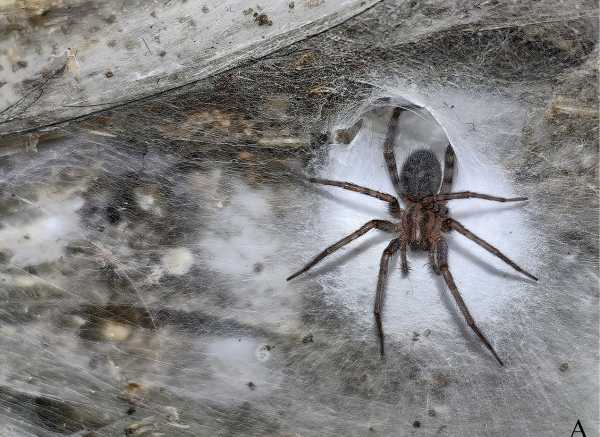
A barn funnel weaver, or domestic house spider (*Tegenaria* *domestica*), within Sulfur Cave. (Image credit: Urak et al. 2025, Subterranean Biology (CC BY 4.0))
Under typical circumstances, scientists would anticipate barn funnel weavers to prey upon *P. vagans*; however, the absence of light within the cave may compromise the spiders’ visual acuity, according to the study.
The spiders subsist instead on non-biting midges, which in turn feed on white microbial biofilms—viscous secretions that shield microorganisms from environmental hazards—produced by sulfur-oxidizing bacteria within the cave. A stream rich in sulfur, fed by natural springs, courses through Sulfur Cave, saturating the cavern with hydrogen sulfide and facilitating the survival of microbes, midges, and their predators, the researchers detailed in their study.
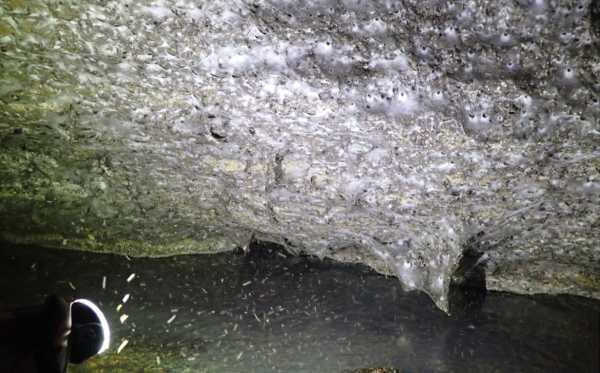
The spiders inhabiting Sulfur Cave consume non-biting midges, which form dense swarms near the cave’s entrance. (Image credit: Urak et al. 2025, Subterranean Biology (CC BY 4.0))
The spiders’ diet, rich in sulfur compounds, impacts their gut microbiomes, resulting in significantly less diversity compared to the microbiomes of individuals of the same two species found outside the cave, as indicated by analyses of gut contents. Molecular data also demonstrated that the cave-dwelling spiders are genetically distinct from their terrestrial counterparts, suggesting that the subterranean inhabitants have adapted to their dim environment.
“Frequently, we believe we have a complete understanding of a species, that we grasp all aspects of it, yet surprising discoveries can still emerge,” Urák remarked. “Certain species exhibit remarkable genetic adaptability, which typically becomes evident only under extreme conditions. Such circumstances can trigger behaviors not observed under ‘ordinary’ settings.”
It is crucial to safeguard this colony, despite potential complications stemming from the cave’s location straddling two nations, Urák emphasized. In the interim, the research team is engaged in further studies intended to unveil additional insights into Sulfur Cave’s resident fauna, he added.