

While the world marvels at the breathtaking images from Artemis II’s groundbreaking lunar flyby, geologists involved in the mission anticipate significant discoveries about the moon.
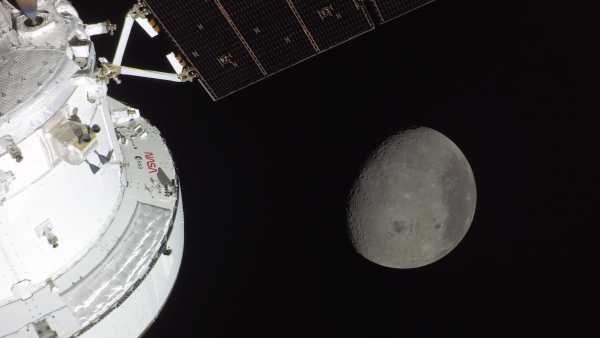
The Orion spacecraft (foreground) approaches the moon for historic close-up observations. Mission geologists are already excited about the data being returned.(Image credit: NASA)Subscribe to our newsletter
The four astronauts on Artemis II are scheduled to return to Earth on Friday (April 10), bringing back not only themselves but also a valuable collection of imagery from their lunar expedition. The geologists supporting the mission are eagerly anticipating the opportunity to analyze these findings.
“The photographs are simply stunning,” commented Gordon Osinski, a specialist in impact craters and a planetary geologist at Canada’s Western University, who played a significant role in the geology training for the Artemis II crew. He shared this sentiment with Live Science after viewing the initial images captured during the crew’s seven-hour lunar flyby.
A green, brown, and striking moon
Two geological observations are particularly noteworthy at this stage. One pertains to impact flashes, which are brief yet intense bursts of light occurring when meteoroids strike the moon, resulting in crater formation.
Artemis II astronauts Reid Wiseman and Jeremy Hanson reported witnessing at least five such flashes during their lunar flyby. Geologists look forward to examining the crew’s photographs upon their return to Earth, hoping to pinpoint the craters linked to these impacts.
“The conditions under which [the crew] could observe these were ideal,” Osinski stated, referencing the spacecraft’s trajectory over the lunar terminator—the distinct boundary separating the moon’s illuminated day side from its dark night side, where heightened contrast makes flashes more discernible.
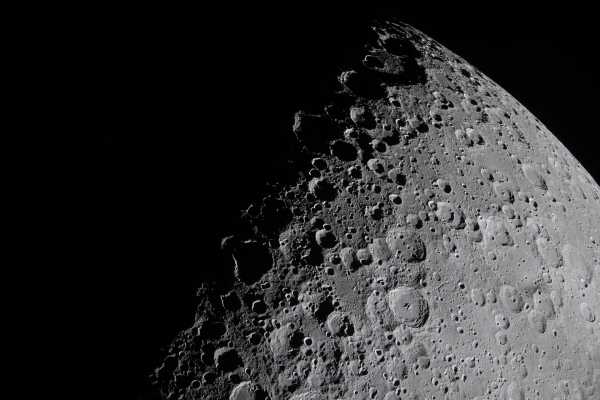
The lunar terminator, where day transitions to night, facilitates observations with maximum contrast. The crew detected impact flashes from incoming meteoroids near this region. (Image credit: NASA)
Secondly, scientists involved in the mission are keen to examine the crew’s descriptions of lunar colors. While geologists have only received brief initial impressions from the crew via public voice communications, the Artemis II astronauts recorded more detailed observations of the lunar flyby using both voice and written notes in an archive that will require several weeks to review.
The astronauts conveyed some fascinating observations, including the presence of areas exhibiting green and brown hues on the lunar surface.
“We are aware that color exists on the lunar surface,” Osinski confirmed. He further noted that the human visual system is more sensitive to color variations than the cameras aboard Artemis II, indicating that “this will certainly be an area of compelling follow-up.”
The human element in space exploration
For several years, Osinski has been instrumental in providing geological training to Artemis II crew members. Hansen has participated multiple times in Osinski’s remote crater expeditions in Canada, often in collaboration with Indigenous communities. During the preparation for Artemis II, mission specialist Christina Koch and Canadian Space Agency backup astronaut Jenni Gibbons joined Hansen and Osinski in 2023 for an expedition to a crater in northern Labrador, Canada, chosen for its resemblance to lunar environments.
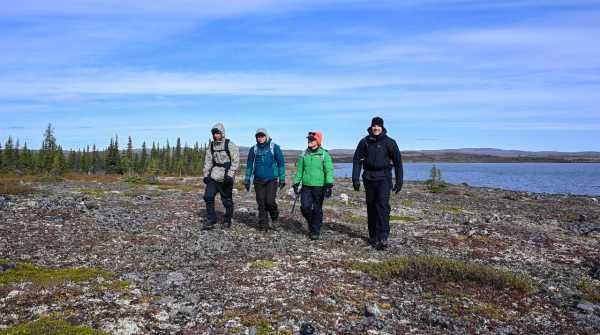
Prior to their lunar mission, some Artemis II astronauts participated in a geological field training and research expedition at the Kamestastin crater in northern Labrador to survey the moon. Pictured from left: Astronauts Raja Chari (NASA), Jenni Gibbons (CSA), Christina Koch (NASA), and Jeremy Hansen (CSA). (Image credit: Canadian Space Agency)
Since the Artemis II astronauts were unable to collect lunar surface samples directly, they received training on how to make detailed descriptions. They also employed “situational awareness” in certain scenarios, such as differentiating between volcanic and impact processes. However, the majority of the interpretation work will be conducted by geologists on Earth over several months following the mission’s conclusion.
Nonetheless, the Artemis II astronauts can offer additional valuable contributions. They are part of an exclusive group of fewer than 30 individuals who have personally witnessed the moon up close, allowing them to apply human perception and experience to their observations.
Furthermore, Artemis II marks the first lunar astronaut mission in nearly two generations, equipping the astronauts (and their supporting scientists) with decades of accumulated knowledge regarding impact craters, water ice, and other lunar features that were unavailable to Apollo-era officials. The images transmitted from Artemis II thus far represent only a portion of the data onboard. Osinski expressed particular interest in viewing the high-resolution images captured with the 400-millimeter (16-inch) lens by the crew, intending to compare them with imagery acquired by NASA’s Lunar Reconnaissance Orbiter.
Bringing lunar knowledge home
Following the return of Artemis II, Osinski and fellow geologists will utilize the insights gained from the astronauts’ observations to inform future lunar surface missions. Planning for these surface operations has been underway for two years, with the team currently focusing on aspects such as identifying potentially suitable landing sites and announcing the participating scientists.
Jacob Bleacher, NASA’s chief exploration scientist, informed Live Science that the geology teams are developing landing protocols for the initial surface astronauts and anticipate receiving additional data from commercial landing missions supporting NASA. Firefly Aerospace’s Blue Ghost mission was the first to reach its destination, completing 60 days of operations in 2025. “We acquired a substantial amount of data from them,” Bleacher stated, expressing optimism that more companies will achieve lunar landings before Artemis IV transports astronauts to the lunar surface in 2028.
For the present moment, geologists are already diligently preparing a plan for lunar sample return.
Osinski serves as a co-investigator for the geology team that will support the Artemis IV astronauts. He indicated that his team will likely utilize a lower-resolution live video feed, which will enable geologists on Earth to assist the astronauts on-site with their observations, at least to some degree.
However, Artemis surface astronauts might also need to make rapid decisions regarding sample selection, necessitating further training, Osinski explained. This will require them to operate more independently.
“They might face situations where they have to make a split-second decision on the surface, perhaps if they are running out of time at a designated site: ‘Do I select this sample or that one?’ And there may not be sufficient time for back-and-forth communication with the science team at Mission Control,” Osinski elaborated.
TOPICS
Sourse: www.livescience.com