

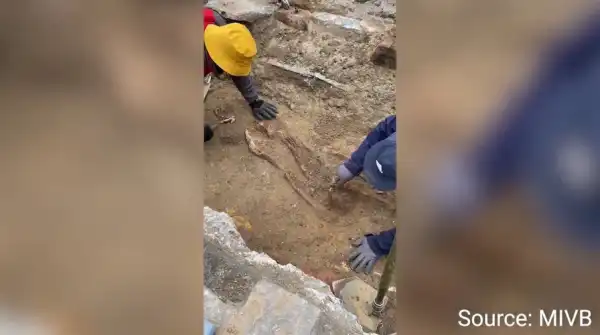
Video Medieval skeletons found in heart of Brussels during archaeological excavation
Archaeologists in Brussels, Belgium, recently came across the remnants of an old cemetery located in a busy part of the city. The remains date back to the Middle Ages. (Source: @mijnmivb via Facebook)
NEWYou can now listen to Fox News articles!
Archaeologists have unearthed ancient skeletons beneath a school site in France — all interred in an unusual seated posture.
The finding was announced by Inrap, France’s national institution for preventive archaeology, in a press release in March.
The skeletal remains were discovered on the grounds of the Josephine Baker school complex in Dijon, approximately 195 miles southeast of Paris. The campus caters to students from preschool through elementary school.
The graves are attributed to the Gallic period in France, an era when Celtic tribes known as the Gauls inhabited the region.
The Gallic period spanned from the fifth century B.C. to 50 B.C., before Julius Caesar’s conquest of the area.
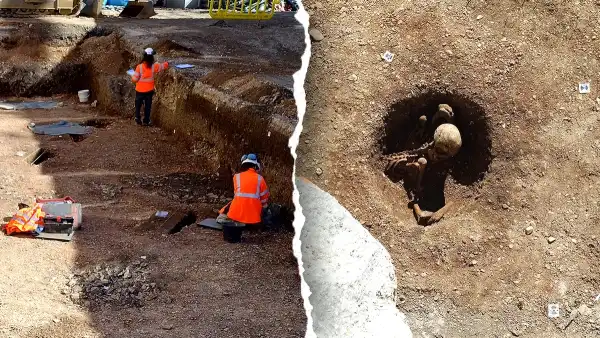
Archaeologists in France uncovered multiple ancient burials beneath a modern school site, with skeletons arranged in a rare seated position dating back to the Gallic period. (Frédéric Bourigault/AFP via Getty Images)
Inrap first identified similar Gallic burials at the location in 2024.
While excavators found 13 graves two years ago, they uncovered “five to six” new graves during the most recent excavation — three of which formed a second, parallel alignment.
Images from the site depict archaeologists at work as sections of earth are meticulously excavated into circular pits, with skeletal remains positioned within.
Inrap stated that the new graves were “seated at the bottom of the pit, [their] backs against the eastern wall, facing west,” according to a translated statement.
“Only about a dozen archaeological sites have yielded around 50 ‘seated’ burials.”
“Their arms are resting along the torso, with hands near the pelvis or femurs,” the statement detailed.
“Their legs are tightly bent, often asymmetrically.”
Adding to the enigma, archaeologists found no personal effects or grave offerings, apart from a black stone armband dated to the third century B.C.
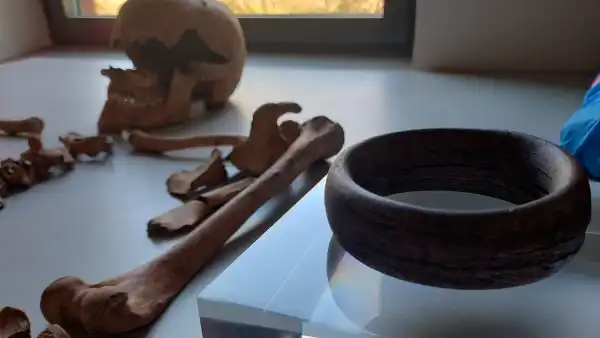
The skeletons were found without grave goods, aside from a single black stone armband dated to the third century B.C., deepening the mystery of the site. (Frédéric Bourigault/AFP via Getty Images)
Archaeologists have released limited details about the site, but noted that the graves discovered in 2024 exhibited “signs of unhealed violence.”
The injuries “likely indicate intentional killing,” Inrap stated — and included lacerations on an upper arm bone.
“One individual sustained two blows from a sharp object (possibly a sword) to the skull,” the statement said.
Officials also indicated that the discovery is significant due to the quantity of burials and “the good condition of skeletal preservation.”
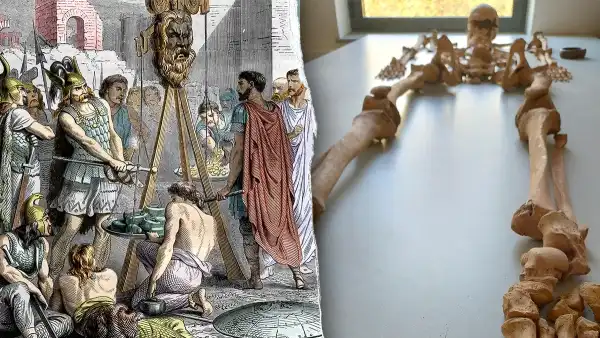
The skeletons date to the Gallic period, spanning from the fifth century B.C. to 50 B.C., when Julius Caesar conquered the region (shown at left). (Leemage/Corbis via Getty Images; Frédéric Bourigault/AFP via Getty Images)
“Instances of individuals buried in a seated position are documented from as early as the Mesolithic and, although uncommon, throughout prehistory,” the announcement noted.
“Only approximately a dozen archaeological sites have yielded around 50 ‘seated’ burials, typically situated near elite residences, sanctuaries, or places of worship, and distinct from conventional cemeteries.”
Archaeologists are still investigating whether the individuals were combatants, members of affluent families, or figures connected to religious customs.
Fox News Digital contacted Inrap for comment, but received no immediate response.
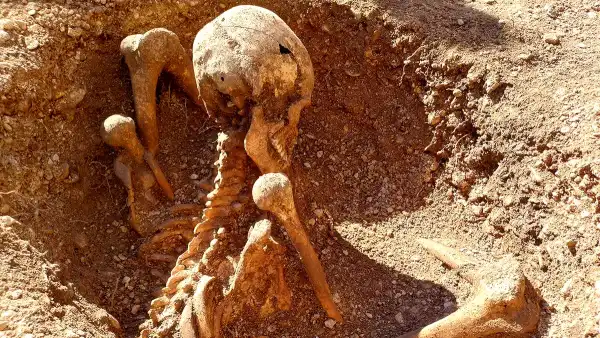
“Examples of individuals buried in a seated position are known from as early as the Mesolithic and, although rare, throughout prehistory,” stated Inrap. (Frédéric Bourigault /AFP via Getty Images)
The most recent find is one of many recent notable archaeological discoveries in France.
Last year, Inrap archaeologists uncovered 16th-century gallows, where condemned prisoners were put on public view during the Protestant Reformation.
Last summer, officials announced the discovery of a rare 16th-century shipwreck in French waters, found at a record depth.