

in Features
(Image credit: ESA/Webb, NASA & CSA, V. Almendros-Abad, M. Guarcello, K. Monsch, and the EWOCS team.)Share this article 0Join the conversationFollow usAdd us as a preferred source on GoogleSubscribe to our newsletter
After more than four years in orbit, the planet’s most advanced telescope has profoundly reshaped our understanding of the cosmos.
The sophisticated, $10 billion James Webb Space Telescope (JWST) unveiled its initial image to the globe on July 12, 2022, observing deeper into the universe than any predecessor. Since then, JWST has captured the enigmatic beauty of our solar system’s planets, remote stellar nurseries, imposing formations of gas and dust, and other findings that both validate and challenge our established cosmological theories.
Here are 48 of the telescope’s most remarkable observations.
Starlit mountaintops
(Image credit: NASA, ESA, CSA, and STScI, A. Pagan (STScI))
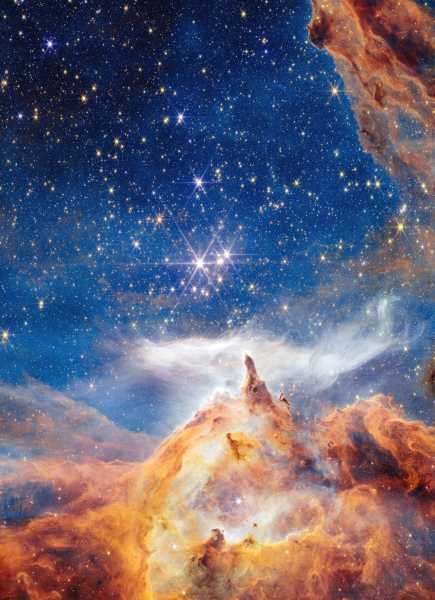
In one of JWST’s most stunning interstellar vistas, a colossal structure of gas and dust ascends above a sky filled with stars. This is the Pismis 24 star cluster, situated approximately 5,500 light-years away within the Milky Way’s Scorpius constellation. We owe this picturesque view to the brilliant stars overhead; their intense radiation erodes the surrounding gas, sculpting it into pointed peaks.
Web of chaos
(Image credit: Credit: X-ray: NASA/CXC/SAO; Infrared: NASA/ESA/CSA/STScI/Webb; Image Processing: NASA/CXC/SAO/L. Frattare)
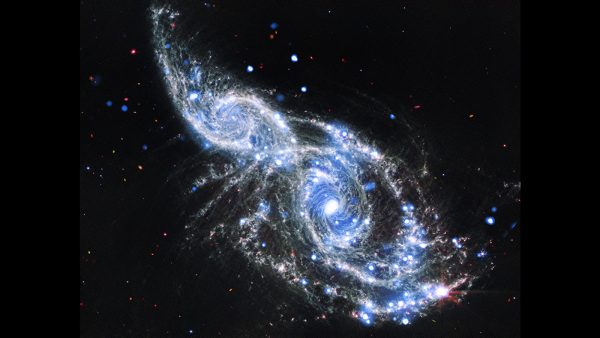
In this ethereal depiction of two merging galaxies, stars unfurl across filaments of gas, resembling a cornucopia overflowing. The merger illustrates the simultaneous destruction and creation that occurs in the cosmos. The two galaxies — NGC 2207 (lower right) and IC 2163 (upper left) — interact gravitationally, distorting each other’s spiral arms and compressing gas to ignite new star formation.
The “Exposed Cranium”
(Image credit: NASA, ESA, CSA, STScI, Image Processing: Joseph DePasquale (STScI))
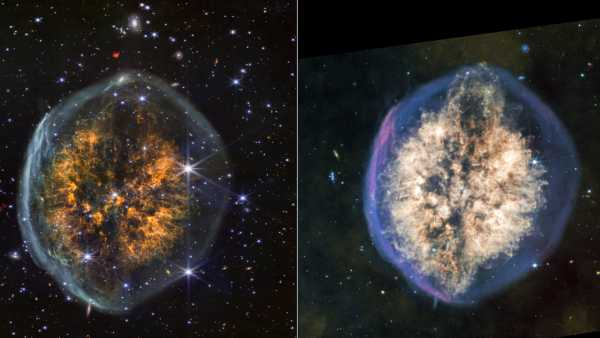
Some celestial objects truly provoke contemplation; others appear to be engaged in thought. The Exposed Cranium Nebula (PMR 1) is an expanding shell of ionized gas ejected by a dying star. In JWST’s NIRCam view (left), a dark, dusty band traverses the center, dividing the nebula’s two hemispheres and imparting its cranial appearance. The MIRI perspective (right) displays the nebula’s diffuse, expanding borders with greater complexity. Combined, these two images provide one of the most intricate neural scans of a celestial body’s demise ever achieved.
Stellar cradle
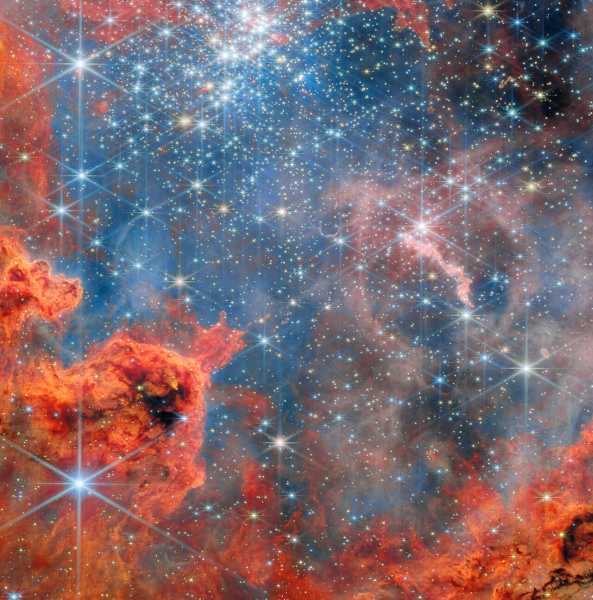
(Image credit: Credit: ESA/Webb, NASA & CSA, V. Almendros-Abad, M. Guarcello, K. Monsch, and the EWOCS team.)
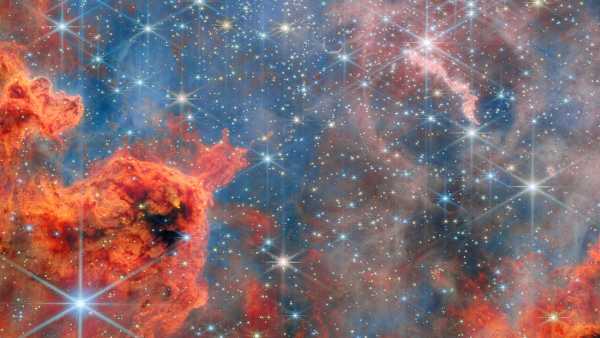
The Westerlund 2 star cluster sparkles within the Gum 29 nebula, approximately 20,000 light-years from Earth. At merely 2 million years of age, the young cluster hosts some of the hottest, largest, and most luminous stars in our galaxy. Stellar radiation sculpts nearby gas into billowing structures, as observed on the left side of the image.
Cigar ablaze
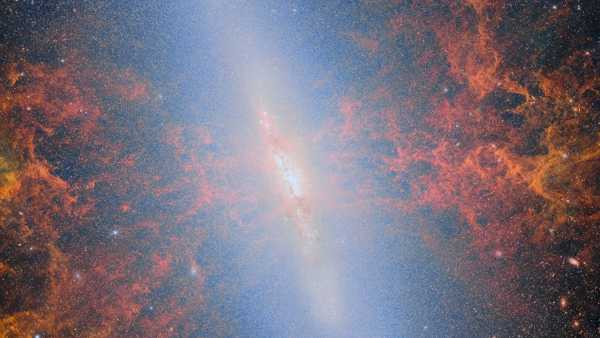
(Image credit: ESA/Webb, NASA & CSA, A. Bolatto via Getty Images)
The Cigar Galaxy (M82) smolders in the night sky, emitting light approximately five times brighter than the Milky Way despite its smaller size by a factor of four. This luminosity is due to accelerated star formation, with new stars emerging at roughly 10 times the pace observed in our galaxy. Although M82 is a spiral galaxy akin to the Milky Way, its orientation provides a profile that appears distinctly cigar-shaped.
Star factory
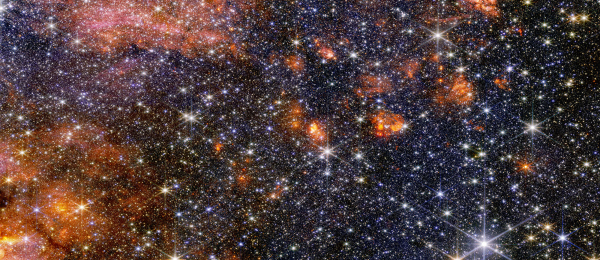
(Image credit: NASA, ESA, CSA, STScI, Adam Ginsburg (University of Florida), Nazar Budaiev (University of Florida), Taehwa Yoo (University of Florida); Image Processing: Alyssa Pagan (STScI))
Merely a few hundred light-years from our galaxy’s central black hole, the immense molecular cloud Sagittarius B2 actively produces new stars. Despite possessing only about one-tenth of the galactic center’s gas reserves, this colossal cloud accounts for roughly half of the region’s stellar genesis. The vibrant orange clouds of star-forming gas revealed in this JWST image may offer an explanation for this phenomenon.
The Pillars of Creation
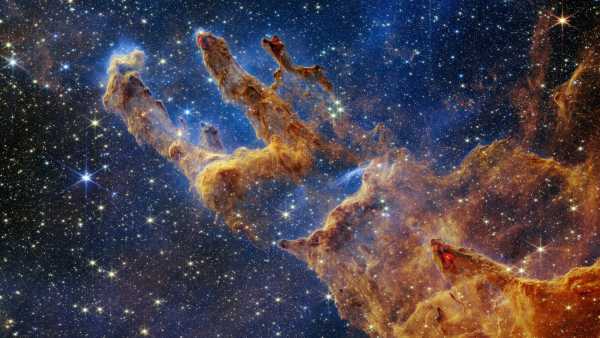
(Image credit: NASA, ESA, CSA, STScI; Joseph DePasquale (STScI), Anton M. Koekemoer (STScI), Alyssa Pagan (STScI).)
The towering pillars of creation – a vast expanse of sculpted gas and dust situated approximately 6,500 light-years from Earth in the Eagle Nebula – have been a prominent celestial landmark since their observation by the Hubble Space Telescope in 1995. JWST’s shimmering rendition of these iconic formations could equip scientists with fresh perspectives on stellar birth and its influence on the surrounding space.
Entangled galaxies smile for the camera
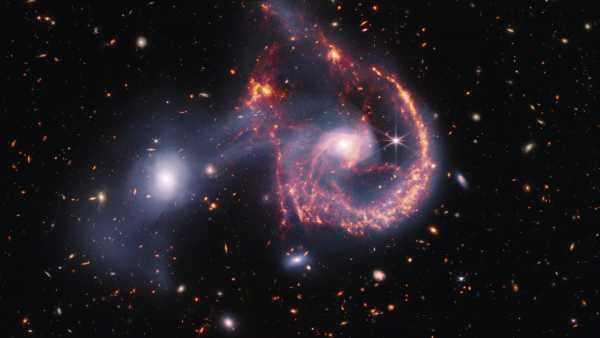
(Image credit: NASA, ESA, CSA, STScI)
Smile! Two interacting galaxies, known collectively as Arp 107 and observed by JWST approximately 465 million light-years away, pause for a celestial portrait as they engage in a gradual gravitational tug-of-war. The bright centers of these entwined galaxies form the “eyes” of the smiley visage, while a connecting bridge of stars between them creates the curved smile.
Webb’s warped penguin
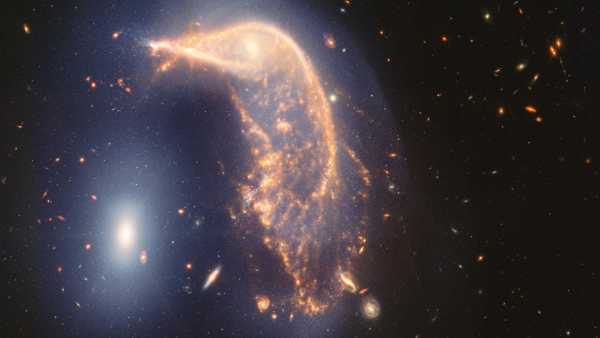
(Image credit: NASA, ESA, CSA, STScI)
What resembles a maternal bird protecting her radiant chick is actually a pair of distant galaxies designated Arp 142 — also known as “the Penguin” and “the Egg,” for apparent reasons in this evocative JWST image. Located approximately 325 million light-years from Earth in the Hydra constellation, the penguin galaxy exhibits a distorted form due to over 25 million years of gravitational interaction with its egg-shaped companion. In a reversal of birth, the two galaxies are destined to merge into one.
The ultimate ‘super star cluster’
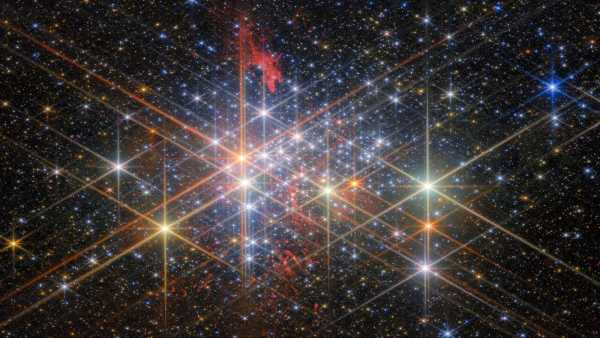
(Image credit: ESA/Webb, NASA & CSA, M.Zamani (ESA/Webb), M. G. Guarcello (INAF-OAPA) and the EWOCS team.)
The Westerlund 1 cluster, possessing the mass equivalent of over 50,000 suns, stands as the most extensive known star cluster within the Milky Way. It is observable from Earth’s Southern Hemisphere beneath the tail of Scorpius. However, only through the infrared capabilities of JWST can one perceive the vibrant hues of stars, both ancient and nascent, mingling in a dazzling display. The spectacle is expected to intensify further: within the next 40 million years, thousands of supernovae are anticipated to illuminate the cluster.
The horse’s mane
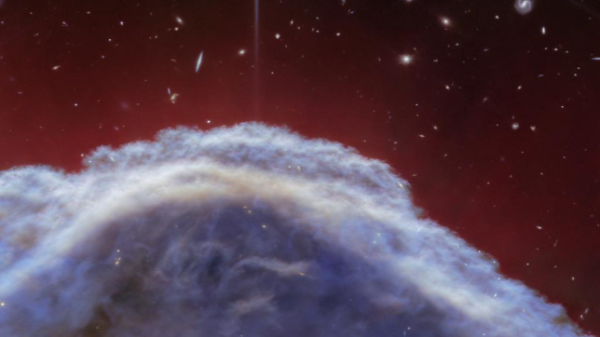
(Image credit: ESA/Webb, NASA, CSA, K. Misselt (University of Arizona) and Abergel (IAS/University Paris-Saclay, CNRS))
Located approximately 1,300 light-years from Earth within the Orion B molecular cloud, the fiery Horsehead Nebula resembles a cosmic equine tossing its magnificent mane. In this close-up JWST depiction of the nebula, high-speed gas appears illuminated in blue by the light from nearby young stars. The nebula is a collapsing cloud of gas and dust that is projected to completely dissipate within approximately 5 million years.
A cosmic lighthouse
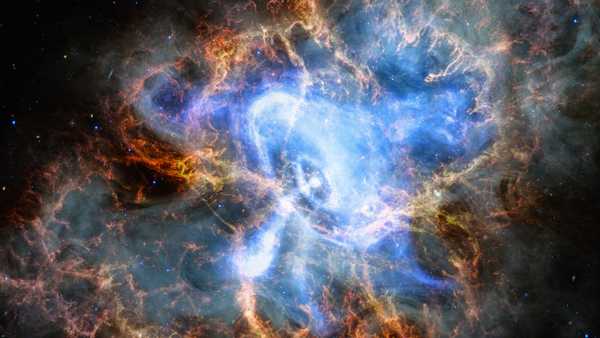
(Image credit: X-ray, Chandra: NASA/CXC/SAO; Infrared, Webb: NASA/STScI; Image Processing: NASA/CXC/SAO/J. Major)
In this composite view from JWST and NASA’s Chandra X-ray Observatory, a deceased star at the core of the renowned Crab Nebula expels twin jets of radiation through its surrounding shell of gas and dust. The star is a pulsar — an exceptionally dense neutron star that spins 30 times each second, projecting energy beams from both poles like a cosmic beacon. The recent imagery reveals the shockwaves produced by these stellar expulsions, originating from a stellar collapse event witnessed by astronomers on Earth nearly a millennium ago.
James Webb saw what???
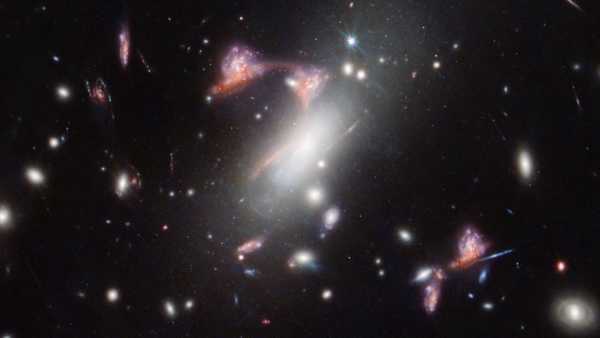
(Image credit: NASA, ESA, CSA, STScI, V. Estrada-Carpenter (Saint Mary’s University))
While examining a distant galaxy cluster, JWST detected what appears to be a colossal question mark suspended in space. This formation is actually a distorted rendition of two closely associated galaxies, magnified and duplicated by the gravitational influence of the foreground cluster through a phenomenon known as gravitational lensing. Closer inspection reveals the same two galaxies appearing five times within this single image.
Stellar babies roar to life
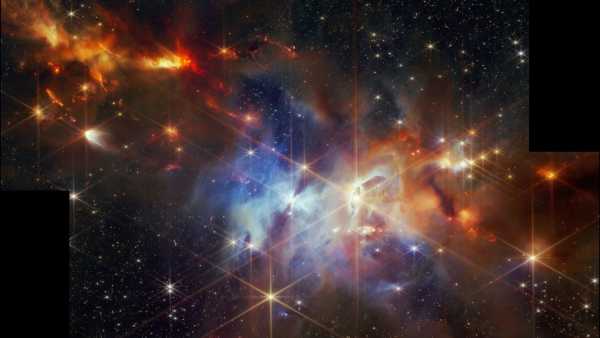
(Image credit: NASA, ESA, CSA, STScI, Klaus Pontoppidan (NASA-JPL), Joel Green (STScI))
In this depiction of the Serpens Nebula, situated 1,300 light-years away in the Serpens constellation, newly formed stars erupt into existence, projecting brilliant red jets of hot gas into the surrounding dust clouds. Observe the upper left of the image: notice how these red stellar jets are all aligned in the same orientation, lending credence to the hypothesis that stars originating from the same collapsed gas cloud begin their existence with a unified rotational direction.
A spectacular spiral
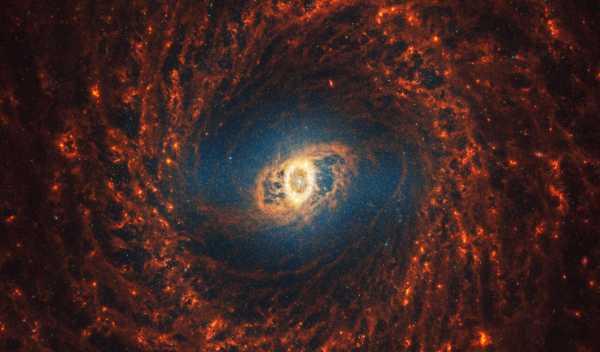
(Image credit: NASA, ESA, CSA, STScI, J. Lee (STScI), T. Williams (Oxford), PHANGS Team)
Spiral galaxies, much like our own Milky Way, are prevalent throughout the universe. As part of a recent observational campaign, JWST focused on 19 known spiral galaxies, revealing their structures in exquisite detail. In this image, clouds of dust surrounding a galaxy glow in infrared light, appearing as red and orange hues.
A ‘lightsaber’ in space
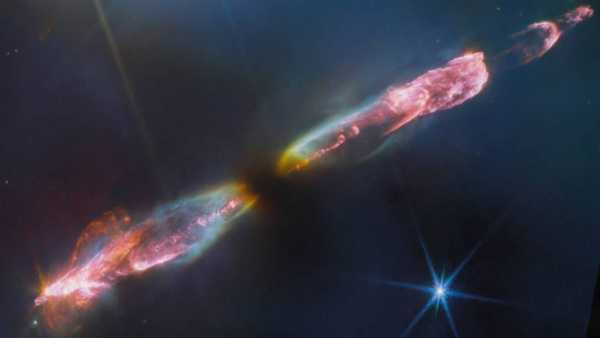
(Image credit: ESA/Webb, NASA, CSA, T. Ray (Dublin Institute for Advanced Studies))
When a nascent star undergoes a disruptive phase, its energetic output can be observed across vast distances. Here, a star referred to as HH 211, located approximately 1,000 light-years from Earth in the Perseus constellation, ejects supersonic streams of gas and dust, generating visually striking shockwaves that researchers liken to “lightsabers.” Our own sun may have exhibited similar characteristics billions of years ago.
A vibrant nursery
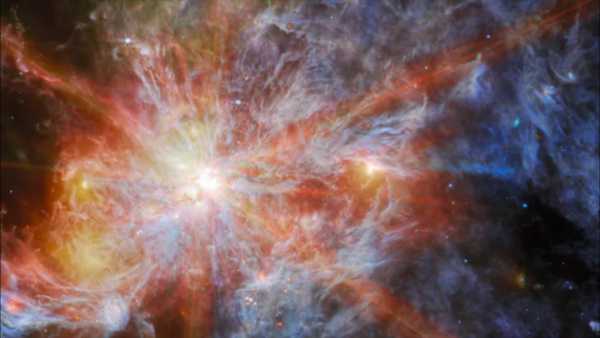
(Image credit: ESA/Webb, NASA & CSA, O. Nayak, M. Meixner)
Bursting with color, a nearby stellar nursery awakens to life. The orange, yellow, and blue image showcases the interstellar atomic hydrogen clouds of the N79 nebula, a vast region measuring 1,630 light-years across, situated within the Large Magellanic Cloud, a satellite galaxy of the Milky Way. This area is actively engaged in star formation and has remained largely uncharted by astronomers.
Webb’s deep field
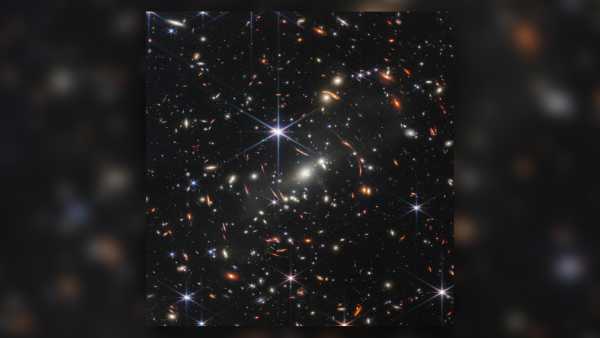
(Image credit: NASA, ESA, CSA, and STScI)
JWST’s inaugural image also stands as the most profound and detailed cosmic view captured to date. At the center of this dazzling, jewel-laden picture, a luminous galaxy cluster acts as a cosmic lens, amplifying the light from stars situated over 13 billion light-years away, while myriad younger galaxies swirl in the background.
James Webb Space Telescope quiz: How well do you know the world’s most powerful telescope?The ‘Phantom Galaxy’
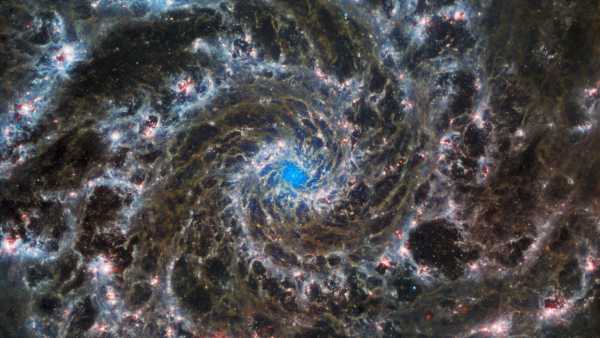
(Image credit: ESA/Webb, NASA & CSA, J. Lee and the PHANGS-JWST Team; ESA/Hubble & NASA, R. Chandar. Acknowledgement: J. Schmidt)
Resembling a celestial nautilus shell, the ethereal ‘Phantom Galaxy’ drifts through space at a distance of approximately 32 million light-years from Earth. Astronomers classify it as a “grand design spiral” due to the remarkable prominence and clarity of its spiral arms.
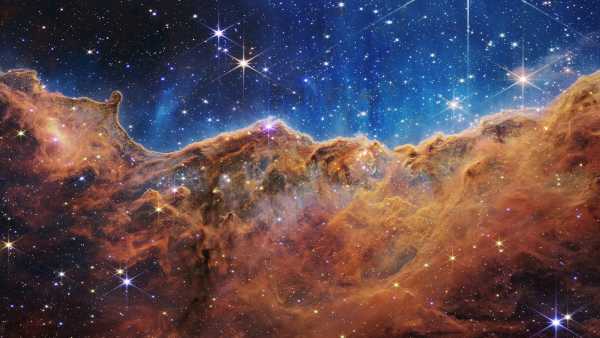
‘Mountains’ of the Carina Nebula
(Image credit: NASA, ESA, CSA, and STScI)
One of JWST’s initial images is this cosmic landscape, capturing the Carina Nebula approximately 7,600 light-years from Earth. Illuminated and shaped by the radiation from young stars, this region is one of the most prolific stellar nurseries ever identified.
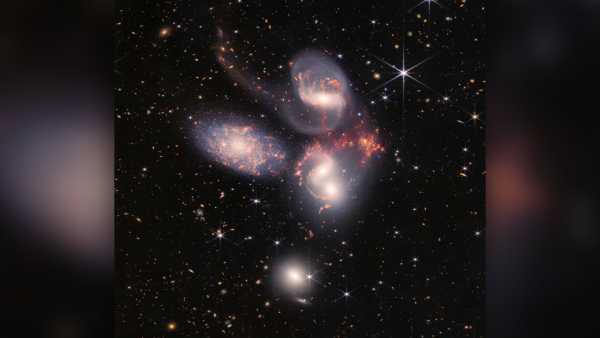
Stephan’s quintet
(Image credit: NASA, ESA, CSA, and STScI)
Stephan’s Quintet, a collection of five closely associated galaxies located 290 million light-years away in the Pegasus constellation, exemplifies what occurs when a region of space becomes excessively crowded. Four of these tightly packed galaxies continuously orbit each other in a perilous dance of near-misses, gradually distorting and stretching the stars situated between them.
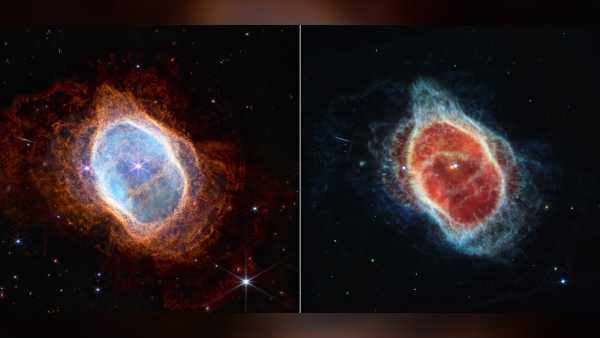
The Southern Ring nebula
(Image credit: NASA, ESA, CSA, and STScI)
Also referred to as the “Eight-Burst nebula” due to its figure-eight shape, the Southern Ring nebula is an immense cloud of gas and dust expelled by a dying star approximately 2,500 light-years distant. JWST captured images of this stellar graveyard using two cameras, revealing greater detail in the nebula’s gaseous structures in the left image, and exposing a hidden, secondary star at the center of the right image.
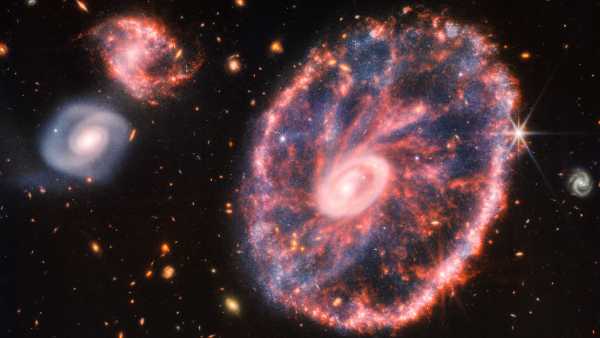
The Cartwheel Galaxy
(Image credit: NASA, ESA, CSA, STScI)
The aptly named Cartwheel Galaxy, situated approximately 500 light-years from Earth, is a stunning spiral galaxy enshrouded in hot dust. It once likely bore a resemblance to the Milky Way; however, an ancient collision with a smaller galaxy bestowed upon it this distinctive wheel-like form.
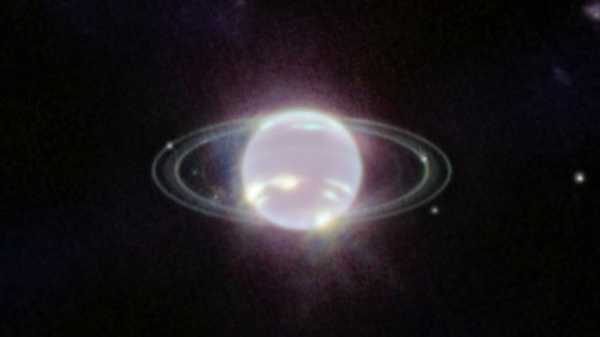
Ghostly rings of Neptune
(Image credit: NASA/ESA/CSA and STScI)
While Saturn is renowned for its planetary rings, this gauzy JWST image reveals Neptune rivaling that distinction. Neptune, the eighth planet from the sun, possesses five rings composed of icy dust, which are seldom observed due to the planet’s distant position in the solar system. Here, they shimmer like precious crystals.
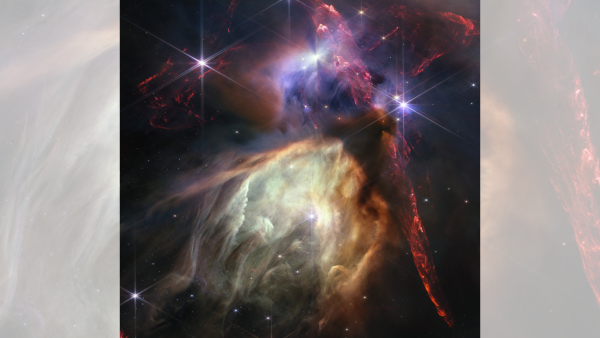
An explosive ‘star factory’
(Image credit: NASA, ESA, CSA)
In celebration of its first year of scientific operations in July 2023, JWST presented this stunning image of Rho Ophiuchi, a star-forming region approximately 390 light-years away in the Ophiuchus constellation. This detailed view of roughly 50 newly formed stars blazing brilliantly through clouds of iridescent gas showcases the splendor of the closest star-forming region to Earth.
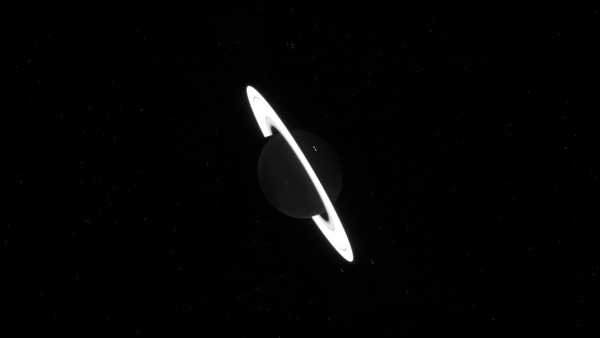
Vanishing Saturn
(Image credit: JWST)
This unprocessed JWST image of Saturn, captured in June 2023, is nonetheless entirely captivating. In this monochromatic view, only Saturn’s rings are illuminated, lacking the typical post-processing treatment that would render our celestial neighbor in its characteristic yellow and gold hues.
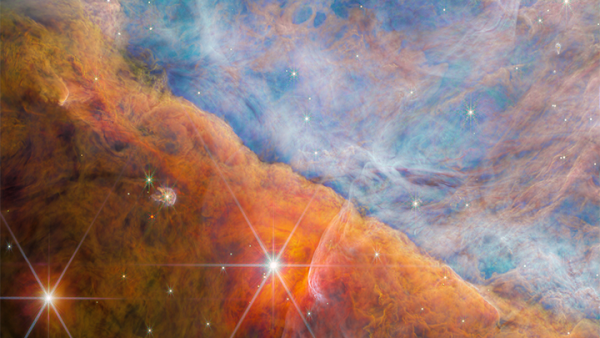
Shimmering Orion
(Image credit: ESA/Webb, NASA, CSA, M. Zamani (ESA/Webb), and the PDRs4All ERS Team)
Upon focusing on the Orion Nebula, located roughly 1,350 light-years from Earth, astronomers discovered more than just a dazzling starscape. Within an infant star system there, JWST detected distinct traces of carbon-based molecules, considered precursors to organic life. While this finding does not confirm the presence of extraterrestrial life in Orion, it illuminates the cosmic processes responsible for the development of life’s fundamental building blocks in star systems across the universe.
Uranus in high-def
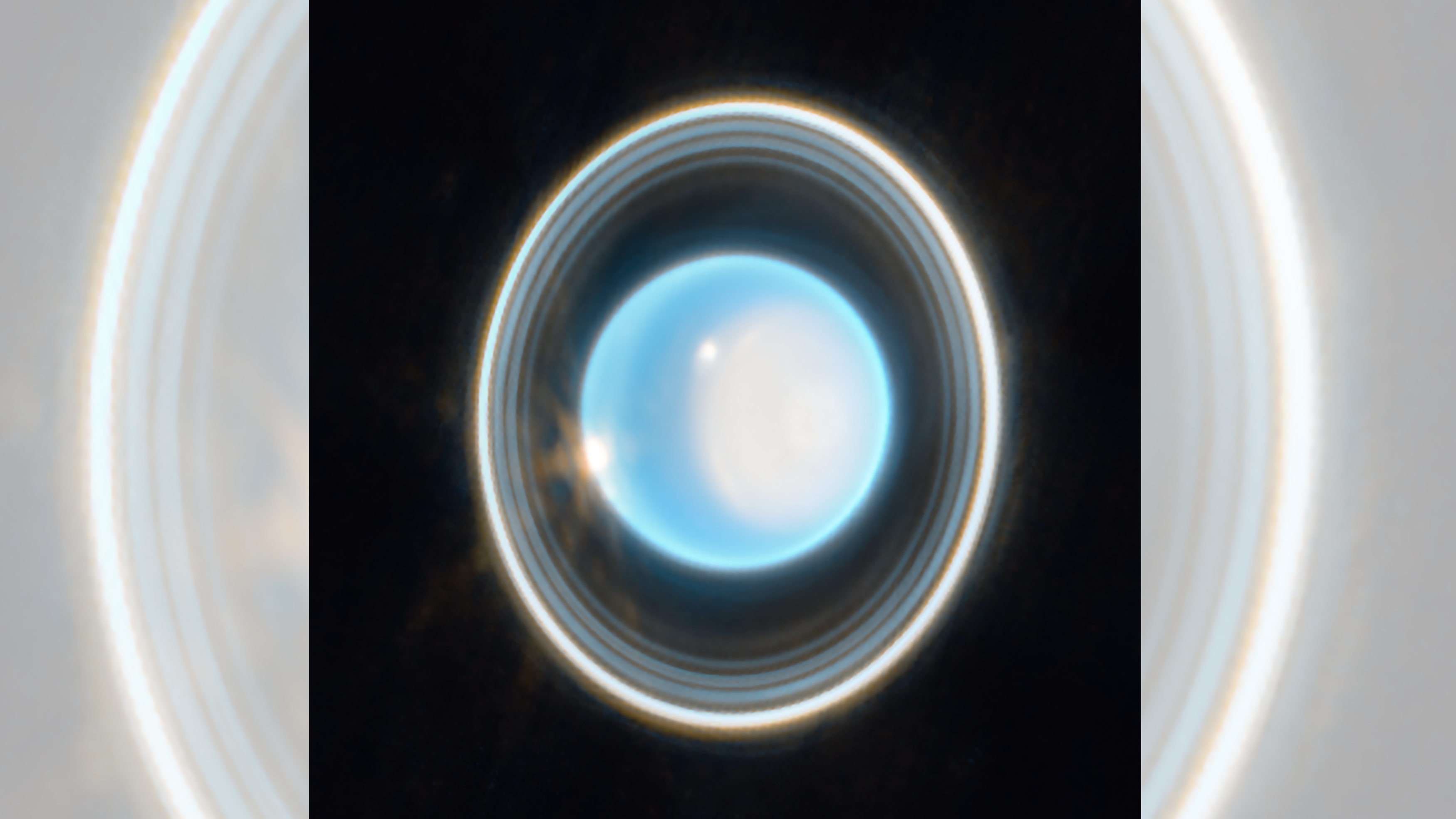
(Image credit: NASA, ESA, CSA, STScI. Image processing: J. DePasquale (STScI))
Similar to Jupiter, Uranus is not particularly recognized for its rings. However, JWST’s intimate cosmic portrait of the seventh planet from the sun reveals 11 of Uranus’ 13 known rings in striking clarity. This offers a radically new perspective on a planet that is too remote to be discerned with the unaided eye from Earth.
Old and faint
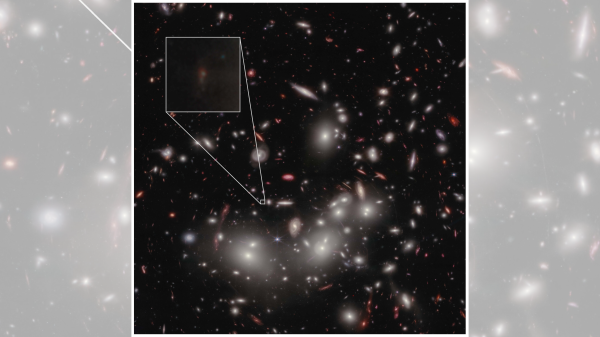
(Image credit: NASA, ESA, CSA, Swinburne University of Technology, University of Pittsburgh, STScI)
In one of its most remarkable achievements to date, JWST gazed back to the universe’s infancy to identify the faintest galaxy ever detected. Known as JD1, this galaxy — whose light traversed approximately 13.3 billion years to reach us — originated merely millions of years after the Big Bang. At that epoch, the cosmos was enveloped in a dense, dark fog impenetrable even to light; galaxies such as this one played a crucial role in dissipating this gloom.
Orion’s sword
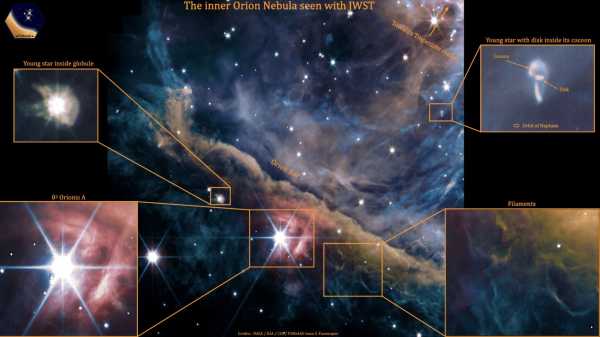
(Image credit: NASA, ESA, CSA, PDRs4All ERS Team; image processing Salomé Fuenmayor)
The Orion constellation, located merely a few hundred light-years from Earth, harbors some of the sky’s most massive and brilliant stars (including the notable red star Betelgeuse). This JWST image bypasses Orion’s famed belt to concentrate on his sword, where the Orion nebula — one of the largest and brightest stellar formation regions in the sky — resides.
A fiery hourglass
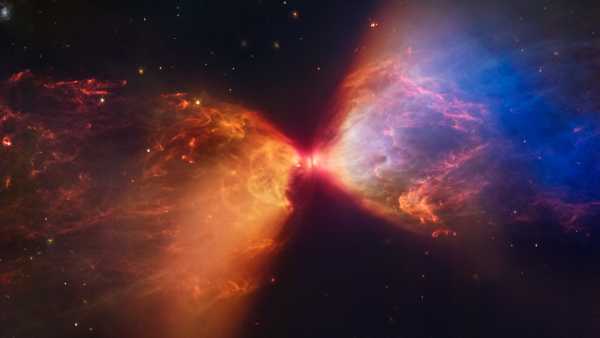
(Image credit: NASA/ESA)
A young star expels streams of gas into surrounding dust clouds, forming a fiery hourglass shape within the Taurus constellation.
The Tarantula Nebula
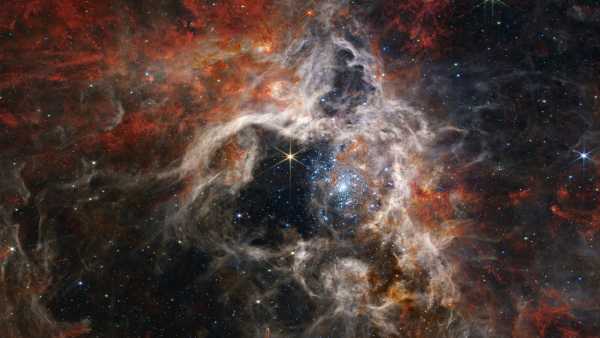
(Image credit: NASA/ESA)
The Tarantula nebula, spanning 340 light-years across, features spindly gas tendrils extending from a cosmic cavity excavated by nascent stars.
Eerie Einstein ring
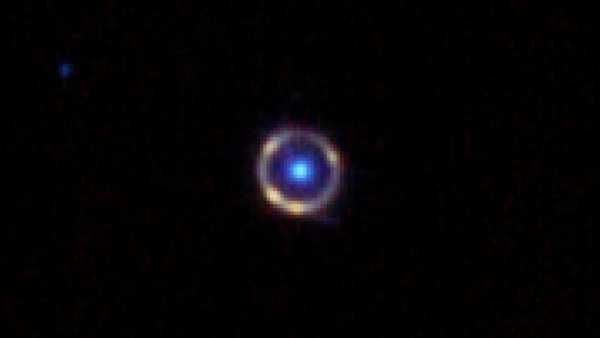
(Image credit: Spaceguy44)
This disorienting deep-space phenomenon, resembling a cosmic bullseye, is termed an Einstein ring. Named in honor of Albert Einstein, who theorized that massive celestial bodies could magnify or bend the light from objects situated behind them, this remarkably symmetrical circle is an optical illusion caused by distorted spacetime.
‘Bones’ of a spiral galaxy
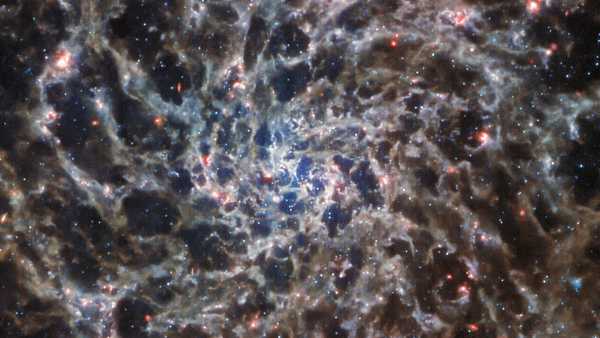
(Image credit: ESA/NASA/CSA/J. Lee)
This celestial entanglement of gas, dust, and stars belongs to the spiral galaxy IC 5332, located in the Sculptor constellation over 29 million light-years from Earth. Because it is positioned almost perfectly face-on relative to Earth, its spiral arms are exceptionally visible.
Ghostly Pillars of Creation
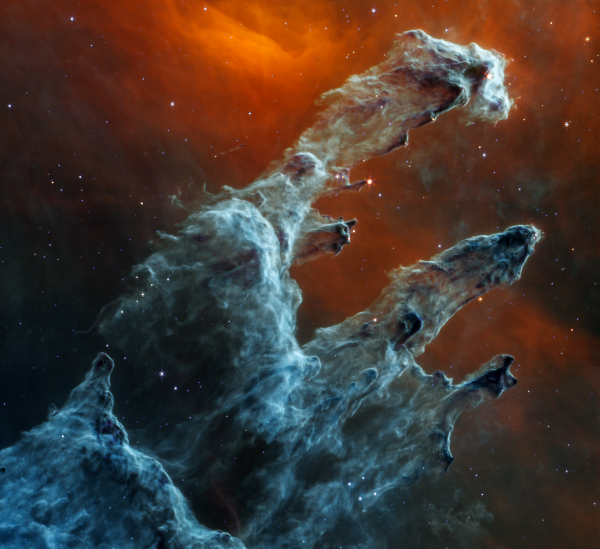
(Image credit: NASA/ESA)
A spectral shroud of dust envelops the iconic Pillars of Creation in this demonstration of JWST’s mid-infrared instrument (MIRI). Unlike the more vibrant depiction previously released, the stars concealed within the dust clouds are not sufficiently luminous to be registered by MIRI, resulting in a haunting and subdued portrayal.
A galactic collision
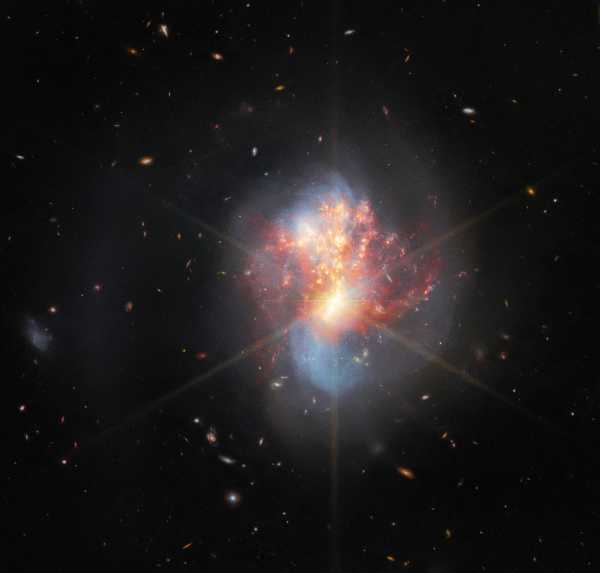
(Image credit: NASA/ESA)
Two colliding galaxies, identified as IC 1623, plunge into one another, triggering a surge of stellar formation. This chaotic event is likely in the process of generating a new supermassive black hole at the nexus of these two galactic giants.
Cosmic clash
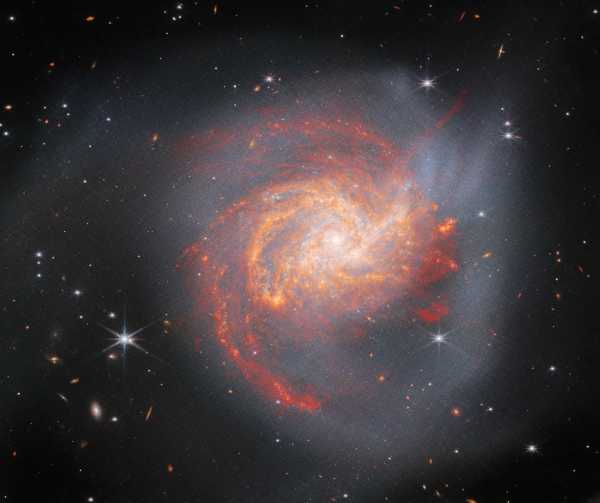
(Image credit: NASA/ESA)
JWST’s image of the galaxy NGC 3256, located 120 million light-years away, depicts the aftermath of a colossal cosmic encounter. This galaxy is the distorted remnant of a head-on collision between two large spiral galaxies, which likely transpired 500 million years ago.
A ‘knot’ of galaxies in the early universe
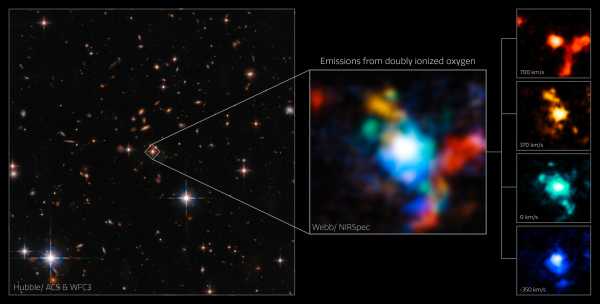
(Image credit: NASA/ESA)
No fewer than five galaxies converge around a colossal, ancient black hole known as a quasar. This concentration, located 11.5 billion light-years away, represents one of the most ancient celestial objects captured by JWST to date.
Webb’s first direct image of an Exoplanet
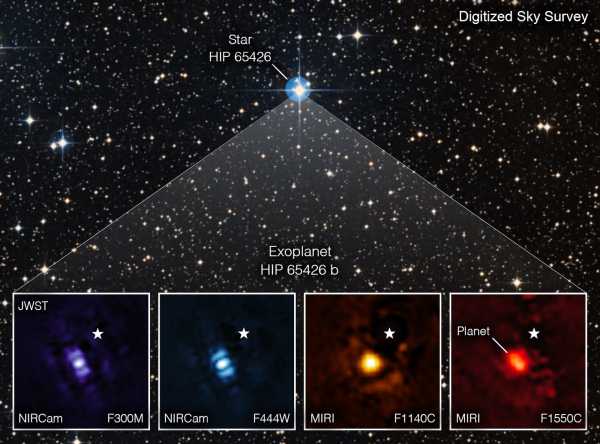
(Image credit: NASA/ESA/CSA, A Carter (UCSC), the ERS 1386 team, and A. Pagan (STScI).)
In this image, JWST captures its inaugural photograph of an exoplanet, a celestial body located outside our solar system. The planet, designated HIP 65426 b, is a gas giant estimated to be up to 8 times the mass of Jupiter and resides 349 light-years from Earth.
Jupiter’s Great Red Spot
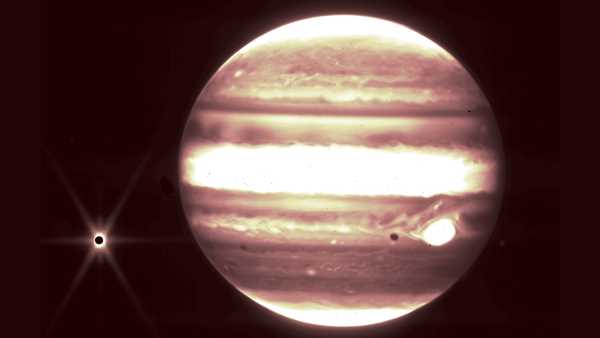
(Image credit: NASA, ESA, CSA, and B. Holler and J. Stansberry (STScI))
Jupiter’s Great Red Spot gleams intensely in this unusual JWST image of our own solar system. To the left, Jupiter’s moon Europa makes a brief appearance.
Starlight, star bright
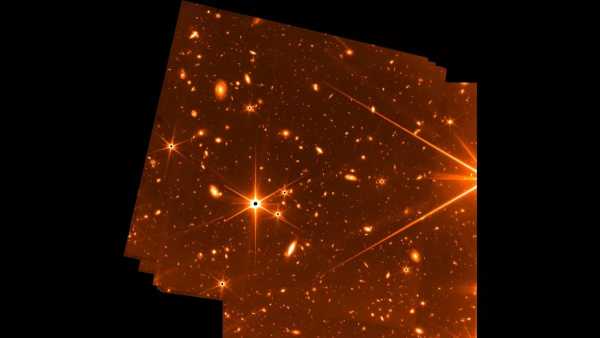
(Image credit: NASA/ESA)
Six points of light emanate from each star in this golden calibration image captured prior to JWST’s official launch. In the backdrop, millions of distant galaxies shimmer.
The darkest, coldest ice in space
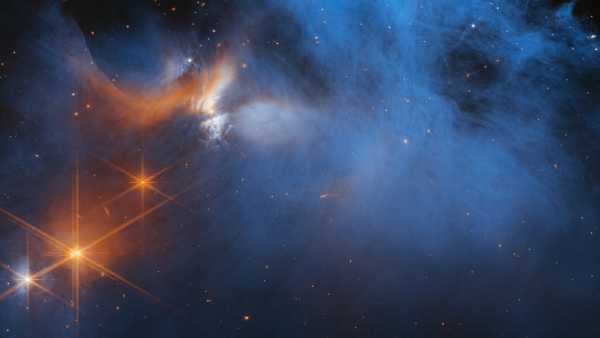
(Image credit: NASA, ESA, CSA, and M. Zamani (ESA/Webb))
While investigating the depths of an interstellar molecular cloud named Chameleon I, JWST identified the coldest ice discovered in the known universe. The frozen molecules registered a temperature of minus 440 degrees Fahrenheit (minus 263 degrees Celsius).
Cloud watching on Titan
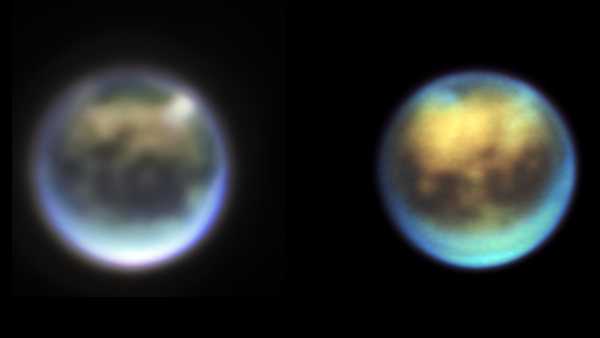
(Image credit: SCIENCE: NASA, ESA, CSA, Webb Titan GTO Team IMAGE PROCESSING: Alyssa Pagan (STScI))
Several JWST images of Titan, Saturn’s largest moon, revealed clouds moving across the moon’s northern hemisphere. Studying these clouds could provide scientists with enhanced insight into Titan’s atmospheric composition and its formation history.
Baffling early galaxies
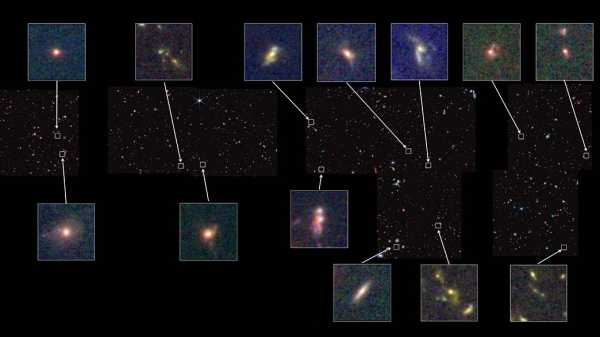
(Image credit: NASA/STScI/CEERS/TACC/S. Finkelstein/M. Bagley/Z. Levay)
An examination of 850 galaxies from the early cosmos, dating between 11 and 13 billion years ago, revealed a similar proportion of elliptical, spiral, and irregular galaxies as observed in the contemporary universe. These findings suggest that galaxy formation in the nascent universe did not proceed as gradually as previously hypothesized.
A spiral in close-up
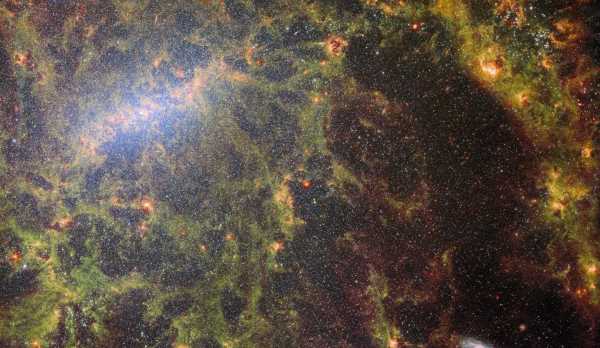
(Image credit: NASA/ESA)
Here, JWST focuses on the barred spiral galaxy NGC 5068, whose central bar is discernible in the upper left portion of the image. According to the ESA, this galaxy is located approximately 17 million light-years from Earth in the Virgo constellation. Countless stars comprise this convoluted tendril.
A wreath of stars
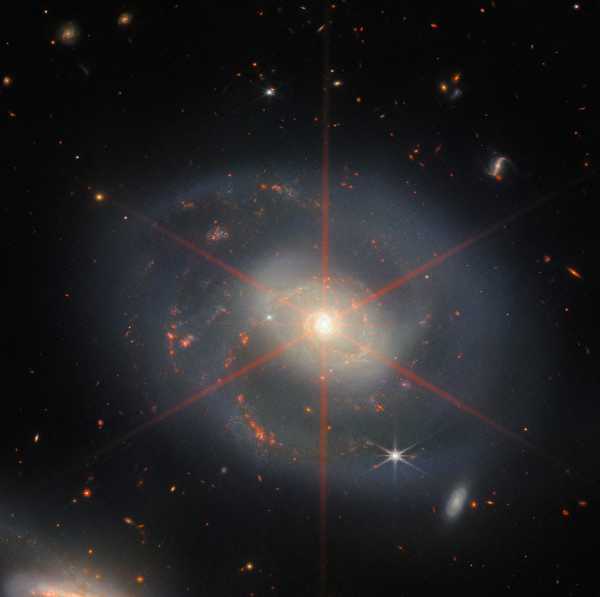
(Image credit: ESA/ NASA)
The spiral galaxy NGC 7469, situated 220 million light-years away, shines like a magnificent halo of stars. A luminous, six-pointed object at the galaxy’s core might indicate an active supermassive black hole.
A ghostly spiral
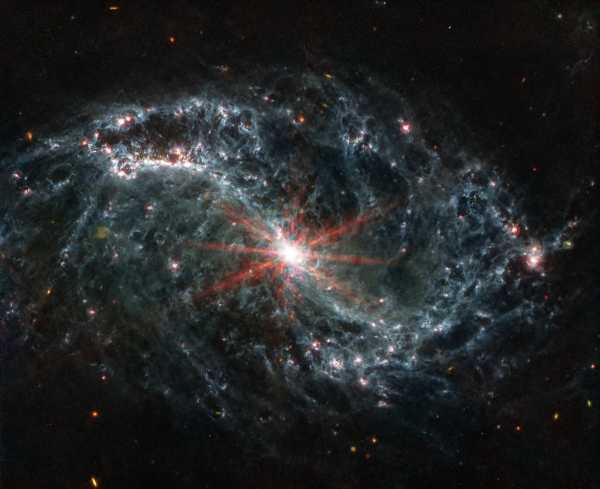
(Image credit: NASA/ ESA)
The spiral galaxy NGC 7496 appears like a cloud of smoke in this image captured by JWST’s mid-infrared instrument. Gaps and voids within the spiral arms reveal regions where young stars have shaped the galaxy through intense radiation.
Thousands of spirals
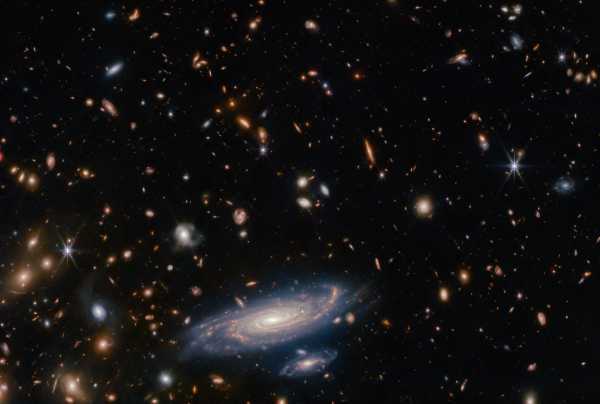
(Image credit: NASA/ ESA)
Thousands of glimmering galaxies congregate in this JWST image of the Hercules constellation, located approximately 1 billion light-years from Earth.
Editor’s note: This article is regularly updated with new images. It was last updated on May 6, 2026.
TOPICS
Sourse: www.livescience.com