

in News
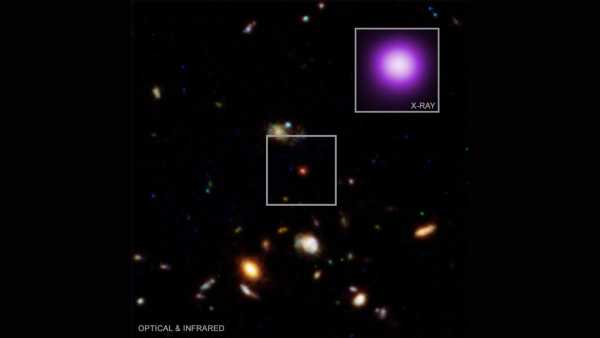
NASA’s Chandra X-ray Observatory recently captured this depiction of an X-ray-emitting black hole.(Image credit: X-ray: NASA/CXC/Max Plank Inst./R. Hviding et al.; Optical/IR; NASA/ESA/STScI/HST; Image Processing: NASA/CXC/SAO/N. Wolk)Share this article 1Join the conversationFollow usAdd us as a preferred source on GoogleSubscribe to our newsletter
A distinctive, X-ray-emitting black hole might help to confirm the perplexing nature of “little red dots,” a curious category of celestial bodies primarily observed in the very early cosmos, approximately 12 billion light-years distant.
Cosmic researchers have endeavored to categorize little red dots (LRDs) ever since the James Webb Space Telescope (JWST) initially detected them shortly after commencing its scientific operations in 2022.
Now, in a study published on March 16 in The Astrophysical Journal Letters, astronomers have detailed an object that could clarify the obscure characteristics of LRDs.
Formally designated 3DHST-AEGIS-12014 and informally referred to as the X-ray dot (XRD), this entity remained undetected in a survey conducted by NASA’s Chandra X-ray Observatory over a decade ago. Its significance only recently became apparent after JWST observed the same celestial region.
“It is always wonderful to see archival data aid in solving mysteries that were completely unknown when the data were first taken,” Anthony Taylor, an astrophysicist at the University of Texas at Austin who was not involved in the study, told Live Science via email. “This is a prime example of legacy science programs that continue to provide scientific value both upon their initial release and far into the future.”
A single black hole may solve two cosmic mysteries
The XRD discovered by Chandra bears a resemblance to an LRD, apart from a few distinctions. The most significant is its status as a luminous source of X-ray radiation.
Typically, LRDs do not appear to emit X-rays. This deviation has intensified the puzzle surrounding their identity, as active black holes commonly radiate X-rays from their turbulent coronas, where infalling matter achieves speeds close to light and experiences extreme temperatures.
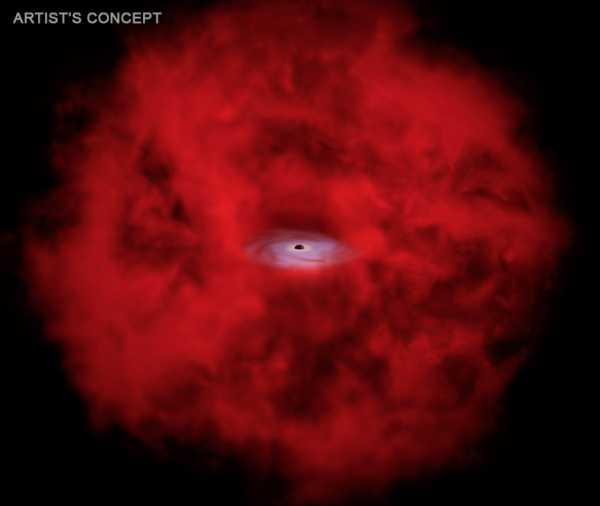
An illustration portraying a close-up view of the “X-ray dot.”
(Image credit: NASA/CXC/SAO/M. Weiss; adapted by K. Arcand & J. Major)
“If little red dots are rapidly growing supermassive black holes, why do they not give off X-rays like other such black holes?” co-author Anna de Graaff, an astrophysicist at the Harvard & Smithsonian Center for Astrophysics, stated in a press release.
As proposed in this investigation and in prior research, the X-rays might be obscured by dense envelopes of gas enveloping LRDs.
The XRD provides evidence for this phenomenon. As the black hole at its core consumes the surrounding gas, it creates openings within its cocoon. This establishes pathways into the object’s interior, allowing X-rays to escape, while simultaneously retaining its overall reddish hue — envision a cosmic jack-o’-lantern with its eerie inner luminescence seeping into the darkness.
“This single X-ray object may be — to use a phrase — what lets us connect all of the dots,” lead author Raphael Hviding, an astronomer at the Max Planck Institute for Astronomy in Germany, remarked in the statement.
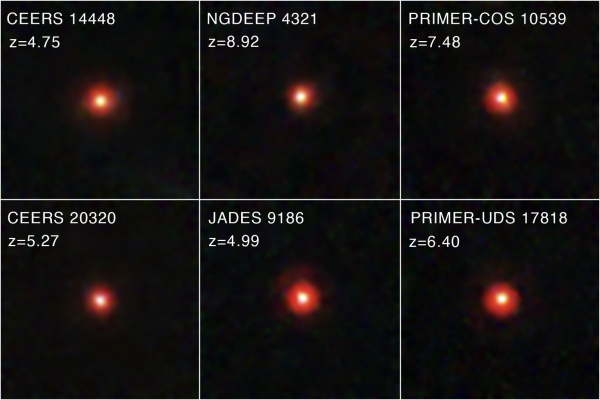
Little red dots, as they appeared more than 12 billion years ago, were discovered through early-universe surveys.
(Image credit: NASA, ESA, CSA, STScI, Dale Kocevski (Colby College))Unveiling an early-universe enigma
Collectively, the XRD may assist in reinforcing the hypothesis that LRDs are nascent black holes undergoing a transitional phase, during which they are encased in a dense gas cloud. This gaseous covering bears a compositional resemblance to certain stellar atmospheres, leading to LRDs being given an awe-inspiring designation: “black hole stars.”
Related stories
- Mysterious ‘little red dots’ discovered by James Webb telescope may be the first stars in the universe on the verge of collapse
- James Webb telescope spots ‘stingray’ galaxy system that could solve the mystery of ‘little red dots’
- Black hole butterflies? James Webb telescope spots dozens of black hole ‘cocoons’ in early universe.
Consequently, if LRDs represent a period of rapid gas accretion by nascent black holes, this phase of swift consumption might shed light on how early supermassive black holes (SMBHs) grew so substantial, so rapidly, accumulating millions or billions of solar masses when the cosmos was merely about 10% of its present age.
It is crucial to examine the evolution of these entities in more recent epochs. “LRD-like objects have actually been found in the modern universe but it is clear that LRD analogues are exceedingly rare,” Hviding informed Live Science via email. “Why? The short answer is that we don’t know.” A potential reason is that giant gas reservoirs diminish in density as the universe evolves, he suggested.
Next-generation observatories such as the Nancy Grace Roman Space Telescope will scan the heavens for scarce, contemporary LRDs within the evolved cosmos. “They cannot go nearly as deep or as detailed as Webb,” Hviding added, “but because they survey wide areas of the sky, finding rare analogues becomes viable.”
In the interim, the XRD merits further scrutiny. It is possible that it is not an ancient LRD after all, but rather a more common SMBH concealed within an unusual dust cloud previously unobserved. In either scenario, astronomers seem to have made a notable discovery that could illuminate a series of cosmic puzzles in the universe’s developmental trajectory.
Test your knowledge of black holes with our black hole quiz!
TOPICS
Sourse: www.livescience.com