

in News
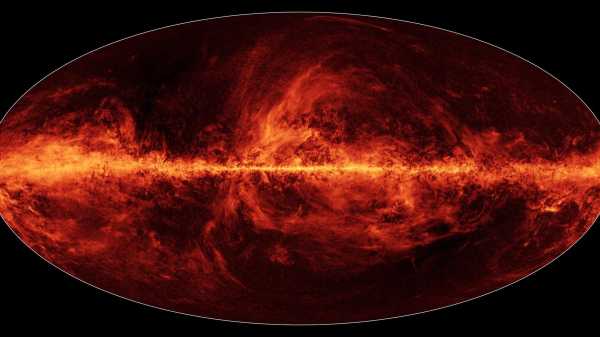
An all-sky map of the Milky Way taken by ESA’s Planck satellite. The horizontal disk of the Milky Way contains clues to previous galaxy mergers, including a potential dwarf galaxy from the ancient universe named ‘Loki’.(Image credit: NASA / ESA)Share this article 0Join the conversationFollow usAdd us as a preferred source on GoogleSubscribe to our newsletter
Astronomers have identified some peculiar stars within the Milky Way that might have originated from a different galaxy.
By examining the chemical composition of these stars and their orbital paths near the galactic disk, researchers have deduced that their parent galaxy, colloquially known as “Loki,” could have merged with our own galaxy approximately 10 billion years ago.
Massive galaxies do not come into existence as complete entities. They are constructed over vast timescales through the amalgamation of smaller galaxies, which are sometimes incorporated. In the early cosmos, shortly after the Big Bang, matter coalesced into gas clouds that then collapsed to form the first rudimentary galaxies. These nascent systems subsequently converged, merged, and progressively evolved into the colossal structures we observe today.
In the recent investigation, published on March 23 in the Monthly Notices of the Royal Astronomical Society, astronomers pinpointed 20 ancient, extremely metal-poor stars orbiting unusually close to the galactic disk — the flat, rotating zone of the Milky Way where the majority of stars, including our Sun, are situated — and analyzed whether a past merger could account for their presence.
A chemical timestamp
The very first stars to form in the universe were composed of hydrogen and helium. It was within these primordial stars that hydrogen and helium were fused into heavier elements, which astronomers refer to as metals. Upon their eventual demise, these stars dispersed these metals into the surrounding gas. Consequently, each subsequent generation of stars was formed from material with a slightly higher metal content than the preceding one.
As these small galaxies collided and merged, their stellar populations, gas, and dark matter became integral parts of the burgeoning young Milky Way. For this reason, computational simulations propose that stars originating from the earliest mergers are anticipated to be found deeper within the Milky Way today, whereas stars from galaxies that merged at a later stage are more likely to be dispersed further out in the galactic halo — an expansive, spherical region extending beyond the luminous disk.
However, a very limited number of metal-poor stars have been discovered in the inner regions of the Milky Way to substantiate this hypothesis. Therefore, when the research team identified 20 metal-poor stars orbiting near the galactic disk, they speculated whether these stars could be remnants of an ancient merger.
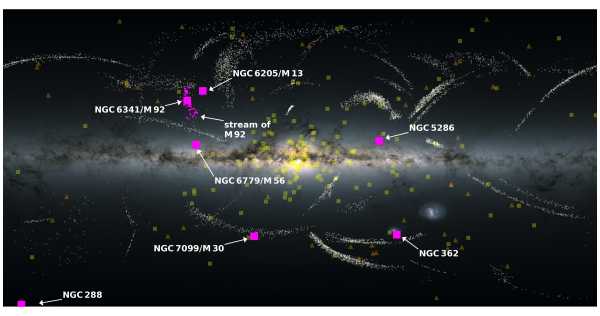
The Milky Way is suspected to have merged with up to a dozen or more dwarf galaxies over its 12-billion-year history. This Gaia telescope map shows the locations of star clusters from suspected mergers in purple.
(Image credit: ESA/Gaia/DPAC)Hide and seek
The team identified these stars from an existing catalog of metal-poor stars. They observed each one using a powerful spectrograph at the Canada-France-Hawaii Telescope, which revealed their chemical abundances. Using precise positional data from the Gaia space telescope, they calculated the stars’ distances and how they orbit in our galaxy.
Sestito stated that “a combination of information from the chemistry and the orbits of these stars” prompted them to investigate the stars’ origins. Instead of being scattered through the galaxy’s halo, where ancient, metal-poor stars are typically found, these stars were following trajectories close to the Milky Way’s disk, within just 6,500 light-years of the Sun.
“Typically, stars within the disk are metal-rich and younger, like our Sun,” he remarked, “whereas our stars [in the study] are old and exceptionally metal-poor (akin to those in dwarf galaxies).”
Furthermore, some of these stars were observed moving in the same direction as the Milky Way’s rotation, while others moved in the opposite direction. However, these two distinct groups exhibited no discernible differences in their chemical compositions. Explaining how a single incoming galaxy could result in stars moving in opposing directions presented a challenge.
The solution emerged from simulations of galactic formation. If the merger occurred sufficiently early, when the nascent Milky Way was still relatively light and had not yet stabilized into a rotating disk, the incoming galaxy would have possessed ample freedom to disperse its stars in all directions.
“The early merging history of a large galaxy can be quite tumultuous, with various smaller systems coalescing and distributing their stars along numerous different orbital paths,” Sestito elaborated. This scenario could account for both prograde and retrograde orbits, placing the merger event approximately 3 billion years after the Big Bang.
Consequently, the simulations indicated that a single dwarf galaxy, assimilated by the young Milky Way over 10 billion years ago, could have scattered its stellar population into the precise orbital configuration observed today. The models also aided in estimating the total mass of this galaxy to be around 1.4 billion solar masses.
The research team consequently assigned the designation Loki to this infalling galaxy.
“Loki, in Norse mythology, is the deity of mischief, and as a trickster, his motives are difficult to discern,” Sestito noted. “Similarly, our accreted stars have presented us with considerable difficulty in comprehending their origin.”
The search continues
Anirudh Chiti, an astrophysicist at Stanford University who was not involved in the research, informed Live Science that the recent discovery shows considerable potential.
“The analysis of chemical abundance is compelling, and a portion of the argument hinges on the observation that the stars’ chemistry appears more clustered than that of stars in the Milky Way halo,” Chiti conveyed via email. “This exemplifies the kind of findings that such datasets could yield or validate.”
Related stories
—The sun may have a long-lost twin
—James Webb telescope reveals long-studied baby star is actually ‘twins’ — and they’re throwing identical tantrums
—Study of ‘twin’ stars finds 1 in 12 have killed and eaten a planet
Nevertheless, the new findings are not yet conclusive. Sestito conceded that further observations are necessary for confirmation.
“Our work is certainly constrained by the limited number of observed stars,” Sestito stated. Observing stars with high-resolution spectroscopy is a time-consuming process, with each star requiring approximately four hours of telescope time, thus explaining the small sample size.
Given that researchers are still in the preliminary phases of investigating the chemical signatures of the most metal-poor stars within the Milky Way disk, it remains plausible that these stars belong to a specific subset of stars or a substructure within the Milky Way, Chiti pointed out. “I eagerly anticipate the insights that future research mapping the chemistry of extensive samples of very metal-poor stars in the Milky Way disk will provide,” he added.
To ascertain the true nature of Loki, the team would need to examine its stars and other non-Loki targets using the same telescope configuration to gain a more comprehensive understanding of the distinctions between this system and other regions of the Milky Way halo.
With the advent of forthcoming advanced spectroscopic instruments, astronomers will be equipped to observe hundreds of stars, obtaining high-quality data on their trajectories and chemical abundances. Sestito believes the search should extend beyond the halo. The concealed systems within the inner regions of the galaxy may hold crucial information about the primordial galaxies of the early universe, although detecting them amidst the crowded disk would pose a significant challenge.
TOPICS
Sourse: www.livescience.com