

in News
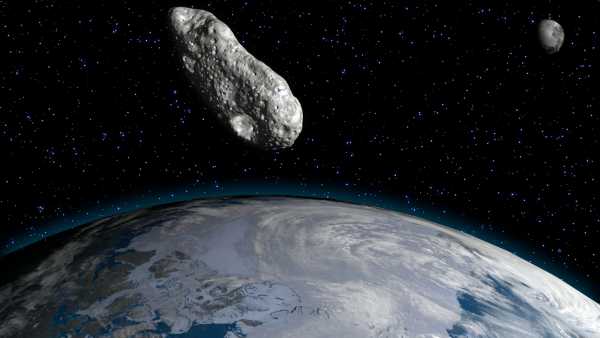
An illustration of a near-Earth asteroid. Asteroid 2026 JH2 will reach a minimum distance of around 56,000 miles (91,000 kilometers) from Earth’s surface on Monday (May 18).(Image credit: JUAN GARTNER via Getty Images)Share this article 0Join the conversationFollow usAdd us as a preferred source on GoogleSubscribe to our newsletter
A substantial, previously undetected asteroid is hurtling towards Earth at approximately 20,000 mph (32,000 km/h) and will narrowly miss our planet, passing closer than some orbiting satellites on Monday (May 18), according to scientific experts. The unusually close celestial event can be observed by the public, even without specialized astronomical equipment.
The celestial body, designated 2026 JH2, was initially identified on May 10 by astronomers at the Mount Lemmon Observatory near Tucson, Arizona, the same observatory that discovered the remarkably bright Comet Lemmon last year. This space object, subsequently confirmed by various observatories worldwide, likely traverses its orbit around the sun every 3.7 years. Its elongated path extends as far as Jupiter, as detailed in the Small-Body Database Lookup maintained by NASA’s Jet Propulsion Laboratory.
How close will it get?
Around 6 p.m. EDT on Monday, 2026 JH2 will pass Earth’s surface at an approximate altitude of 56,000 miles (91,000 kilometers) – roughly a quarter of the separation between our planet and the moon. At this proximity, the considerable space rock will traverse above the majority of Earth’s satellites, yet remain closer to us than a few spacecraft, including the Transiting Exoplanet Survey Satellite (TESS). (There is currently no indication that these spacecraft face any risk of collision with 2026 JH2.)
Owing to limited observational data, scientists indicate a degree of uncertainty regarding the asteroid’s precise closest approach to Earth. However, the possibility of it impacting our planet is nonexistent.
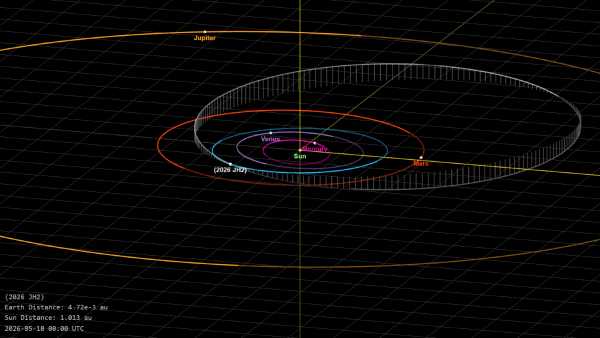
2026 JH2 completes a circuit around the sun every 3.7 years on a highly elongated trajectory between Earth and Jupiter.
(Image credit: NASA/JPL/Small-Body Database Lookup)
Near its closest point of approach, 2026 JH2 is projected to attain a maximum brightness of approximately magnitude 11.5, rendering it quite discernible with a capable telescope or a pair of stargazing binoculars. (A detailed, current guide on locating the asteroid is available at TheSkyLive.com.)
Furthermore, it can be viewed online. The Virtual Telescope Project, managed by astronomer Gianluca Masi, will broadcast a live stream of the flyby as observed from a telescope situated in Manciano, Italy.
It is exceptionally rare for an asteroid of 2026 JH2’s dimensions to approach Earth this closely, although smaller space debris frequently impacts our planet, as evidenced by a recent proliferation of “fireball” meteors.
The subsequent substantial space rock anticipated to approach this near Earth will likely be the asteroid known as “God of Chaos,” 99942 Apophis. It is scheduled to pass within 20,000 miles (32,000 km) of Earth on April 13, 2029, potentially becoming visible to the unaided eye.
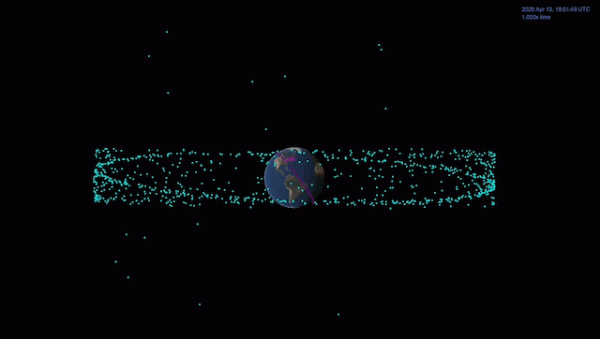
2026 JH2 will approach Earth more closely than certain satellites, mirroring the trajectory of the “God of Chaos” asteroid Apophis (depicted in this simulation).
(Image credit: NASA/JPL)
In contrast to 2026 JH2, Apophis possesses the capacity to inflict significant damage upon our planet due to its considerable size, exceeding 1,100 feet (340 m) in diameter. While there is currently no risk of Apophis colliding with Earth on its present course, a very slight probability exists that its trajectory could be altered by interactions with other asteroids within the next three years. Consequently, scientists are maintaining vigilant observation of Apophis and intend to dispatch a probe to rendezvous with it during its close passage.
RELATED STORIES
- An ‘invisible threat’: A multitude of concealed ‘city killer’ asteroids near Venus might eventually strike Earth, simulations suggest
- No, NASA has not issued a warning of an imminent asteroid impact in 2038. This is the actual situation.
- ‘City killer’ asteroid 2024 YR4 could unleash ‘bullet-like’ meteors upon Earth if it impacts the moon in 2032
Following Apophis, the subsequent major celestial flyby will be from the “city killer” asteroid 2024 YR4. It is projected to pass the moon at a minimum distance of approximately 13,200 miles (21,200 km) in 2032. This space object garnered considerable attention last year when it was briefly forecast to have about a 3% likelihood of hitting Earth, followed by a 4% chance of impacting the moon. Current scientific consensus is that 2024 YR4 poses no threat of collision with either celestial body.
All these near-Earth passages serve as a crucial reminder of the potential hazards posed by asteroids to our planet and underscore the importance of identifying them and developing strategies for mitigation, if necessary.
Sourse: www.livescience.com