

in News
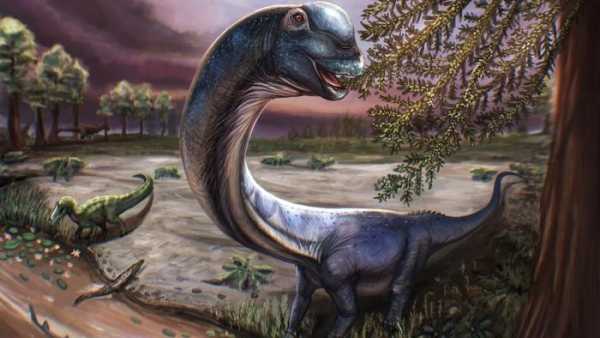
The newly discovered dinosaur, Nagatitan chaiyaphumensis, inhabited what is now Thailand approximately 120 million to 100 million years ago. (Image credit: Patchanop Boonsai)Share this article 0Join the conversationFollow usAdd us as a preferred source on GoogleSubscribe to our newsletter
Monumental fossil remains unearthed in Thailand have revealed the existence of the “last titan,” a colossal long-necked dinosaur that roamed the Earth up to 120 million years ago when the region experienced a semi-arid climate, according to a recent study.
This newly identified species, christened Nagatitan chaiyaphumensis, represents the largest sauropod, or long-necked dinosaur, discovered in Southeast Asia to date. It is estimated to have reached about 90 feet (27 meters) in length and possessed a weight of approximately 30 tons (27 metric tons), as detailed in a study published on Thursday, May 14, in the journal Scientific Reports.
“By most common measures, our dinosaur is immense – it likely surpassed Dippy the Diplodocus (Diplodocus carnegii) in weight by at least 10 tonnes [11 tons],” stated Thitiwoot Sethapanichsakul, the study’s lead author and a paleontologist at University College London, in a press release. Nevertheless, it does not claim the title of the largest known sauropod, weighing less than half as much as its South American counterparts, Patagotitan and Argentinosaurus.
The scientific team recovered the fossilized remains from the Khok Kruat Formation, located within the Chaiyaphum province of northeastern Thailand. The initial discovery of these fossils occurred in 2016, when a local inhabitant noticed them on the edge of a drying pond within a bone bed.
Among the unearthed fossils are numerous vertebrae, portions of the pelvis, and limb bones, including the dinosaur’s right femur, or thigh bone. Despite the femur being fractured into several segments, the researchers estimated its original length to be around 6.5 feet (2 meters) – comparable to the height of a tall human.
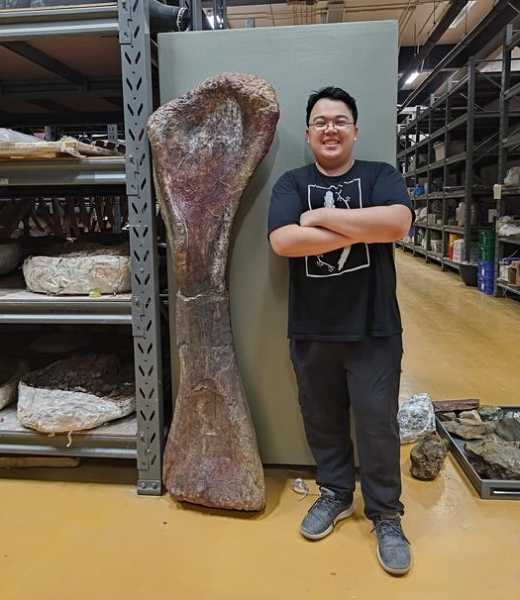
Paleontologist Thitiwoot Sethapanichsakul stands beside the humerus, or the front limb bone, of Nagatitan chaiyaphumensis.
(Image credit: Thitiwoot Sethapanichsakul)
The species N. chaiyaphumensis belongs to a category of dinosaurs known as somphospondylan sauropods, which are a sub-group of large, elongated-necked dinosaurs that existed from the late Jurassic period through the Cretaceous period. Fossils from this group have been discovered on every continent. The distinct morphology of N. chaiyaphumensis’s vertebrae and leg bones differentiates it from other previously identified sauropods.
The research team chose the genus name Nagatitan to honor Naga, described in the study as “the mythological serpent-like creature revered in various Asian cultures, particularly in northeastern Thailand, often linked with water and Buddhism.” “Titan” refers to the mythical giants of Greek legend. The specific epithet chaiyaphumensis is derived from the province of its discovery, Chaiyaphum.
During the Cretaceous era (spanning from 145 million to 66 million years ago), northeastern Thailand would have presented a semi-arid landscape. N. chaiyaphumensis, with its extended body and substantial surface area, would have been adept at dissipating heat and maintaining a cool body temperature. The fossil site was likely part of a riverine ecosystem during that epoch, suggesting N. chaiyaphumensis coexisted with crocodiles, fish, and fish-eating pterosaurs.
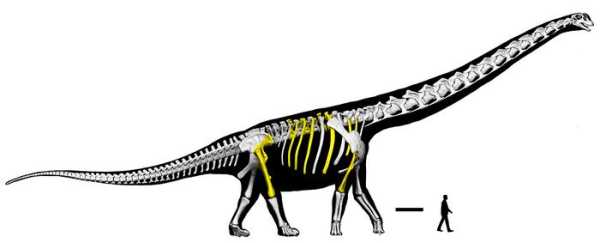
A skeletal reconstruction of Nagatitan chaiyaphumensis, with the unearthed bones marked in yellow.
(Image credit: Thitiwoot Sethapanichsakul et al)RELATED STORIES
- The massive skull of a 200-million-year-old colossal dinosaur was uncovered in China
- A colossal, previously unknown long-necked dinosaur, a ‘titan,’ has been found in Europe
- A gigantic ‘star lizard’ was among the last (and largest) of its species
The fossils were discovered within the most recent rock strata in Thailand that still contain dinosaur remnants. Although subsequent rock layers formed over the N. chaiyaphumensis fossils, the specific environmental conditions later in the Cretaceous period likely precluded the preservation of subsequent dinosaur fossils, according to the investigators.
“The deposition of younger rocks toward the conclusion of the age of dinosaurs is improbable to yield dinosaur remains, as the region had transformed into a shallow sea by that time,” explained Sethapanichsakul. “Therefore, this specimen may represent the final or most recent large sauropod that we will encounter in Southeast Asia.”
How well do you know the ruler of the dinosaurs? Gauge your understanding with our T. rex quiz!