in NEWS EXCLUSIVE
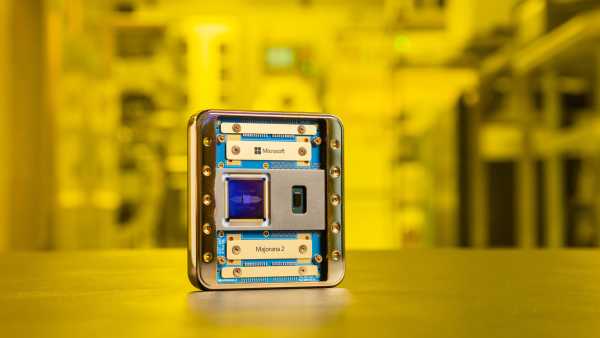
A close up of Majorana 2, Microsoft’s next-generation quantum chip(Image credit: John Brecher/Microsoft)Share this article 0Join the discussionFollow usAdd us as a preferred source on GoogleSubscribe to our newsletter
Microsoft has unveiled a new quantum computing chip featuring qubits that it claims can preserve their quantum state for 1,000 times longer than its predecessor, potentially enabling more dependable quantum computers by 2029. However, not all scientists concur with the company’s assertions.
The experimental quantum processing unit (QPU), designated Majorana 2, incorporates a four-qubit array that demonstrates an average qubit lifespan of 20 seconds, extending up to a minute in certain cases. This represents a substantial enhancement in quantum coherence times—the duration during which qubits remain entangled, allowing for parallel calculations—which are typically measured in milliseconds (thousandths of a second) in QPUs.
According to Microsoft representatives, this new chip could propel scientists toward developing a commercially viable quantum computer by 2029, halving the timeline initially anticipated by researchers. The scientists involved in developing the new processor detailed their findings in a preliminary study published in June, which has not yet undergone peer review.
“We must achieve annual improvements to move closer to delivering a computer we believe will offer immense commercial and societal value,” stated Chetan Nayak, a technical fellow at Microsoft. “We need to adhere to our roadmap to achieve this, but relative to last year, we are 1,000 times better.”
Despite the claimed advancements over the initial chip, Majorana 1, experts have expressed skepticism regarding Microsoft’s work in the specific area of topological quantum computing research. They have previously questioned the validation of the underlying technology and called for more extensive evidence supporting claims about qubit coherence times.
Regardless of the criticism, Microsoft representatives maintain that this development has halved the projected time for creating a future fault-tolerant quantum computer—a machine capable of correcting errors and sustaining lengthy computations to potentially surpass supercomputers.
Next-generation topological qubits
The predecessor to Majorana 2 was introduced in February of the previous year. Both chips are founded on a 90-year-old theory by Italian physicist Ettore Majorana, which posits that a particle can be its own antiparticle. This implies that such a particle either self-destructs in a significant energy release or exists stably when paired, thereby allowing it to store quantum information as a qubit.
As Majorana particles do not occur naturally, a substantial portion of the research, including Microsoft’s prior findings, focuses on inducing their existence.
Under specific environmental conditions, the qubits within these chips can achieve a “topological” state of matter—a distinct phase where atoms become entangled across extended distances. This enables them to leverage the principles of quantum mechanics for parallel processing of binary data (1s and 0s).
Microsoft representatives stated upon the launch of Majorana 1 that these qubits offered greater stability, smaller form factors, enhanced scalability, and lower power consumption compared to qubits made from superconducting metals, which are commonly employed in quantum computing systems by companies such as IBM, Google, and Microsoft.
The qubits in the initial Majorana chip were constructed from a layered material combining a semiconductor made of indium arsenide (utilized in devices like night vision goggles) with an aluminum superconductor. This combination forms a “topoconductor,” a topological superconductor whose qubits are encoded in the physical structure of the material stack.
Each qubit is fashioned from two superconducting nanowires terminating in Majorana zero modes (MZMs)—the foundational elements of topological qubits that encode information via parity, indicating whether the number of electrons in a topoconductor wire is even or odd.
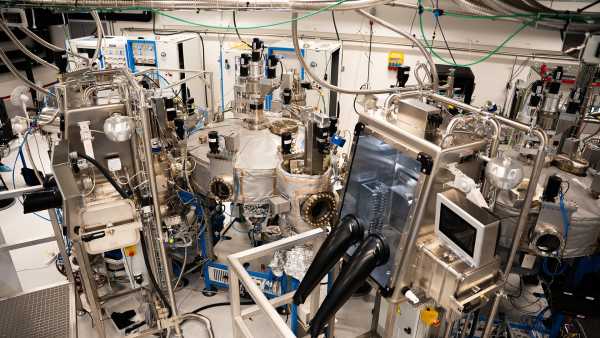
At Microsoft’s Quantum Lab in Lyngby, Denmark, the team is employing agentic AI to aid in the development of more resilient topological qubits.
(Image credit: Microsoft)
For Majorana 2, lead is used instead of aluminum to shield the delicate qubits from disruptions such as electromagnetic waves or cosmic radiation. Regarding the semiconductor component, researchers substituted indium arsenide with a composite of indium arsenide and indium arsenide antimonide. This alteration effectively doubled the “topological gap”—the protective barrier that shields qubits from environmental noise and computational errors.
Furthermore, this modification resulted in a significant increase in stability and dependability, boosting the quantum coherence lifetime from the range of 1 to 12 milliseconds observed in Majorana 1 to an average of 20 seconds, with a peak lifespan of one minute, according to the researchers’ study.
Combining AI and quantum computing
The core components of Majorana 2 were meticulously designed at the atomic level, necessitating the introduction of impurities in the form of other materials into the crystalline structure to secure each atom in its precise location. However, an excessive or improperly placed addition of impurities could destabilize the structure. To achieve the correct positioning of these impurities, the scientists leveraged artificial intelligence (AI).
“Determining the precise formula, the correct quantity to introduce to achieve the desired energy configuration, historically required extensive experimentation. In the current paradigm, simulations allow us to identify the most probable target location. Armed with this knowledge, ideally, only a single experiment would be necessary,” explained Zulfi Alam, corporate vice president for quantum at Microsoft, in the statement.
Utilizing the Microsoft Discovery platform, the scientists deployed AI agents to manage the intricate interdependencies involved in designing Majorana 2. Changes in software, architecture, design, material composition, fabrication processes, or measurements could impact all other aspects. The project also drew upon nearly two decades of data stored in various formats across different silos. AI agents were instrumental in re-contextualizing this data and establishing connections between disparate pieces of information.
AI also dramatically reduced the experimental timeframe, from weeks to “several orders of magnitude,” as stated by Alam, though he did not provide specific figures for the time savings.
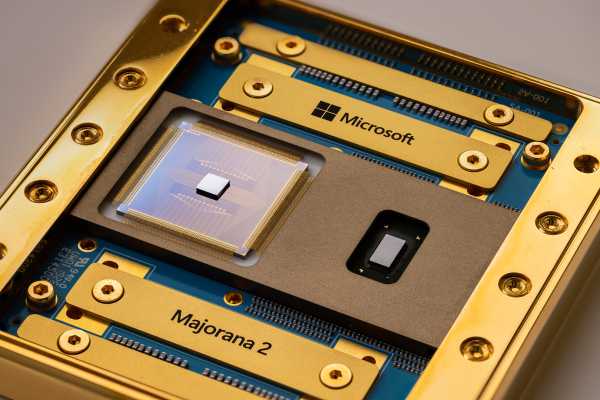
AI played a role in the design of Microsoft’s Majorana 2 chip.
(Image credit: John Brecher/Microsoft)
“Automating the measurements using agentic AI proved to be a transformative step,” Alam remarked in the statement. “It analyzes data and identifies optimal conditions, searching for the lowest point where everything functions effectively. It can perform numerous voltage adjustments simultaneously, a capability beyond human linear processing.”
Pathway to the holy grail
Nayak indicated in a technical blog post that the company is now expediting its development timeline for a practical and scalable quantum computer, setting a new target year of 2029. “This accomplishment will represent a significant milestone on the journey toward a groundbreaking fault-tolerant quantum computer, possessing the potential to address challenges impacting all of humanity.”
This projected timeline is broadly consistent with that of competitors in the field. However, this apparent advancement in topological quantum computing is not without its critics.
Following the unveiling of Majorana 1 last year, physicists raised questions about the extent to which Microsoft researchers had conclusively demonstrated the presence of MZMs within the device. Nayak, who was part of the previous year’s research team, subsequently presented supplementary evidence during a presentation at the Global Physics Summit in March.
Others have voiced objections concerning the evidence supporting the claims made in the recent study. In discussions with Scientific American, researchers, including Sergey Frolov, a quantum computing specialist at the University of Pittsburgh, suggested that the reported data lacks sufficient validation. Frolov pointed to the fact that Microsoft’s previous preprint on a similar topic remained unpublished, indicating it had not undergone peer review.
In commentary provided to Live Science, Yuval Boger, a quantum computing researcher and chief commercial officer at QuEra (a company developing neutral atom machines), acknowledged the progress but advised a cautious approach.
“Topological qubits represent a bold, long-term investment, and the reported device enhancements are noteworthy,” he stated. “As with any such announcement, it is prudent to await peer review and independent replication before drawing definitive conclusions,” he added.
Related stories
- Scientists utilized an IBM quantum computer to train an AI model, which then successfully answered questions that the original model could not
- A revolutionary quantum computer could require 2,000 times less energy than a supercomputer while performing computations 200 times faster
- Researchers have successfully linked two quantum processors using existing fiber optic cables, a crucial step in building quantum supercomputers
“The scientific community has been debating the topological evidence since 2018, and this scrutiny is beneficial for everyone,” he commented. “It’s also important to maintain perspective. Topological computing has not yet demonstrated a functional qubit, whereas other approaches are significantly more advanced.”
Various entities, including corporations and academic institutions, are actively exploring a multitude of different qubit technologies in their pursuit of the ultimate goal: developing a fault-tolerant quantum computer that achieves exponentially decreasing error rates as the system size increases. This concept is referred to as “below threshold” quantum error correction. These diverse approaches may include superconducting qubits, neutral atom qubits, photonic qubits, or, as in Microsoft’s current endeavor, topological qubits, among others.
“Ultimately, any genuine progress in quantum computing benefits us all,” he concluded. “The field advances most rapidly when multiple approaches are pursued concurrently, and we welcome such developments.”
TOPICS
Sourse: www.livescience.com