in Countdowns
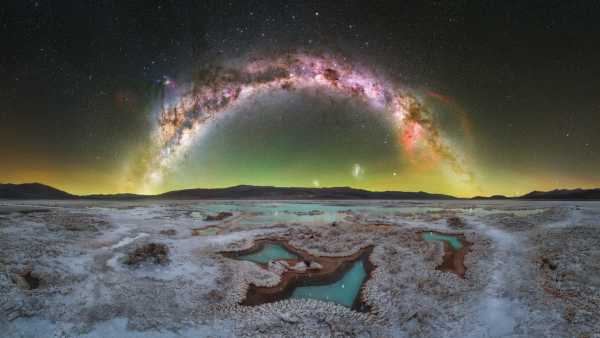
A panoramic image of the Milky Way captured in Catamarca, Argentina.(Image credit: Daniel Viñé Garcia/Capture the Atlas.)Share this article 0Join the conversationFollow usAdd us as a preferred source on GoogleSubscribe to our newsletter
The recipients of the 2026 Milky Way Photographer of the Year awards have been revealed — and they are breathtaking. Each photograph showcases a distinct perspective of our galaxy’s core, illustrating the intricate convergence of gases and celestial bodies that constitute our cosmic abode.
This competition was initiated in 2018 by photographer Dan Zafra to illuminate the various characteristics of the Milky Way galaxy. While this year’s honorees feature diverse shots from around the world — spanning from New Zealand to Yellowstone National Park — they all shared a common element: a profound admiration for the universe surrounding us.
Below, we showcase a selection of our preferred award recipients that beautifully capture the enchantment of the Milky Way.
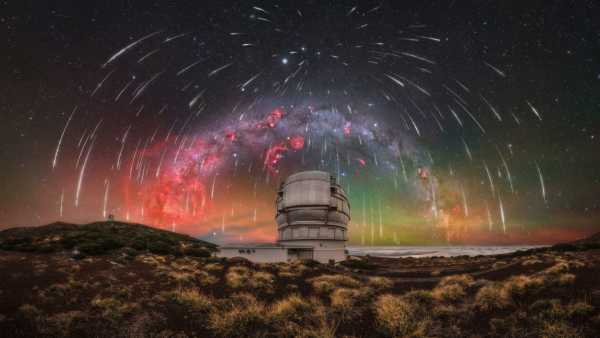
“Geminid Symphony Over La Palma’s Guardian of the Sky”
(Image credit: Uroš Fink/Capture the Atlas)
Photographer: Uroš Fink
Location: Roque de los Muchachos Observatory; La Palma, Spain
This panoramic shot captures the Geminid meteor shower against the backdrop of La Palma, one of Spain’s Canary Islands. La Palma is home to the Gran Telescopio Canarias, the world’s largest optical telescope. Additionally visible in this photograph is the Gum Nebula, situated between the southern constellations Vela and Puppis.
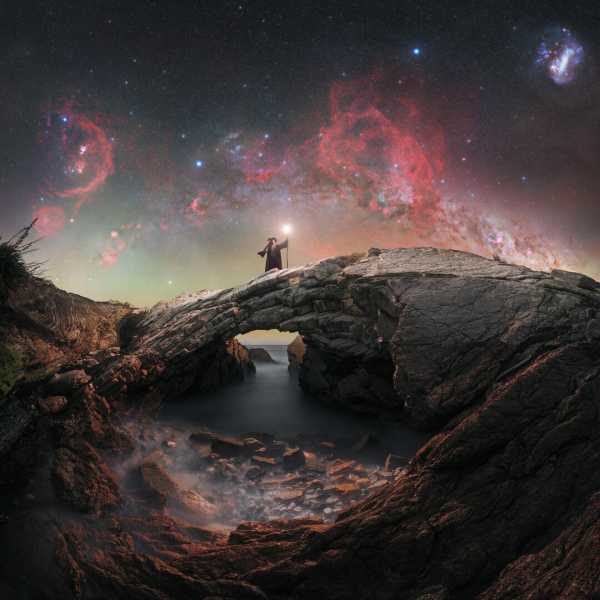
“Galactic Gandalf”
(Image credit: Evan McKay/Capture the Atlas)
Photographer: Evan McKay
Location: Wairarapa Coast, New Zealand
Leveraging New Zealand’s fame as the filming location for much of the “Lord of the Rings” series, photographer Evan McKay presents a magnificent night sky scene, albeit with the wizard Gandalf digitally added later.
“Upon discovering this site, I immediately envisioned creating something extraordinary under the celestial expanse,” McKay stated. “Given the scene’s intricacy, I knew the final photograph would demand substantial effort. Over the subsequent weeks, beginning in November, I returned whenever feasible to gather the requisite data for this panorama, meticulously assembling the image piece by piece beneath the starry heavens.”
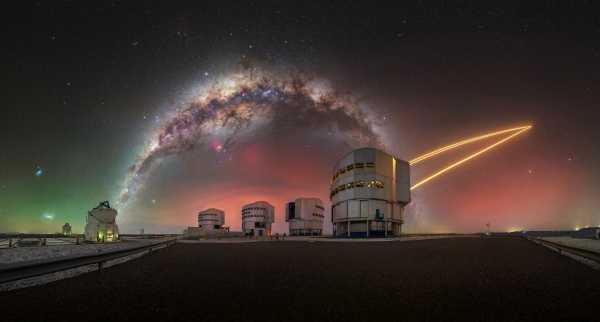
“Sodium Milky Way”
(Image credit: Julien Looten/Capture the Atlas)
Photographer: Julien Looten
Location: Very Large Telescope; Paranal, Chile
Chile’s Atacama Desert is host to numerous observatories, including the Very Large Telescope (VLT) situated on Mount Paranal. Its elevated position and arid desert atmosphere considerably enhance celestial observation compared to areas with significant light pollution.
In this depiction, both the Large and Small Magellanic Clouds — satellite galaxies orbiting the Milky Way — are visible towards the left side.
“A faint airglow imparts an additional dimension to the scene, a natural luminescence originating from chemical reactions in the upper atmosphere, approximately 80 to 100 kilometers [50 to 62 miles] high,” Looten elaborated in the statement. “This image reveals a spectrum of colors, with greenish tones on the left transitioning to warmer reddish shades on the right.”
In the foreground, one of the VLT’s telescopes emits four sodium laser beams skyward, generating four reference stars that astronomers can utilize for calibrating their observation equipment.
“Firewater”
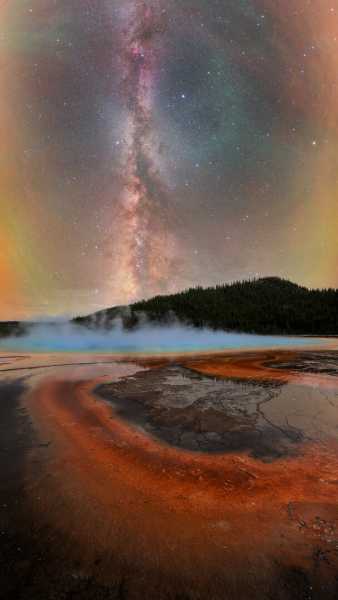
(Image credit: Baillie Farley/Capture the Atlas)
Photographer: Baillie Farley
Location: Grand Prismatic Spring, Yellowstone National Park, Wyoming
Similar to the VLT photograph, this image of our home galaxy above Yellowstone National Park features a subtle airglow. It also showcases the vibrant Grand Prismatic Spring, a geothermal feature measuring 121 feet (36.8 meters) deep, whose resident bacteria are responsible for its colorful appearance.
“Perseid Meteors Over Durdle Door”
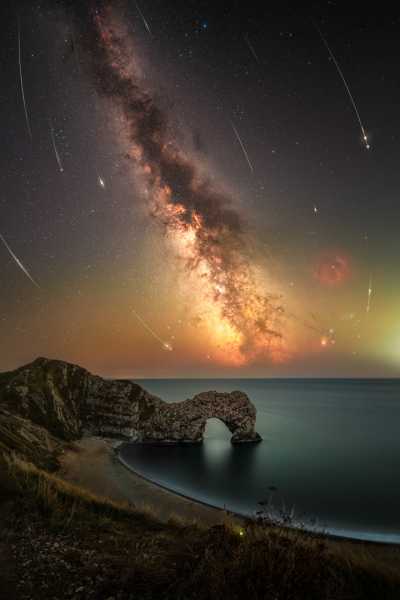
(Image credit: Josh Dury/Capture the Atlas)
Photographer: Josh Dury
Location: Durdle Door; Dorset, England
Astrophotographer Josh Dury is acclaimed for his remarkable night sky photography, and this piece is no exception. The extended exposure captures the luminous trails of meteors from the annual Perseid shower, which occurs from mid-July to late August as debris from Comet Swift-Tuttle traverses Earth’s atmosphere.
“‘Ancient fireworks’ originating from Comet Swift-Tuttle streaked across the atmosphere, documenting this ultra-wide angle composite image above the natural limestone arch of Durdle Door,” Dury remarked in his statement. “In the foreground, a solitary glow worm was observed amidst the reeds along the edge of the sea cliff.”
“Galaxy on the Rise”
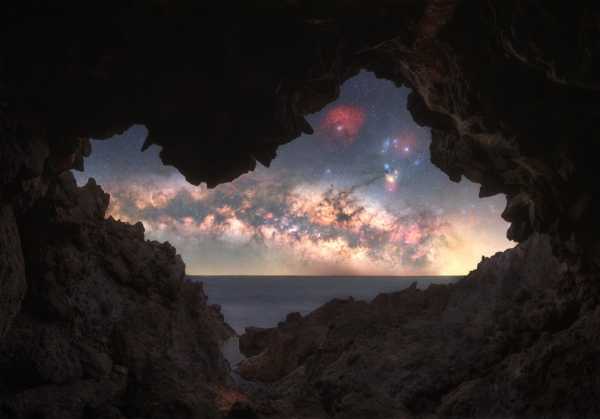
(Image credit: Anastasia Gulova/Capture the Atlas)
Photographer: Anastasia Gulova
Location: Tenerife, Spain
It required over four hours for photographer Anastasia Gulova to pinpoint the ideal vantage point for capturing the Milky Way’s splendor from within a cavern on Tenerife, one of Spain’s Canary Islands.
“Composing and capturing the panoramic foreground proved just as demanding,” Gulova explained. “Establishing the correct positioning was crucial for the foreground composition and capture, while adequately illuminating the upper portion of the cave presented a significant challenge. To overcome this, I employed focus stacking across various planes, encompassing the upper rim, the horizon, and the lower foreground, all within near-total darkness, where the brief twilight offered minimal assistance.”
Gulova’s perseverance yielded remarkable results, as she documented the brilliant hues of the Milky Way mingled with the night sky and the onset of dawn.
“Salto del Agrio”
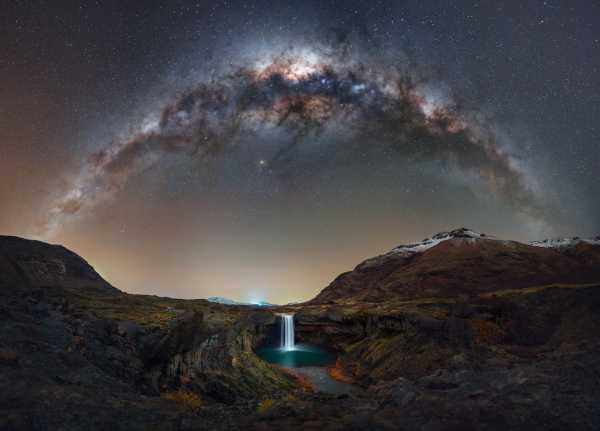
(Image credit: Alejandra Heis/Capture the Atlas)Related stories
- The Milky Way consumed a galaxy named Loki, and researchers believe they’ve found its remnants
- What is the origin of the Milky Way?
- All major galaxies are receding from the Milky Way, except one — and we now understand why
Photographer: Alejandra Heis
Location: Salto del Agrio; Caviahue, Argentina
The luminous Milky Way is not the sole spectacular feature in this photograph; it elegantly frames a waterfall dropping 148 feet (45 m) into a vast canyon, formed by the volcanic lava flows of Mount Copahue.
“Despite the challenging environmental factors, I waited for the precise moment when the Milky Way aligned perfectly above the cascade, creating an arc suspended over this ancient landscape,” Heis conveyed in the statement. “By positioning the tripod close to the ground and taking repeated exposures, I finally managed to capture the scene I had long envisioned.”
Can you identify all the animals, objects, and mythical figures concealed within the night sky? Test your knowledge with our constellations quiz!
TOPICS
Sourse: www.livescience.com

