in News
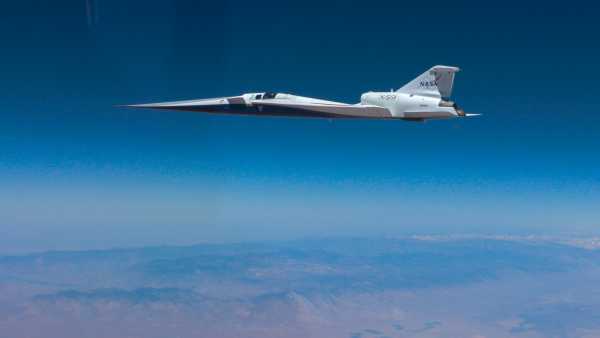
A view of NASA’s experimental X-59 supersonic aircraft taken from a companion jet. The X-59 just broke the sound barrier for the first time.(Image credit: NASA / Lori Losey)Share this article 0Join the conversationFollow usAdd us as a preferred source on GoogleSubscribe to our newsletter
NASA’s X-59, an experimental supersonic aircraft developed in partnership with Lockheed Martin, has achieved its first supersonic speed. This test represents a significant milestone toward enabling “quiet supersonic” flight, where an aircraft exceeds Mach 1 — the speed of sound — with a soft thump instead of a thunderous crash.
On June 5, test pilot Jim “Clue” Less piloted the craft on an 81-minute round trip from Edwards Air Force Base in California, NASA stated. During this journey, the X-59 attained a velocity of Mach 1.1 — 713 mph (1,147 km/h) — at an elevation of 43,400 feet (13,200 meters).
However, despite successfully completing this critical test, the craft’s “quiet” supersonic capabilities remain largely undetermined. During this particular flight, an F-15 fighter jet accompanied the X-59, and its loud supersonic boom overshadowed the noise generated by the X-59. Further evaluations scheduled for later this year will provide a clearer demonstration of the experimental aircraft’s advancements in noise reduction.
Breaking barriers
The world’s inaugural supersonic flight occurred in 1947, when U.S. Air Force test pilot Charles “Chuck” Yeager piloted the Bell X-1 aircraft over California’s Mojave Desert. Yeager’s flight reached Mach 1.06, heralding a new era of possibilities in aviation, though not necessarily for commercial air travel.
“We always sort of joke that the X-1 broke the sound barrier, and now we’re endeavoring to mend it,” Catherine Bahm, NASA’s Low Boom Flight Demonstrator project manager, who oversees the X-59’s development, commented to the BBC in 2023.
As an aircraft moves forward, it displaces the air molecules in its path. This action causes the air to oscillate, generating sound waves that radiate from the aircraft, much like the wake left by a moving boat. When an aircraft breaches the sound barrier, the pressure waves trailing behind it consolidate and intensify into a shock wave, which releases energy as a profound “sonic boom.”
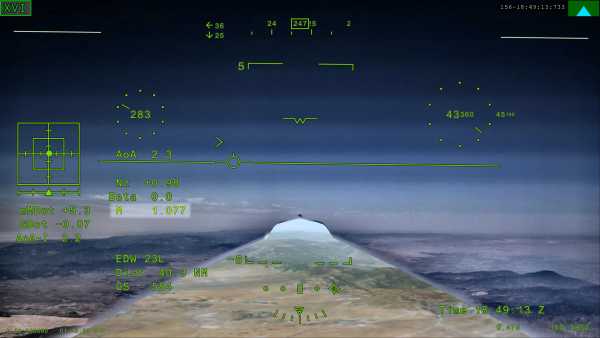
This perspective from NASA’s X-59 eXternal Vision System captures the craft achieving Mach 1.077 on Friday, June 5, signifying the aircraft’s initial venture into supersonic speeds.
(Image credit: NASA)
A sonic boom can surpass 110 decibels — registering as loud as a fully operational steel mill and exceeding the level at which most individuals experience ear discomfort. Sonic booms have even been documented to cause damage to property, such as cracking windows and, in at least one recorded instance, aquarium tanks. For this reason, the Federal Aviation Administration imposed a prohibition in 1973 on non-military aircraft exceeding the sound barrier over U.S. territory.
Related stories
- Rare ‘daytime fireball’ meteor creates powerful sonic boom as 7-ton space rock explodes above eastern US
- NASA confirms meteor exploded over northeastern US with force of 230 tons of TNT
- NASA captures stunning new image of shock waves from next-gen supersonic plane as it flies across the sun
Although Air France and British Airways’ Concorde, which operated between London or Paris and New York City from 1976 to 2003, was the world’s first commercial supersonic flight, that aircraft was permitted to fly only because it surpassed the sound barrier over the Atlantic Ocean. It was eventually retired after a catastrophic crash during takeoff from France’s Charles de Gaulle airport, resulting in the loss of all passengers and crew.
The X-59’s exceptionally long and slender nose is engineered to diminish the shockwave generated by its sonic boom. An aircraft that produces a softer sonic “thud” could potentially facilitate faster-than-sound commercial domestic flights over land. This would enable passengers to travel, for instance, from Los Angeles to New York City in less than three hours (contrasted with the current five-to-six-hour journey). However, NASA has not yet disclosed the decibel level of the X-59’s inaugural sonic boom.
Beyond its potential for commercial use, quiet supersonic flight offers evident military advantages, notably enhancing the stealth capabilities of covert operations. NASA intends to conduct the X-59’s first “mission conditions” test flight, reaching speeds of Mach 1.4 at an approximate altitude of 55,000 feet (17,000 m), in the upcoming weeks.
TOPICS
Sourse: www.livescience.com

