in News
- Facebook
- X
- Reddit
- Pinterest
- Flipboard
Share this article 0Join the conversationFollow usAdd us as a preferred source on GoogleSubscribe to our newsletter
Extraordinary and unanticipated video evidence of wolves targeting a herd of bison, comprising adult, juvenile, and a newborn calf, has been recorded by a camera trap situated in an ancient Polish woodland, according to a recent scientific investigation.
The occurrence transpired on September 15, 2025. Five wolves (Canis lupus) appeared in the camera’s field of view, closely trailed by three bison cows and their newborn offspring. The captured footage depicts the cows pursuing the wolves, leaving the calf vulnerable and isolated. Subsequently, the wolves converged on the calf, inflicting bites to its neck and attempting to drag it away, only for two cows to intervene and protect it. The wolves then re-engaged, seizing the calf a second time in the background of the recording—however, on this occasion, the entire bison herd rallied to its defense, successfully repelling the predators.
This remarkable clip originates from the Bialowieza Primeval Forest, recognized as Europe’s oldest and most well-preserved temperate lowland forest, which harbors the world’s largest population of European bison (Bison bonasus). Spanning 350,600 acres (141,900 hectares), the forest straddles the border between Poland and Belarus. The latest research indicates that over 870 bison inhabit the Polish sector, while the Belarusian side is home to approximately 730 bison.
The European bison, also referred to as “the king of the forest,” is generally regarded as a species that is not preyed upon, meaning it has no natural predators other than humans. Nevertheless, the recently obtained footage challenges this long-held notion.
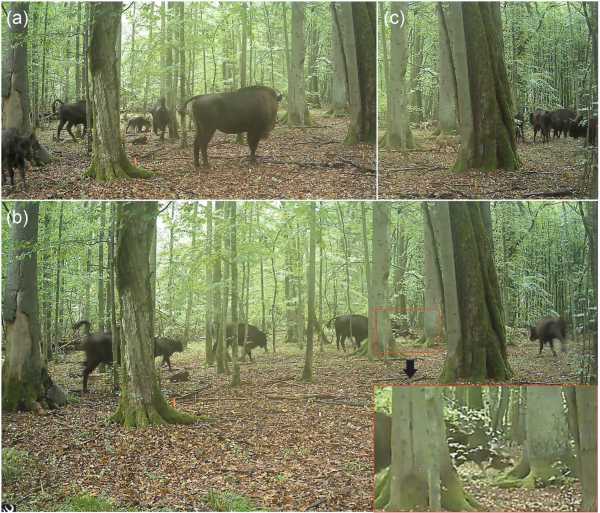
These still images derived from the video illustrate (a) the wolves capturing the newborn calf for the initial encounter; (b) the wolves securing the newborn calf for the second attempt; and (c) the bison herd forming a protective perimeter around the newborn calf following both assaults.
(Image credit: Wijnands & Borowik, 2026. (CC BY 4.0). Mammal Research Institute, Polish Academy of Sciences.)
“To the best of our knowledge, we are presenting the inaugural video documentation of wolves initiating an assault on a European bison herd within the Białowieża Primaeval Forest,” the researchers stated in their study, which was published on May 29 in the journal Ecology and Evolution. “While the video did not capture a fatal outcome, it implies that other attempts on European bison could potentially result in a successful kill.”
Historical records indicate that wolf predation on European bison was once more frequent, with approximately 8 fatalities documented annually in the Bialowieza Primeval Forest between 1840 and 1849. The forest served as a favored hunting preserve for royalty from the 14th century onwards, which accounts for the existence of such detailed records.
European bison disappeared from the wild in 1919 but were successfully reintroduced into the Bialowieza Primeval Forest in 1952. The first confirmed instance of a bison being killed by a wolf since that reintroduction dates back to the mid-1990s. Following this event, it appears that wolves primarily subsisted on a diet of roe deer (Capreolus capreolus), red deer (Cervus elaphus), and wild boar (Sus scrofa), likely due to the considerably easier nature of preying on these animals compared to bison, as noted by the researchers in their study.
RELATED STORIES
- ‘Striking’ footage captures the moment a red fox preys on a wolf pup — a behavior never seen on film before
- Wolf stealing underwater crab traps caught on camera for the first time — signalling ‘new dimension’ in their behavior
- Watch bear and wolf attack moose mom and calf at same time in rare, remarkable footage
However, the researchers concluded, “our observation has demonstrated that the European bison is, in reality, a viable prey option for wolves.” They further elaborated, “This brings forth inquiries regarding the reasons behind the rarity of such predation attempts, whether the bison can still be categorized as a non-prey species, and the potential implications for the conservation and management strategies for this species.”
An interesting development observed in the Bialowieza Primeval Forest is the apparent increase in the size of wolf packs, possibly attributed to a hunting prohibition implemented in the late 1980s. This demographic shift may lead to a greater frequency of wolf predation on bison in the future, as larger packs are better equipped to tackle larger prey animals.
“If predation on European bison, particularly on young individuals, occurs more often than was previously thought, wolves could contribute a minor yet potentially significant role in the natural regulation of bison populations,” the researchers posited in their study. “Consequently, such regulatory influence could potentially lead to a reduction in human-bison conflicts.”

