in News
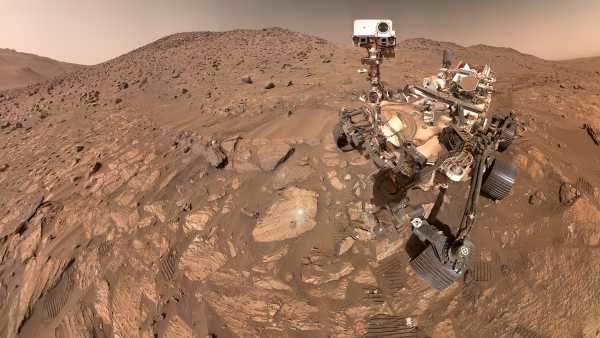
NASA’s Perseverance rover captures a self-portrait beside the Cheyava Falls rock formation on Mars. Recent studies indicate the presence of intricate organic molecules within this formation, which is regarded as some of the most compelling evidence for past life on Mars.(Image credit: NASA/JPL-Caltech/MSSS)
- Facebook
- X
- Reddit
- Pinterest
- Flipboard
Share this article 0Join the conversationFollow usAdd us as a preferred source on GoogleSubscribe to our newsletter
Scientists have uncovered a new element in Mars’ geological chronicle that suggests the Red Planet might have once supported life. New findings from NASA’s Perseverance rover point to the existence of a sophisticated type of carbon within the mudstones of Jezero crater, the fundamental chemical building block of all known life. This represents the highest concentration of organic molecules detected on Mars to date.
While the mere existence of carbon does not definitively prove that life once flourished on Mars, the location of its discovery amplifies the significance. This “macromolecular carbon” was found in proximity to other potential indicators of life, or biosignatures, which NASA highlighted with considerable excitement in 2025. This geological setting lends greater weight to the possibility that microorganisms may have once inhabited the Martian surface. The findings were officially released on Wednesday, June 24, in the journal Science Advances.
Perseverance successfully touched down in Jezero crater on February 18, 2021. Since its arrival, the area has become recognized as one of Mars’ most geologically intriguing locations. “Jezero crater was once nourished by water and sediment from rivers, and, eons ago, it contained a lake,” Ashley Murphy, a researcher at the Planetary Science Institute and a co-author of the recent study, communicated to Live Science via email.
It might have harbored more than just a lake. A study published last year in the journal Nature revealed that certain rocks within a region of Jezero known as the Bright Angel outcrop contain clays and other minerals capable of preserving fossils on Earth. One sample, in particular, garnered significant attention: a fragment of rock nicknamed Cheyava Falls, exhibiting patterns reminiscent of those created by terrestrial microbes. Although these patterns could originate from non-biological processes, NASA officials described it as one of the most distinct indications to date of past microbial existence on the Red Planet.
The backbone of life
The latest research complements this previous work by corroborating the widespread presence of complex carbon molecules within and around the Bright Angel outcrop. In their investigation, the scientists employed the rover’s Scanning Habitable Environments with Raman and Luminescence for Organics and Chemicals (SHERLOC) instrument to chart the distribution of carbon in these rocks and sediments. They subsequently compared this data with carbon findings from NASA’s Curiosity rover, collected at Gale crater approximately 2,300 miles (3,700 kilometers) away, a comparison that suggests water might have been prevalent on Mars in the distant past.
Murphy’s team also concluded that the carbon had not undergone significant degradation, implying it might have been recently exposed. However, it remains impossible to definitively ascertain whether the newly discovered carbon is linked to biological activity or not.
This work represents a crucial advancement in understanding Mars’ geological history, including its potential habitability and the processes that shaped its surface through water. Nevertheless, Murphy emphasized that it is far from conclusive.
“The presence of macromolecular carbon on Mars does not serve as definitive proof of life there,” Murphy stated. While the molecules could signify the existence of fossilized microorganisms, they could equally have originated from abiotic sources, such as meteorite impacts or flowing water.
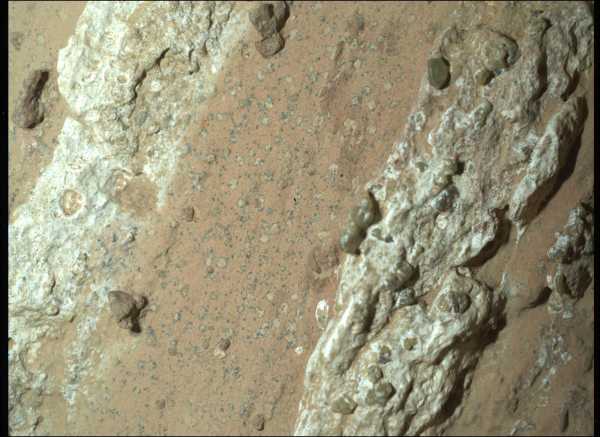
‘Leopard spots’ on the rock formation Cheyava Falls could potentially be linked to microbial life on Mars.
(Image credit: NASA/JPL-Caltech/MSSS)Related stories
NASA rover discovers an unusual ‘Skull’ formation on Mars, baffling scientists
Extensive string of organic molecules on Mars might be among the strongest indicators of life found yet
A large ‘shadow’ has been observed migrating across Mars for 50 years — and its cause remains unclear to researchers
Without direct access to a sample, it will be challenging to determine the precise origin of this complex carbon and whether it constitutes a genuine biosignature. However, the research that could provide answers may be decades away, if it materializes at all.
The Cheyava Falls sample was initially slated for retrieval to Earth in the 2030s as part of the collaborative Mars Sample Return program between NASA and the European Space Agency. However, in its 2026 budget proposal, the Trump administration declared the mission “financially unsustainable” and suggested significant cuts to the project. Currently, the initiative is considered defunct.
It is possible that China will be the first to successfully bring Martian samples back to Earth for examination. The nation’s Tianwen-3 sample-return mission intends to collect multiple samples — albeit from a more accessible but less promising location than where Perseverance has been searching for biosignatures — with a launch planned no earlier than 2028.
How well do you know the Red Planet? Put your knowledge to the test with our Mars quiz!
TOPICS
Sourse: www.livescience.com