InNews
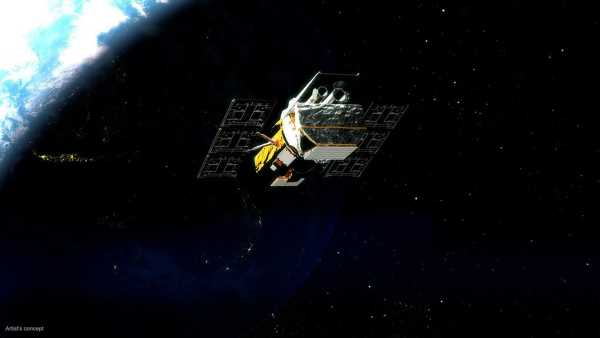
An illustration depicting NASA’s Swift gamma-ray observatory in its orbital path around Earth. The $250 million space telescope faces an atmospheric reentry later this year unless a daring recovery operation proves successful.(Image credit: NASA’s Goddard Space Flight Center Conceptual Image Lab)
- Facebook
- X
- Reddit
- Pinterest
- Flipboard
Share this article 0Join the conversationFollow usAdd us as a preferred source on GoogleSubscribe to our newsletter
Editor’s note: This article was updated at 07:43 EDT on July 2 to reflect that the mission has been postponed due to a launch vehicle issue, rather than having successfully launched as initially reported. NASA will establish a new launch date after evaluating data from the recent attempt.
A recovery spacecraft intended to intercept a NASA telescope and avert its descent into Earth’s atmosphere has encountered another setback.
The pioneering mission was scheduled for liftoff at 5:09 a.m. EDT (0909 GMT) on Thursday, July 2, from the Marshall Islands. The launch was to carry a robotic-arm equipped spacecraft, named Link, into the sky via a modified Lockheed Martin L-1011 aircraft. Mid-flight, a Northrop Grumman Pegasus XL rocket was designated to propel Link into orbit, where it would then rendezvous with NASA’s Neil Gehrels Swift Observatory. This gamma-ray telescope has been gradually descending toward Earth, facing an imminent end.
However, a malfunction with the launch vehicle has led to a postponement of the operation, marking the second such delay in as many days following a cancelled attempt yesterday.
Link was developed by the private firm Katalyst Space at a cost of $30 million. Katalyst’s objective is to meet the descending Swift Observatory, which was deployed in 2004, and elevate its orbit using Link’s robotic appendages and thrusters. Swift remains scientifically valuable but is rapidly losing altitude due to atmospheric drag. Without intervention, Swift is predicted to cease functioning later this year, according to scientific assessments.
“This undertaking is characterized by substantial risk and significant potential rewards,” stated Shawn Domagal-Goldman, director of NASA’s Astrophysics Division. “The potential benefits of attempting this orbital boost are considerable, proving more cost-effective than replacing Swift’s capabilities, and it will contribute to the advancement of the nation’s satellite servicing sector, benefiting everyone.”
Swift’s initial cost in 2004 was $250 million, equating to approximately $450 million in today’s currency, considering inflation. This makes it a relatively economical observatory when contrasted with the $10 billion James Webb Space Telescope. The Swift mission was originally conceived to investigate gamma-ray bursts — cataclysmic cosmic events resulting from the gravitational collapse of massive, dying stars into black holes. Over the past two decades, Swift has documented numerous such bursts while also monitoring other celestial phenomena, including X-ray flares, supernova explosions, and transient entities like comets and asteroids.
In essence, Swift aids our understanding of the universe’s dynamic evolution over brief timescales.
“Swift serves as NASA’s versatile instrument for cosmic exploration,” commented S. Bradley Cenko, Swift’s principal investigator and an astrophysicist at NASA’s Goddard Space Flight Center, in the statement. “It surveys the heavens across a broad spectrum of light and swiftly directs its attention to transient outbursts, signaling other space-based and terrestrial observatories to coordinate follow-up studies.”
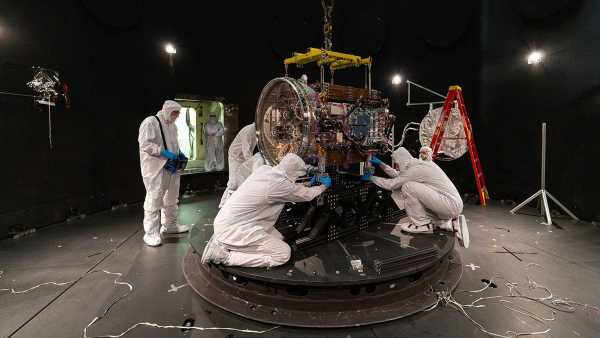
Katalyst technicians affix Link to a mounting plate within the Space Environment Simulator at NASA Goddard on April 28, 2026. The team practiced igniting the satellite’s ion thrusters and operated one of its robotic arms while simulating space-like temperatures.
(Image credit: NASA/Sophia Roberts)High-stakes salvage operation
The recovery mission presents numerous hurdles. Swift was not initially engineered for servicing upon its launch, rendering the mission’s logistics a complex challenge. Furthermore, NASA awarded the contract to Katalyst only in September. This decision followed a period of intense solar activity that expanded Earth’s atmosphere, consequently accelerating the spacecraft’s descent more than anticipated due to heightened drag. Consequently, the mission had to be prepared for deployment in under a year, a compressed timeframe given the typically demanding design, construction, and testing phases.
Katalyst embraced this demanding task with the aspiration of undertaking such operations more frequently. “To establish a lasting human presence beyond Earth, we must develop the capacity to interact with our space environment,” stated Katalyst CEO Ghonhee Lee in the announcement. “This necessitates the deployment of robotic spacecraft capable of repositioning, repairing, refueling, and refitting satellites post-launch.”
However, unless Swift modified its operational strategy, the spacecraft would have become unrecoverable by July. To maximize Link’s opportunity to rescue Swift, the operational team at Penn State’s Eberly College of Science implemented several adjustments.
For instance, Swift’s scientific operations were curtailed, with the telescope now targeting celestial objects only when oriented in a “streamlined position” to minimize atmospheric resistance, as explained by NASA. Power consumption has also been significantly reduced, allowing Swift’s solar panels to be positioned in a “more aerodynamic orientation,” which further mitigates the drag causing the spacecraft’s orbital decay.
Related stories
- Can we refuel ‘dead’ satellites in space? Bold new missions aim to try.
- Falling metal space junk is changing Earth’s upper atmosphere in ways we don’t fully understand
- Paperclip-sized spacecraft could visit a nearby black hole in the next century, study claims
These modifications are projected to enable Swift to maintain an altitude above the minimum rescue threshold of 185 miles (298 kilometers) until the autumn, according to agency projections. Katalyst will utilize this extended timeframe to conduct standard spacecraft “commissioning” on Link, ensuring all its systems function optimally. NASA estimates that Link will require approximately one month to reach Swift.
Following these preliminary steps, Link will approach Swift for an assessment, after which Katalyst will employ Link’s robotic arms to secure a connection with the NASA observatory. Link will then engage its propulsion system to gradually elevate Swift’s orbit to approximately 370 miles (595 km) — a trajectory safely above the path of the International Space Station, which orbits roughly 250 miles (400 km) above Earth.
NASA has not specified the potential duration of Swift’s continued scientific operations should it successfully attain its new orbital altitude. However, data from the European Space Agency suggests that spacecraft positioned at an altitude of 310 miles (500 km) typically reenter the atmosphere within approximately 25 years. This implies that, provided Swift’s instruments remain functional, scientists could anticipate many more years of valuable observations.
TOPICS
Sourse: www.livescience.com

