

in News
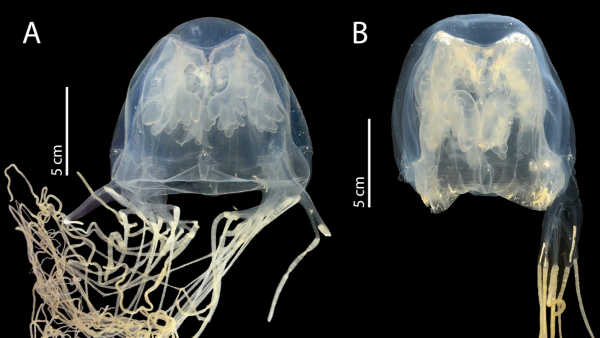
Scientists have identified a novel type of box jellyfish from the seas surrounding Singapore.(Image credit: ©Iesa et al. Raffles Bulletin of Zoology, 2026)Share this article 0Join the conversationFollow usAdd us as a preferred source on GoogleSubscribe to our newsletter
Researchers have documented a new species of highly toxic box jellyfish, discovered from specimens found near a Singaporean island previously known as Pulau Blakang Mati, or the “Island of Death Behind,” during 2020 and 2021.
The recently cataloged species, Chironex blakangmati, was given its name based on the island’s former, foreboding moniker in Malay, as opposed to its designation since 1972, Sentosa, which signifies “peace and tranquility.” This naming is quite fitting considering the animal’s perilous nature.
Prior to this discovery, scientists had erroneously classified C. blakangmati as a different box jellyfish species, C. yamaguchii. However, subsequent genetic and morphological analyses have revealed that these box jellies are distinct, as reported by researchers in a new study published on May 15 in the journal Raffles Bulletin of Zoology.
“C. blakangmati bears a striking resemblance to Chironex yamaguchii — a jellyfish species I initially identified in Okinawa during my master’s studies there,” stated study co-author Cheryl Ames, a professor of applied marine biology at Tohoku University in Japan and a research associate at the Smithsonian National Museum of Natural History in Washington, D.C. “However, we ascertained they were entirely separate. I even retrieved an old sample of C. yamaguchii from my storage in Okinawa to aid in the comparative analysis!”
The research team observed that the newly identified species lacks the branched canal structures situated at the base of its bell-shaped body, which are present in C. yamaguchii and the two other Chironex species, C. fleckeri and C. indrasaksajiae. Specifically, these canals are located within the perradial lappets, which are supportive flaps enhancing the musculature that powers box jellyfish locomotion. Combined with genetic differences, this anatomical distinction confirms C. blakangmati as a separate species, according to the announcement.
“Our comprehensive examination and evaluation of all Chironex species identified to date offer significant insights into these box jellyfishes,” commented study co-author Danwei Huang, an associate professor at the National University of Singapore’s Department of Biological Sciences and the Lee Kong Chian Natural History Museum, in the statement.
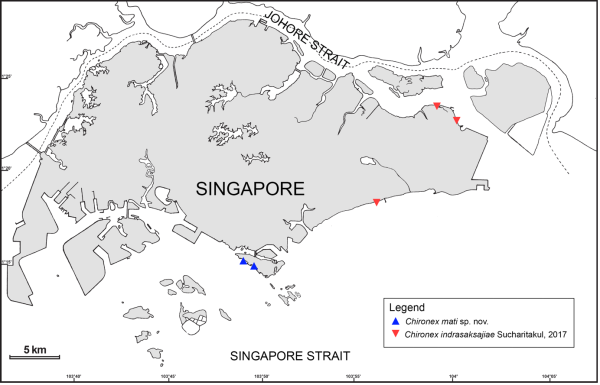
The analysis was based on jellyfish specimens that washed ashore on Singaporean beaches in 2020 and 2021. The newly identified species is indicated in blue, while Thai sea wasps are depicted in red.
(Image credit: ©Iesa et al., Raffles Bulletin of Zoology, 2026)
The findings also revealed, for the first time, the presence of C. indrasaksajiae in Singapore’s waters, a species typically found off the coast of Thailand. Referred to as the Thai sea wasp, this species is capable of causing death.
RELATED STORIES
- Bizarre jellyfish with bright-red cross for a stomach discovered in volcanic caldera off Japan
- A mysterious barrier in the Atlantic divides weird deep-sea jellyfish cousins
- Jellyfish Lake: Palau’s saltwater pool with a toxic bottom and surface waters brimming with millions of jellyfish
“We were astonished to find C. indrasaksajiae so far from its usual habitat in Thailand,” Ames remarked. “Documenting such range expansions is crucial, given our current limited knowledge of box jellyfish biodiversity and their geographical distribution.”
A more thorough understanding of box jelly distribution patterns could contribute to preventing severe human injuries and fatalities, according to the statement.
Available records indicate that box jellyfish stings are responsible for approximately 40 fatalities annually worldwide, though some specialists believe this figure to be a significant underestimation.
TOPICS