

A meticulously documented “civil war” among wild chimpanzees demonstrates that shifts in social connections alone can disintegrate a community, sparking lethal clashes between individuals once allied.
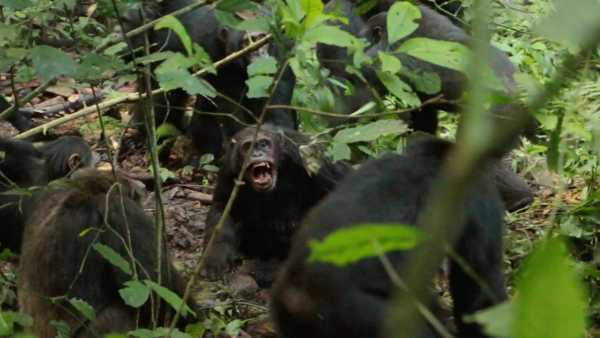
Chimpanzee males assault one of their own in 2019.(Image credit: Aaron Sandel)Subscribe to our newsletter
Wild chimpanzees in Uganda are engaged in a rare “civil war,” which appears to have originated when a large community fractured, leading to persistent and fatal hostilities between individuals who were once comrades.
Interactions between distinct chimpanzee groups (Pan troglodytes) are fairly frequent as they vie for essential resources, such as fruit-bearing trees, water sources, and vegetation suitable for building nests. However, internal conflicts within previously unified communities are considerably less common.
More recently, Aaron Sandel, an anthropologist at the University of Texas at Austin, and his associates have detailed another, far more extensive, lethal confrontation among the members of the Ngogo chimpanzee community in Kibale National Park, Uganda. This research was published on Thursday, April 9, in the journal Science.
The chimpanzees in this region have been under observation for roughly 30 years, yielding substantial data on their social structures and conduct. Despite belonging to a single large collective, they tended to form transient “parties” that shifted throughout the day as individuals traversed their territory.
However, between 1998 and 2014, certain informal groupings evolved into more consistent cliques, such as a trio of adult males who were perpetually together.
Researchers discovered that from around 2015, the vast Ngogo community—then comprising approximately 200 chimps—split into two separate clusters that resided and reproduced independently. The nucleus of one of these factions was the aforementioned trio of adult males.
At this juncture, numerous connections still existed between individuals in both segments, and they continued to collaborate and form bonds. However, by 2018, the remaining social ties had dissolved, and hostility escalated during territorial boundary patrols.
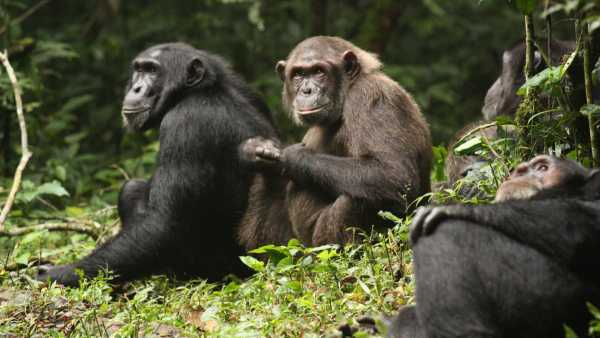
Prior to the internal conflict, chimpanzees from different social factions would interact. (Image credit: John Mitani)
“Following their separation into two factions, chimps from one segment commenced assaults and fatalities against members of the opposing segment, initiating an intensified period of deadly violence,” Sandel informed Live Science.
Deadly raids
Incursions resulted in the demise of numerous adult males. Beginning in 2021, researchers also consistently observed the killing of infants. The actual death toll from what the researchers designate as a civil war is likely higher, as many other individuals vanished without a discernible cause, Sandel added.
“I hesitate to label it a civil war,” he remarked. “The term ‘civil war’ carries specific connotations in human contexts, and while chimps lack nations and similar constructs, there’s a significant conceptual distinction between warfare against outsiders and internal conflict. These are chimps who are familiar with each other.”
James Brooks, an evolutionary anthropologist at the German Primate Center in Göttingen, who was not involved in the research, concurred that this conflict differs from human civil war but suggested the terminology aids public comprehension of the general concept.
The precise reasons for the community’s division leading to such intense conflict remain unclear, but Sandel proposed several contributing factors that might have undermined social cohesion. These include the exceptionally large group size, competition for sustenance and reproductive opportunities, the passing of five adult males and one adult female in 2014, a transition in leadership from one alpha male to another in 2015, and a respiratory epidemic that claimed 25 chimpanzees in 2017.
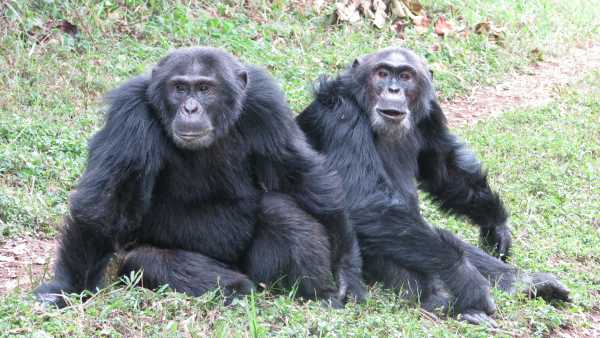
Central male Morton (left) and Western male Garrison (right) were both involved in the confrontations. (Image credit: John Mitani)
Brooks suggested that the community’s size might have been a contributing factor. “Perhaps they were no longer experiencing such an abundance of resources, and the group became too large to maintain its unity,” he proposed.
Zoologist Liran Samuni, also affiliated with the German Primate Center and co-director of the Taï Chimpanzee Project, who was not part of this investigation, noted that the Ngogo community is recognized as one of the more aggressive groups studied by researchers. “Kibale National Park is considered a notably rich habitat, with chimps living in high densities and experiencing long lifespans. However, even before this schism, this was among the most aggressive chimpanzee communities regarding incursions into neighboring territories,” she conveyed to Live Science.
Between 1998 and 2008, the Ngogo chimps were responsible for the deaths of at least 21 chimpanzees from adjacent groups, expanding into their territories and leading to population growth.
The internal conflict is ongoing, Sandel confirmed. The research publication covers data gathered up to 2024, but he indicated that further aggressions occurred in 2025 and 2026.
He suggested that this study illustrates how, even in the absence of factors like ethnicity, religion, or political ideologies, social networks can fragment, precipitating collective violence.
Considering that chimpanzees are among humans’ two closest relatives, this finding underscores how divisions within groups can pose a threat to human societies. However, Brooks cautioned that this does not imply that conflict is biologically predetermined. He pointed to bonobos (Pan paniscus)—our other closest relatives—who form stable and distinct communities. While also aggressive, bonobos, unlike chimpanzees, do not engage in such lethal intergroup conflicts; instead, they foster tolerant, cooperative associations, suggesting that such conflicts are not evolutionarily fixed.
“Our evolutionary history does not dictate our future,” he stated.
How knowledgeable are you about primates like chimpanzees? Gauge your understanding with our primate quiz!