in Opinion
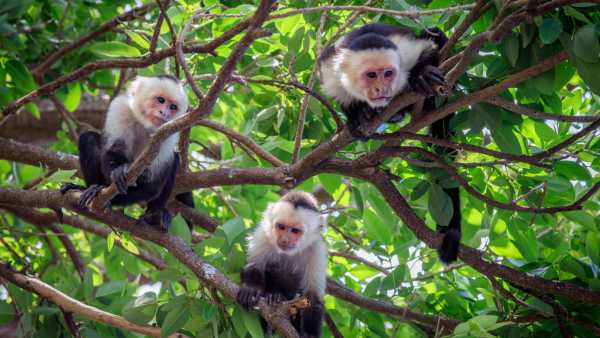
Extreme weather events, such as those associated with El Niño and La Niña, can impact the social dynamics of capuchin monkey groups, recent research indicates.(Image credit: Kenny Borenstein/Getty Images)
- Facebook
- X
- Reddit
- Pinterest
- Flipboard
Share this article 0Join the conversationFollow usAdd us as a preferred source on GoogleSubscribe to our newsletter
Flora, fauna, and larger creatures like the white-faced capuchin monkeys inhabiting the forest are typically well-adjusted to these shifts. However, in 2015, during an unusually severe drought linked to the El Niño–Southern Oscillation (ENSO), Perry, an evolutionary anthropologist from the University of California, Los Angeles, observed behaviors that were previously unimaginable.
Under typical circumstances, she noted, “The [capuchin] mothers are quite devoted. Now, I was seeing babies crying on the ground piteously. And the mothers just looking down like ‘Too much trouble’ and walking off, abandoning their infants.”
“Even capuchins have their limits,” Perry stated. “And we need to start paying attention because all the weather predictions are saying that we’re going to get more unpredictability and more climate extremes.”
Monkeying around
Odd Jacobson, a behavioral ecologist at the Max Planck Institute of Animal Behavior, was a student at Lomas Barbudal in 2016, the year following this severe drought. His primary research interest was understanding how the 12 distinct capuchin groups at the study site navigated the forest. Now, however, he is focused on investigating other ways that extreme climates might influence the behavior and social structures of these primates.
In a study published in Nature Ecology and Evolution, Jacobson and his collaborators, including Perry, examined the correlation between climate variability and 33 years of geolocation data they had collected on the capuchins.
Their initial step involved comprehending how the size of each group affected the interactions among monkeys within that group. To achieve this, they monitored variables such as daily fruit consumption, the extent of the group’s home territory, and the daily distances covered in their search for sustenance.
Ultimately, to understand the intergroup dynamics of the monkey populations, they employed a “hierarchical social relations model.” This model enabled the researchers to forecast how two different monkey groups would traverse the forest and the locations where their territories might intersect.
The team replicated this methodology, examining pairs of monkey groups, until they had analyzed the interactions among all 12 groups present at Lomas Barbudal. Subsequently, they integrated climate data spanning the observed period to predict potential shifts in home range overlap and encounter rates (periods when capuchins from different groups interacted, often aggressively) across the seasons.
Strength (and weakness) in numbers
In general, larger monkey groups possess both advantages and disadvantages within their forest environment. A significant benefit is their capacity to secure control over resource-abundant zones, such as areas with fruit-bearing trees identified as food patches. A notable drawback, however, is increased competition for food within the group, leading to reduced daily fruit intake for individual monkeys.
The researchers discovered that during periods of climatic extremity, such as exceptionally wet or dry seasons, this intra-group competition intensifies, diminishing the group’s overall foraging efficiency. Inter-group behavior also varied with the climate. For instance, during a typical dry season, larger groups frequently dominate smaller ones to claim territories offering more accessible fruit, such as those found along riverbanks.
However, the recent study revealed that this long-established notion does not consistently apply: During extreme climate events, like a dry season exacerbated by El Niño’s influence, capuchins did not attempt to monopolize the higher-quality territories.
“We don’t really know exactly why,” Jacobson remarked. “Maybe there’s not as much heterogeneity in the landscape during these resource poor times, and so there’s not much that larger groups can monopolize.”
The research suggests that climatic extremes may be disrupting the equilibrium that determines the ideal size for monkey groups. Furthermore, as a warming atmosphere heightens the intensity of climate extremes like El Niño or La Niña, understanding their impact on animal societies becomes increasingly crucial.
Filippo Aureli, an ethologist at the Universidad Veracruzana in Mexico, who was not involved in this research, has studied the effects of extreme weather on spider monkeys in Mexico. He also recorded infant mortality rates for capuchin and spider monkeys in Costa Rica’s dry tropical forest during the same 2015 drought. While capuchin populations exhibited high infant mortality during the extreme event, spider monkey populations tended to cease reproduction.
Related stories
Capuchins have started abducting newborn howler monkeys in bizarre, deadly fad
Adorable monkeys caught commiting grisly act of cannibalism
Lab monkeys on the loose in Mississippi don’t have herpes, university says. But are they dangerous?
“With climate change, [climate extremes] are going to be more frequent and intense,” Aureli commented. “And we don’t know what’s going to happen. For this period [so far], they’ve held on very well, the spider monkeys, but we don’t know for how much longer.”
Perry concurred, emphasizing “the importance of having a baseline when you’re trying to study rare events like El Niño droughts.”
“We know what normal is,” she elaborated. “If you just try to drop in right now in all the chaos that we’re starting to feel around the planet, then you really can’t study it.”
This article was originally published on Eos.org. Read the original article.

