

Cuttlefish employ patterns and hues on their skin to convey messages, and it’s hypothesized by scientists that they might gesture with their tentacles to transmit visual and vibrational cues.
Subscribe to our newsletter
Cuttlefish might “gesture” to one another using their tentacles for communication, according to emerging research. However, the study, which awaits peer review, has not yet determined the specific messages conveyed by these arm movements.
The communication methods of cuttlefish are intricate, frequently integrating changes in skin coloration and patterns with alterations in body posture. Cuttlefish even eject ink during mating rituals, thereby creating complex signals. They also utilize tentacle motions for interaction—for instance, when males engage with other males, they might extend or flare their “arms” to signify aggression.
In the recent investigation, the research group examined arm waving—the action where cuttlefish raise their tentacles, possibly to initiate contact with other cuttlefish performing similar actions. The researchers concentrated on the common cuttlefish (Sepia officinalis) and the dwarf cuttlefish (Sepia bandensis), after observing that these species appeared to execute distinct arm movements in a predictable manner.
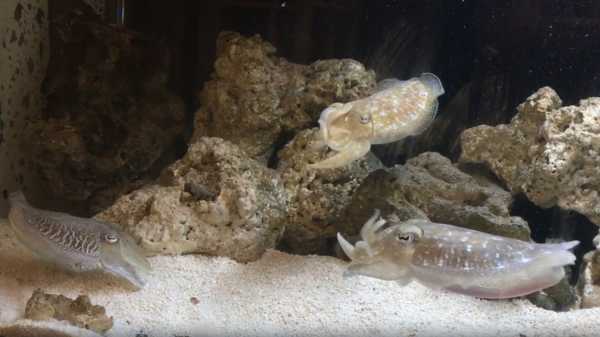
Cuttlefish seem to gesture to each other, which researchers believe might be a form of communication. (Image credit: Sophie Cohen-Bodenes and Peter Neri)
The researchers identified four distinct “arm wave signals”—recurring sequences of arm undulations that could be combined to form specific patterns: the “up” signal, the “side” signal, the “roll” signal, and the “crown” signal.
The research team recorded videos of cuttlefish performing these movements and subsequently played them back. The cuttlefish frequently positioned themselves in front of the videos and appeared to wave back at the screen, according to Sophie Cohen-Bodénes, a neuroscientist at PSL University in Paris and co-author of the new publication. They replicated the movements significantly more often when the video was oriented upright, as opposed to being inverted, indicating that the wave signals possess significance that cuttlefish comprehend when correctly positioned.
Furthermore, the researchers observed that the arm movements generated vibrational waves within the water. “When they cannot see each other—for instance, if a large rock obstructs their view—they still perform the signals,” Cohen-Bodénes informed Live Science. “This generates vibrations in the water, which could be perceived.”

During experiments, cuttlefish positioned themselves before videos and appeared to reciprocate the gestures of the cuttlefish in the footage. (Image credit: Sophie Cohen-Bodenes and Peter Neri)
To ascertain the role of these vibrations, the researchers recorded the vibrational signature of the waving behavior using a hydrophone, a device designed to detect underwater sound waves. Subsequently, they produced modified versions of the vibrational signal, both reversed and scrambled, and introduced these along with the original recording into the water. They discovered that the cuttlefish reacted solely to the original vibrational recordings, suggesting that the sequence of vibrations might hold specific meaning.
“It was quite remarkable, as they would approach the hydrophone and, directly in front of it, they would re-enact the signals,” Cohen-Bodénes stated.
However, defining a behavior as communication presents complexities, noted Trevor Wardill, a biologist at the University of Minnesota who was not involved in the recent study. A key challenge lies in interpreting an animal’s response to recordings of itself as communication, as this reaction might be analogous to how animals react to their reflections in a mirror, Wardill explained to Live Science. Nevertheless, when housed in tanks, cuttlefish have been observed to wave their arms when caretakers are present, possibly as a means to attract their attention for feeding, Wardill speculated.
“I would not dismiss the possibility of actual communication; it seems plausible given that they are a social species,” Wardill commented. The subsequent phase involves gathering conclusive evidence to elucidate the precise nature of these interactions and to establish a connection between the originator of a signal and the recipient’s response, Wardill added.
The research team indicated that the experiments provide support for their theory that cuttlefish arm waving serves as a communicative signal incorporating both visual cues and vibrational waves, although they acknowledged the necessity for additional investigation.
The researchers aim to employ machine learning algorithms, similar to those used for analyzing cephalopod skin pattern sequences, to decode the meaning of arm movements in various contexts. They are also considering the development of an underwater robotic device mimicking cuttlefish behavior and signal generation to observe cuttlefish responses.
“Our analyses are consistent, but this opens avenues for further investigation to fully unravel the significance of these signals,” Cohen-Bodénes concluded.