

For the very first time, a colossal squid has been captured on film in its natural environment, a hundred years after scientists first identified it.
Subscribe to our newsletter
The rarely seen colossal squid has now been recorded on video, a full century after its initial discovery.
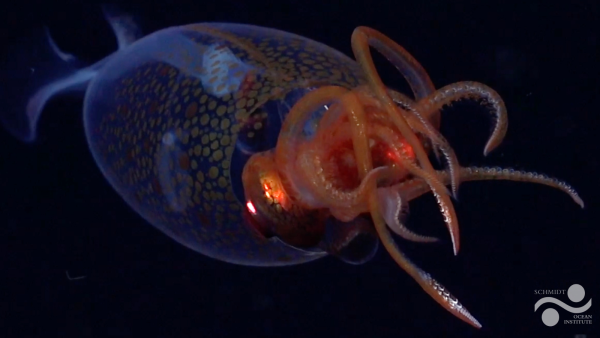
The young colossal squid was filmed in the vicinity of the South Sandwich Islands. (Image credit: ROV SuBastian / Schmidt Ocean Institute)
“It’s thrilling to capture the first footage of a juvenile colossal squid in its natural setting, and it’s quite humbling to consider that they are unaware of human existence,” stated Kat Bolstad, a squid expert from Auckland University of Technology in New Zealand, who served as an independent scientific authority consulted to confirm the video. “For a century, our encounters have primarily been with remnants found in the digestive tracts of whales and seabirds, or by observing them as predators of commercially fished toothfish.”
Colossal squids (Mesonychoteuthis hamiltoni) surpass even the well-known giant squid (Architeuthis dux) in size. They are recognized as the largest invertebrates on Earth, potentially reaching lengths of up to 46 feet (14 m) — equivalent to the length of a semi-trailer truck — and weighing as much as 1,100 pounds (500 kilograms). Their eyes are the largest among all known animals, measuring up to 11 inches (27 cm) in diameter, comparable to the size of a soccer ball.
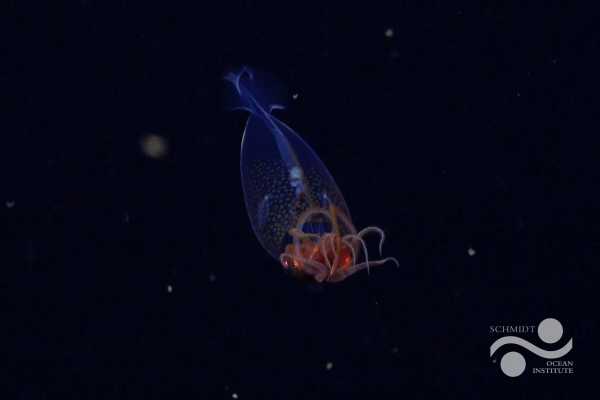
The squid was slightly less than 12 inches long. Adult specimens can reach up to 46 feet. (Image credit: Schmidt Ocean Institute)
These peculiar cephalopods inhabit the profound depths of the Southern Ocean, near Antarctica. Their habitat deepens as they mature; the youngest and smallest are found at depths down to approximately 1,640 feet (500 m), adolescents reside between 1,600 and 6,600 feet (500 to 2,000 m), and fully developed adults dwell even deeper.
This year marks the centenary since the colossal squid was officially identified and named. However, in the century that has passed, remarkably few individuals have been observed. The species was initially identified when two of its arms were discovered within the stomach of a sperm whale during the winter of 1924-1925.
The recently captured video represents the inaugural live sighting of this species in its natural environment. Dying adult colossal squids have been filmed by fishing crews, and the first complete specimen was retrieved by a fishing vessel near Antarctica in 2007. Much of our understanding regarding this species and its way of life is derived from beaks found in sperm whale digestive systems. As of 2015, only 12 complete colossal squid specimens had been recovered, with roughly half of these being juveniles.
During a preceding expedition by the Falkor in January, scientists also recorded the first confirmed footage ever of the glacial glass squid (Galiteuthis glacialis), a species that had also remained unobserved in its natural habitat until that point.
“The initial sighting of two distinct squid species on consecutive expeditions is extraordinary and underscores how little we have explored of the Southern Ocean’s magnificent fauna,” commented Jyotika Virmani, executive director of the Schmidt Ocean Institute, in the statement. “These indelible moments continue to serve as a potent reminder that our oceans are replete with undiscovered marvels.”