in News
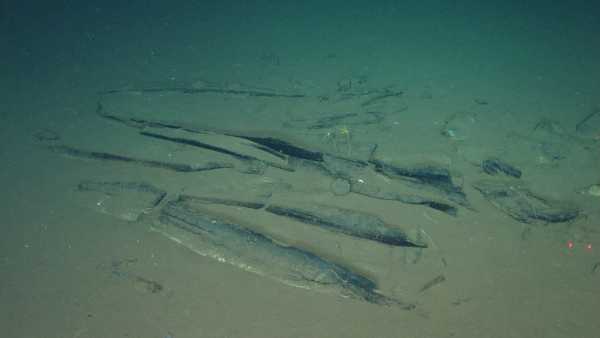
Fossils of possible baleen whale ribs at a water depth of 3.5 miles (5,656 meters) in the Indian Ocean.(Image credit: Global TREnD, IDSSE)Share this article 0Join the conversationFollow usAdd us as a preferred source on GoogleSubscribe to our newsletter
Researchers have uncovered an extensive whale graveyard spanning hundreds of miles across the Indian Ocean, with some fossilized bones dating back over five million years.
This deep-sea “megasite,” which the scientists have christened the Diamantina Zone necropolis, represents the most significant collection of whale carcasses and fossils ever documented, according to findings presented in a recent study published on Wednesday, June 10, in the journal Nature.
“It spans more than 1,200 kilometers [750 miles], which is almost unbelievable,” stated Nick Pyenson, a curator of fossil marine mammals at the Smithsonian National Museum of Natural History in Washington, D.C., who was not involved in the research, in comments to Live Science. “The term ‘megasite’ is entirely fitting. I believe they’ve unearthed something truly remarkable.”
“The concentration is astonishing”
Xiaotong Peng, a deep-sea researcher affiliated with the Institute of Deep-sea Science and Engineering at the Chinese Academy of Sciences, along with his team, utilized a submersible vessel named the Fendouzhe to explore the ocean floor within the Diamantina Zone, a region characterized by undulations and fissures in the southeastern Indian Ocean.
Following the initial discovery of a single fossil, the team undertook 32 dives, surveying an area of approximately 0.25 square miles (0.64 square kilometers). In total, they identified 476 whale fossils and five recently deceased whale remains, referred to as whale falls, at depths ranging from 13,800 to 23,000 feet (4,200 to 7,000 meters).
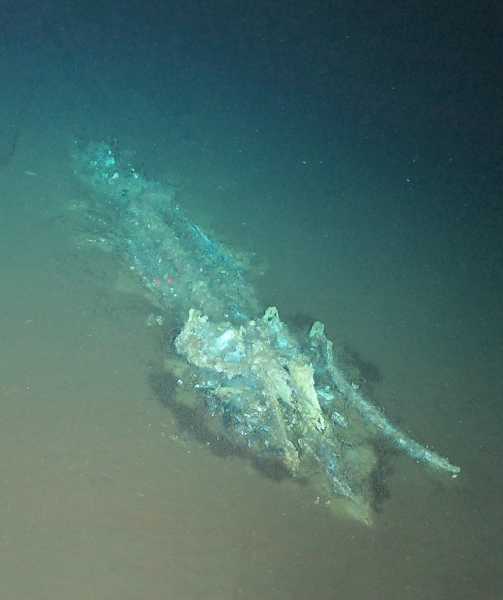
A 16.4-foot-long (5 meter) Antarctic minke whale on the seafloor. This whale fall was host to 26 invertebrate species.
(Image credit: Global TREnD, IDSSE)
Based on these findings, the authors projected that there could be between seven and eight whale carcasses and approximately 750 fossils per square kilometer in the region.
The largest specimen discovered is a skeleton measuring 16.4 feet (5 m) long, belonging to an Antarctic minke whale (Balaenoptera bonaerensis), the researchers reported. However, the majority of the remains are from beaked whales — marine mammals about which little is known, as they inhabit the open ocean and spend considerable time diving.
The five active whale falls are covered in bacteria that thrive without light or oxygen, metabolizing the oils within the whales’ bones and generating hydrogen sulfide. This chemical energy source supports diverse communities of jellyfish, brittle stars, Osedax worms that consume bone, and bivalve mollusks. These organisms collectively reach densities of up to 2,840 individuals per square meter, the authors observed.
Many of the creatures forming these whale-fall communities might be newly identified species, the authors suggested. While most could be classified at the genus or family level using DNA analysis from samples, only one was definitively identified to the species level: a clam known as Abyssogena southwardae.
“The density is incredible, as is the likelihood that they are predominantly new to science,” commented Stephen Godfrey, a curator of paleontology at the Calvert Marine Museum in Maryland, who was not involved in the study. “It’s akin to each of these whale falls being a new eatery opening in a 1,200-kilometer [745 miles] long strip mall,” he remarked to Live Science.
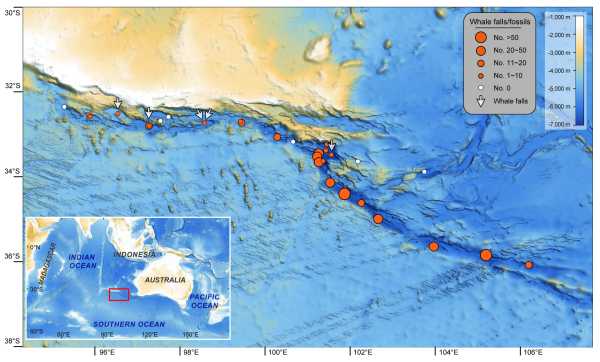
The distribution and abundance of whale fossils and whale falls in the Diamantina Zone. The orange circles mark dive locations where whale fossils or whale falls were observed.
(Image credit: Wiley, under a Creative Commons license CC BY 4.0. )
These are the deepest whale-fall communities ever encountered, with the one located at approximately 22,000 feet (6,700 m) being about 8,200 feet (2,500 m) deeper than any previously known such site, according to the study’s authors.
A fossil deposit being formed
Peng and his associates retrieved 43 fossils and determined the age of 33 of them by analyzing the strontium isotope ratios present. The fossils pertained to five species of beaked whales and one species of baleen whale, a category that includes bowhead and humpback whales.
The most ancient fossil unearthed in the area belonged to an extinct beaked whale of the Pterocetus genus, dating back approximately 5.3 million years to the Early Pliocene epoch. Another fossil discovery represented a new species, which the authors have designated Pterocetus diamantina.
For most of the specimens, only the bony upper jaw, or rostrum, remains. These fossils predominantly originated from two species: the Andrews’ beaked whale (Mesoplodon bowdoini) and the strap-toothed whale (Mesoplodon layardii). Both of these species are still found in the Indian Ocean, but the fossils recovered by the team could be as old as 1 million years.
“The truly remarkable aspect is that this megasite illuminates beaked whale ecology across geological timescales, enabling the observation of extinct species alongside the fossilized remains of extant species,” Pyenson commented.
Godfrey suggested that the megasite is comparable to either the renowned Lagerstätte fossil sites, known for high-quality preservation including soft tissues, or to Canada’s Burgess Shale, which features an immense abundance of animals, “except here, one is still actively forming.”
Given that beaked whales are seldom observed, the discovery of numerous individuals’ remains in one location might seem unexpected. However, Godfrey proposed that these animals may fossilize better due to the durability of their rostra, which possess one of the highest bone densities and mineral contents known among living vertebrates.
This characteristic allows them to endure for extended periods at great depths without dissolving or being consumed by bone-eating worms. Consequently, they become coated with ferromanganese oxides, solidifying and preserving the bone within a natural sarcophagus.
“This effectively seals the specimen, ensuring its preservation for perpetuity, or at least for over 5 million years, and potentially much longer,” Godfrey stated.
Why so many dead whales?
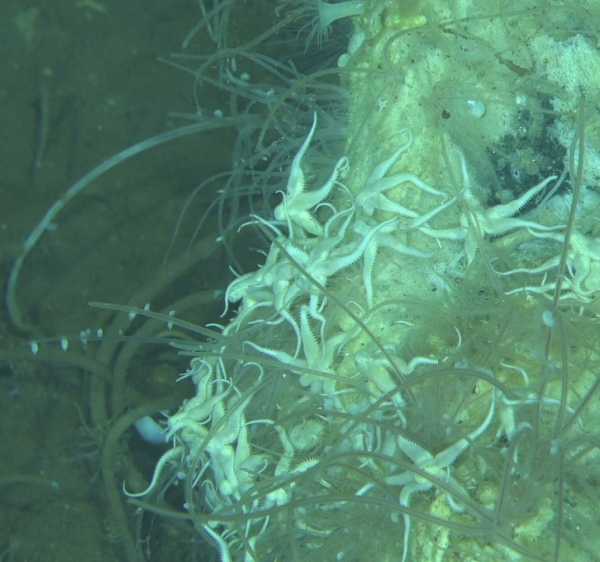
An Antarctic minke whale fall that’s now host to many marine species, including brittle stars, bone-eating worms, tubeworms, sea anemones and amphipods.
(Image credit: Global TREnD, IDSSE)
The researchers observed numerous squid and fish during their dives in the Diamantina Zone, indicating that the area serves as an optimal foraging ground for beaked whales in deep waters. This could explain the presence of more whales living and perishing in the vicinity, even though whale decomposition typically causes them to inflate with gas and drift considerable distances before reaching the seabed.
Peng and his team also hypothesized that beaked whales might face an elevated risk of mortality by being enticed to pursue prey beyond their maximum observed diving depth of approximately 10,000 feet (3,000 m), putting them in danger of lung collapse or decompression sickness.
An additional possibility is that the V-shaped topography of the Diamantina Zone could channel sinking carcasses into a more concentrated area, the authors proposed.
Related stories
- Watch sperm whale headbutt another for no apparent reason
- These endangered whales can live up to 150 years — twice as long as previously thought
- Hidden DNA found in blue whales reveals they’ve been mating with other species — and their hybrid offspring
“I believe they are observing a phenomenon analogous to terrestrial tar pits or caves, which function as natural traps where biological remains accumulate over time,” Pyenson stated.
However, that only accounts for part of the explanation. Ordinarily, ancient remains on the seabed would become buried by sediment from eroded rocks, preventing the fossils from being discovered. But the sedimentation rate near the Diamantina Zone is exceptionally low — merely 0.02 to 0.22 inches (0.05 to 0.55 cm) per 1,000 years, the study authors noted. This low rate allows skeletal remains to remain exposed for hundreds of thousands of years on the flat bottom sections of the zone and for millions of years on slopes or elevated areas, the team concluded.
They speculate that similar “necropolises” might exist off the coasts of South Africa, the Iberian Peninsula, and the remote Crozet and Kerguelen islands near Antarctica, where some fossils have previously been found through trawling operations.
How much do you know about killer whales? Find out with our orca quiz!

