

There are eye-opening claims that orcas and dolphins are working together on salmon hunts and sharing food — but not everyone is convinced.
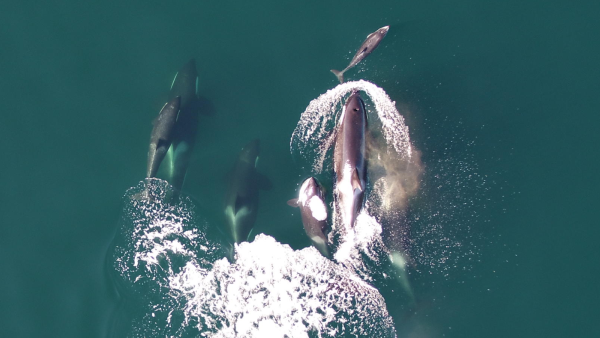
A dolphin swims alongside a pod of northern resident killer whales.(Image credit: University of British Columbia (A.Trites), Dalhousie University (S. Fortune), Hakai Institute (K. Holmes), Leibniz Institute for Zoo and Wildlife Research (X. Cheng))Subscribe to our newsletter
Orcas inhabiting the waters off British Columbia, Canada, have been observed participating in hunts alongside dolphins and sharing portions of their salmon catches with them post-capture.
The northern resident group of orcas (Orcinus orca), also known as killer whales, located off the coast of British Columbia, has been seen collaborating with Pacific white-sided dolphins (Aethalodelphis obliquidens) in their pursuit of Chinook salmon (Oncorhynchus tshawytscha).
Investigators utilized underwater video recordings, data from suction-cup biologging devices, and aerial drone imagery to track the movements and hunting patterns of nine northern resident orcas during August 2020, focusing on their interactions with Pacific white-sided dolphins near Vancouver Island, Canada.
They documented coordinated interactions between the two species through aerial and underwater footage. In this region, these two species typically exhibit minimal aggression towards each other and occasionally seek each other out, a situation that is noteworthy considering that orcas prey on dolphins in other areas, while some dolphin populations engage in mobbing behavior towards orcas.
The research team recorded 258 instances where dolphins were observed in close proximity to the tagged orcas. In every one of these situations, the orcas were actively engaged in behaviors related to foraging, such as capturing, consuming, or pursuing salmon, which are fish too substantial for dolphins to secure and swallow whole.
The investigators noted 25 occurrences where orcas altered their direction upon encountering dolphins, subsequently leading to both species diving, possibly for foraging purposes. This adjustment in behavior could stem from the orcas potentially listening for dolphin echolocation signals, according to lead author Sarah Fortune, an oceanographer affiliated with Dalhousie University in Nova Scotia, Canada.
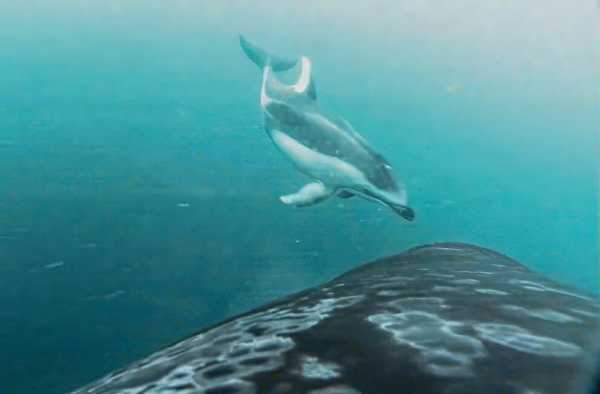
A Pacific white-sided dolphin approaches a Northern Resident killer whale. (Image credit: University of British Columbia (A.Trites), Dalhousie University (S. Fortune), Hakai Institute (K. Holmes), Leibniz Institute for Zoo and Wildlife Research (X. Cheng))
The researchers also documented eight instances where orcas successfully caught salmon, subsequently breaking them into pieces and sharing them with other orcas. Dolphins were present during four of these feeding events, and on one occasion, the dolphins were observed scavenging the conveniently fragmented salmon remnants.
“The surprising aspect for us, knowing that resident killer whales are specialized Chinook salmon hunters, is that the killer whales should theoretically be the most adept at locating them. Therefore, we question why they would be inclined to follow the dolphins,” Fortune communicated to Live Science.
She indicated that these findings represent the initial documented evidence of cooperative hunting and prey sharing between orcas and dolphins. The research findings were published in the journal Scientific Reports on Thursday, December 11.
“Researchers remain uncertain whether this constitutes a mutually beneficial cooperative system for both species,” Fortune elaborated. “We have not yet been able to quantify the degree to which killer whales and dolphins gain advantages from this interaction, but our observations suggest positive outcomes for both.”
Aerial drone video for killer whales following dolphins during salmon pursuit. – YouTube
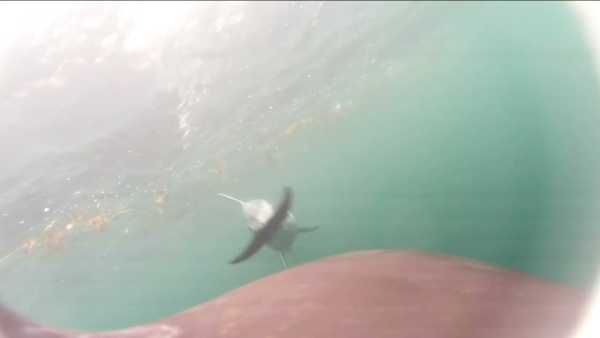
Watch On
By associating with the orcas, the dolphins might also gain a measure of safety from other orca pods that do hunt dolphins, she posited.
“It is perhaps not unexpected, considering the cognitive capacities of toothed whales, that these two species have learned that certain foraging activities conducted concurrently and in the same vicinity offer advantages to both,” stated Luke Rendell, an academic in biology at the University of St. Andrews in Scotland, who was not involved in the research. “The risk management undertaken by the dolphins in proximity to killer whales is particularly remarkable,” he remarked to Live Science via email, adding that associating with the wrong group of orcas could prove fatal.

Researchers aboard the research vessel Steller Quest observe Northern Resident killer whales. (Image credit: University of British Columbia (A.Trites), Dalhousie University (S. Fortune), Hakai Institute (K. Holmes), Leibniz Institute for Zoo and Wildlife Research (X. Cheng))Scrounging for food?
Michael Weiss, associated with the Center for Whale Research in Friday Harbor, Washington, and not involved in this study, expressed skepticism about whether the observed conduct indicates genuine cooperation between the two species.
“I am not entirely convinced that this represents cooperation; it seems evident that the dolphins stand to gain from reduced predatory risk and by scavenging from killer whale kills. However, I believe further research is necessary to establish a tangible benefit for the whales,” Weiss conveyed to Live Science via email.
Alternatively, this behavior might be classified as kleptoparasitism – where one organism appropriates food already procured by another – suggested Jared Towers, the executive director of Bay Cetology, a research institute focused on cetaceans in Canada, who also did not participate in the study.
“They provide evidence suggesting dolphins pilfering fish scraps from killer whale meals, and this observation is quite valuable, as it aligns with our long-held assumptions about such interactions,” Towers informed Live Science.
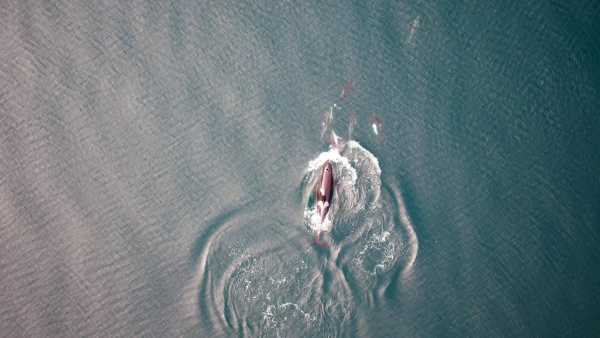
A group of killer whales, dolphins and Dall’s porpoise interact at the surface between foraging dives. (Image credit: University of British Columbia (A.Trites), Dalhousie University (S. Fortune), Hakai Institute (K. Holmes), Leibniz Institute for Zoo and Wildlife Research (X. Cheng))
He proposed that the synchronized movements also lend support to an alternative hypothesis – the notion that orcas actively avoid dolphins, rather than cooperating with them. “The killer whales undertake extended dives, travel greater distances underwater, and reduce their vocal activity. To me, this indicates that the killer whales are attempting to evade the dolphins,” he suggested.
Fortune concurs that alternative explanations are plausible. “It’s conceivable that the dolphins are the ones subtly acquiring fish from the killer whales, functioning as kleptoparasites. However, we have documented instances of dolphins actively pursuing salmon at the surface, and on at least one occasion, a dolphin is observed successfully catching a salmon, losing it, and then attempting to recapture it,” she noted. “It is evident that the dolphins desire the salmon, but they are not ideally equipped morphologically to capture these sizable fish.”
Engaging in coordinated activities with orcas could potentially provide the dolphins with the means to effectively obtain the fish, she added, while the orcas might enhance their salmon detection capabilities by following the dolphins.
Fortune emphasized that further scrutiny of the relationship between these marine mammals is essential to ascertain the prevalence and consistency of any cooperative behaviors observed.
In recent times, orcas have been observed engaging in a variety of intriguing behaviors, demonstrating considerable cultural learning. Members of the southern resident population near Washington and British Columbia have been seen adorning their heads with salmon and engaging in mutual grooming with kelp. Furthermore, another group of these intelligent marine mammals has been involved in damaging vessels off the coast of Spain.
Orca quiz: Will you sink or swim?