

An in-depth examination of 27 fossilized jaws from finned octopuses disputes the long-held notion that the dominant oceanic predators of the Cretaceous era were exclusively vertebrates.
Subscribe to our newsletter
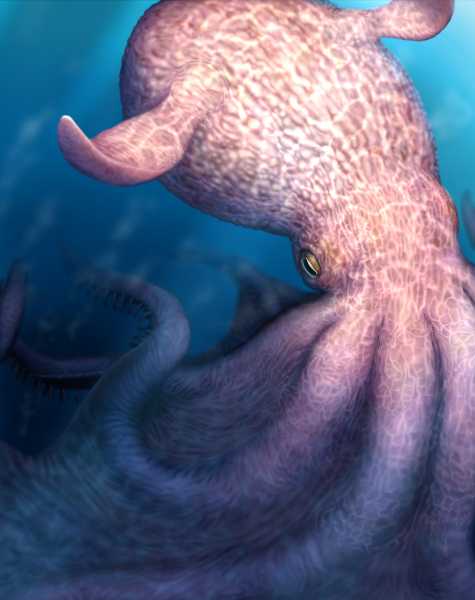
These discoveries extend the known timeline of the earliest octopuses by approximately 5 million years. (Image credit: Yohei Utsuki: Department of Earth and Planetary Sciences, Hokkaido University)
Researchers have identified colossal finned octopuses, dubbed “kraken,” which might have attained lengths of up to 62 feet (19 meters). These immense creatures inhabited the oceans during the Cretaceous period and could represent the largest invertebrates ever found.
This revelation implies that scientists may need to reassess the oceanic hierarchy during the Cretaceous period (spanning from 145 million to 66 million years ago).
“These findings reshape the perception of the Cretaceous ocean as a realm exclusively ruled by large vertebrate predators,” stated study co-author Yasuhiro Iba, a paleontologist at Hokkaido University in Japan, in an email to Live Science. “They demonstrate that enormous invertebrates, specifically octopuses, also occupied the highest positions in the food web.”
Other specialists suggest these size estimations represent the upper limit of a broad potential range. Nevertheless, the discovery prompts inquiries into the Cretaceous marine environment, such as the mechanisms enabling these species to achieve such immense sizes and whether even larger marine life forms existed subsequent to the Cretaceous epoch, they commented.
Investigating the Top Predators
Organisms at the pinnacle of the food chain significantly influence ecosystems, prompting their prey to develop defensive strategies, such as hard shells. Comprehending which species held the apex position is crucial for understanding the functioning of Cretaceous marine ecosystems, Iba explained.
Up until this point, it was presumed that the dominant predators were all vertebrates, including creatures like mosasaurs and plesiosaurs. However, the scarcity of preserved remains from soft-bodied octopuses has rendered their role in the Cretaceous food chain an enigma, as noted by the study’s authors.
“Octopuses are currently recognized as highly intelligent beings, but their study in deep geological time is exceedingly challenging due to their lack of rigid external skeletons,” Iba remarked. “A primary driver for this investigation was to illuminate this largely obscured history of octopuses.”
Within the scope of the study, the research team re-examined 15 fossilized octopus jaws previously recovered from Japan and Vancouver Island. Furthermore, they unearthed 12 new Cretaceous fossil octopus jaws in Japan by employing cutting-edge digital fossil-mining technology. Collectively, these findings identified two species of extinct finned octopuses: Nanaimoteuthis jeletzkyi and Nanaimoteuthis haggarti.
The fossils of N. jeletzkyi were discovered in rock strata dating back between 100 million and 72 million years ago, pushing the earliest known octopus lineage back by roughly 5 million years, and finned octopuses by 15 million years, the authors detailed in their study.
The team then proceeded to compare the dimensions, form, and wear marks on all 27 jaws with those of extant octopuses to reconstruct their body size, feeding habits, and position within the food web.
The size of the mantles—the prominent sac-like organ above the eyes—in living octopuses correlates with the length of their jaws. The overall length of modern, long-bodied finned octopuses is approximately 4.2 times their mantle length.
Iba and his colleagues applied this correlation to estimate the potential size of the mantles of N. jeletzkyi and N. haggarti. From these estimates, they were able to calculate the probable total lengths of these ancient creatures.
Based on the largest jaw discovered for each species, the team projected the maximum length of N. jeletzkyi to be between 10 feet and 26 feet (3 m to 8 m), while N. haggarti was estimated to range from approximately 23 feet to 62 feet (7 m to 19 m). This suggests N. haggarti could be the largest invertebrate discovered to date and “among the greatest body sizes of all organisms in the Cretaceous oceans,” the study’s authors noted. (Contemporary giant squid, Architeuthis dux, reach lengths of about 40 feet (12 m), and Cretaceous mosasaurs attained lengths of approximately 56 feet (17 m).)

N. haggarti may have been one of the largest species inhabiting Cretaceous seas. (Image credit: Hokkaido University)
The kraken jaws also exhibited evidence of substantial wear, with patterns indicating that these creatures utilized their entire jaws to process hard-shelled prey. The anterior portions of both species’ jaws showed wear on one side by as much as 10% of their total size, according to reconstructions. This uneven abrasion suggests lateralized behavior, which is associated with higher cognitive function, the authors posited in their study.
“These were not merely enormous octopuses, but exceptionally intelligent and formidable marine predators,” Iba asserted.
However, while experts commended the digital fossil-prospecting techniques employed in the study, they expressed reservations regarding the size estimations for each species.
The study’s authors estimated the size of N. jeletzkyi and N. haggarti by relying on “error-prone” averages of jaw-to-mantle and mantle-to-total-body size relationships found in extant species, which consequently resulted in a broad potential size range for both species, René Hoffman, a paleontologist specializing in fossil cephalopods at the Ruhr University Bochum in Germany, informed Live Science via email.
Their immense dimensions do not definitively establish them as the apex predators, Hoffman further commented.
Christian Klug, a professor of paleontology and a specialist in cephalopod evolution at the University of Zurich in Switzerland, concurred. While the estimations fall within conceivable limits, he noted that a degree of uncertainty is unavoidable. “There is no question that Nanaimoteuthis was a massive and effective predator,” he conveyed to Live Science in an email, but he cautioned that focusing solely on the maximum total length “allows one to overlook the possibility that they may not have reached ten meters.”
Are you captivated by cephalopod science? Put your knowledge to the test with our Octopus quiz!
TOPICS