

in News
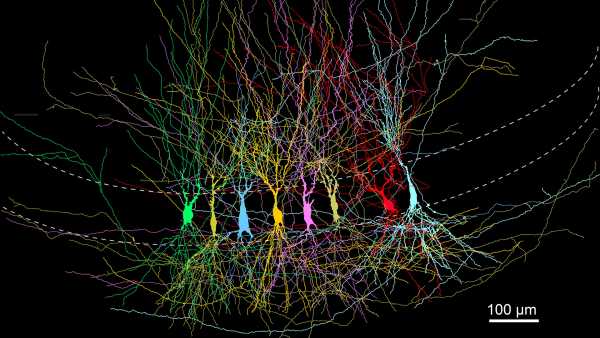
Researchers mapped the intricate designs and architectures of neural circuits within the mouse hippocampus, contrasting the circuits’ characteristics at various life stages.(Image credit: Vargas-Barroso et al./Nature Communications)Share this article 0Join the conversationFollow usAdd us as a preferred source on GoogleSubscribe to our newsletter
The brain’s primary memory hub might arrive “pre-formed,” rather than being constructed from the ground up after birth, according to a new study involving mice.
This research, detailed in the April issue of the journal Nature Communications, presents a fresh viewpoint on a persistent question in neuroscience: Does the brain begin as an unwritten page and establish memories by forging connections through experience, or does it possess inherent circuitry? The current investigation focused on the hippocampus, a curl-shaped structure situated deep within the brain, which is vital for memory formation.
The investigators concentrated on a specific area of the hippocampus known as cornu ammonis 3 (CA3), which plays a critical role in the storage and retrieval of memories. A characteristic called plasticity allows neurons within CA3 to continually strengthen and weaken their interconnections, thereby reinforcing or diminishing various memories.
The research team analyzed mouse brain tissue gathered shortly after birth, during adolescence, and in adulthood. They observed that in the early stages of life, hippocampal networks are densely interconnected, with numerous neurons linked in what appears to be a haphazard arrangement. As the brain matures, these seemingly disordered networks become less dense but more organized through a process of connection pruning. This trimming of connections commences soon after birth, with a substantial reduction in connectivity by adolescence.
This discovery challenges the notion that the hippocampus originates as a blank canvas, or “tabula rasa.”
“In essence, we’ve found that the system isn’t a tabula rasa, as we initially believed, where information can simply be written and subsequently fills the system,” stated study co-author Peter Jonas, a neuroscientist at the Institute of Science and Technology Austria. “Instead, it commences as a tabula plena [a full slate] and subsequently becomes sparser and more specifically linked.”
This developmental pattern might shed light on why our recollection of infancy is so limited.
Memories are understood to be encoded within networks of neurons that activate synchronously, representing distinct experiences. However, the study suggests that in a young brain, these connections between neurons, termed synapses, function differently. The team discovered that in young brain tissue, a single stimulus could cause a neuron to fire, whereas in mature networks, neurons typically require multiple stimuli to become activated.

In very young mice, neurons in a region of the hippocampus called CA3 form a dense, highly interconnected network (yellow), with connections that are largely random.
(Image credit: Vargas-Barroso et al./Nature Communications)
Jonas noted that the researchers were surprised not only by the early pruning of connections but also by the robustness of those initial links. “One might assume that early in development, synapses are weak and poor, but we found the reverse,” he informed Live Science.
This heightened excitability, however, comes at a price: When neurons are activated too readily, different experiences can lead to overlapping patterns of neural activity. If this overlap is excessive, the brain may encounter difficulties in differentiating between distinct memories. Rather than forming discrete networks, it might generate broader, less precise recollections. In other words, the system is highly active but lacks fine-tuned accuracy.
This lack of precision may also influence behavior. For instance, studies on rodents indicate that young animals learn to associate a specific cage area with a mild shock, becoming immobile upon re-entering it. However, unlike adult animals, who freeze in that precise spot, young animals exhibit this response in similar surroundings as well—indicating the memory is present but not sharply defined.
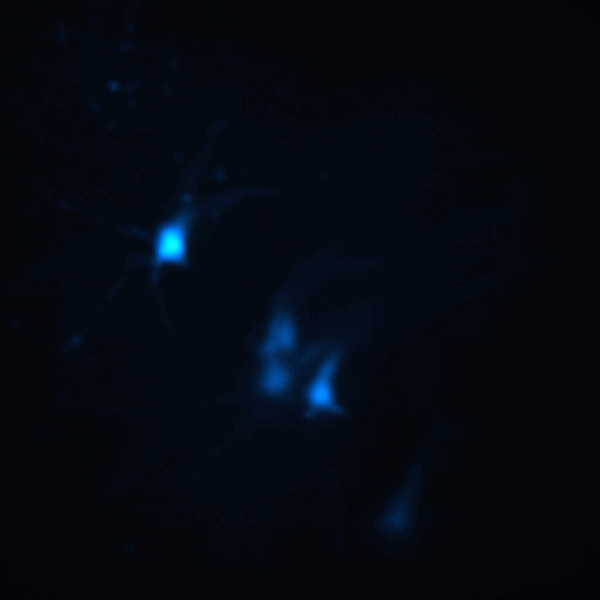
As mice mature, the network within CA3 becomes sparser but more organized (blue) with pruning refining the once-dense web of neural connections.
(Image credit: Vargas-Barroso et al. Nature Communications)
As the brain matures, neurons become more discerning and require multiple signals to activate. The outcome is the formation of more distinct, separate networks that translate into specific and stable memories. Therefore, regarding the inability to recall early childhood, it’s possible that our earliest memories are too vaguely defined to be retained long-term.
These findings align with a growing body of research on memory development, according to Hauður Freyja Ólafsdóttir, an assistant professor at the Donders Institute for Brain, Cognition and Behaviour at Radboud University in the Netherlands.
“It’s exciting on multiple fronts,” Ólafsdóttir, who was not involved in the study, remarked to Live Science. “There’s a wealth of developmental psychology research suggesting that memory becomes more specific with age. It’s quite interesting that we are now observing, at the circuit level, that connectivity patterns are also becoming sparser.”
So, what governs brain wiring prior to birth? This dense, early connectivity may stem from a genetically programmed developmental process. Subsequently, after birth, experience refines this wiring, Jonas proposed.
The discoveries do not preclude the possibility that prenatal experiences leave enduring imprints on the brain. However, Ólafsdóttir believes that these early forms of learning utilize different neural systems than the mature hippocampal circuits.
“I’m not disputing their existence or influence,” she stated, referring to prenatal experiences. “They leave a trace, let’s say, in our brains and likely in our psychology as well.” Nevertheless, these traces might not resemble the detailed recollections formed later in life.
Related stories
- Memories aren’t static in the brain — they ‘drift’ over time
- The brain stores at least 3 copies of every memory
- ‘As if a shudder ran from its brain to its body’: The neuroscientists that learned to control memories in rodents
When questioned whether the connections formed before birth represent genuine memories or are merely a consequence of prenatal development, Jonas responded, “The latter is more probable.”
This “full slate” may provide the brain with a critical advantage by enabling neurons to rapidly associate diverse types of information, such as sights, sounds, and smells. If the brain began as an empty slate, neurons might be too sparsely interconnected to establish contact, hindering early communication, the study authors infer.
By initiating with an overconnected network, the hippocampus may ensure that the essential wiring is already in place, Jonas theorized.
Test your knowledge of the most intricate organ in the human body with our brain quiz!