News

The future of healing might be at the nanoscale. (Image credit: Malte Mueller via Getty Images)
- Facebook
- X
- Reddit
- Pinterest
- Flipboard
Share this article 0Join the conversationFollow usAdd us as a preferred source on GoogleSubscribe to our newsletter
For most individuals, a minor abrasion or scratch is inconsequential; the body self-repairs rapidly, and antibiotics can manage any resulting infections. However, certain injuries, like severe burns and diabetic lesions, are susceptible to microbial infections that can develop resistance to antibiotics.
“Diabetic wounds present significant challenges for healing, and individuals often live with these conditions for the remainder of their lives,” remarks Vitaliy Khutoryanskiy, a materials scientist at the University of Reading in the United Kingdom.
To address this issue, researchers are devising novel treatment strategies for infected wounds employing specially engineered nanomaterials activated by light to deliver targeted antimicrobial effects. This method has demonstrated potential in diminishing infection and hastening wound recovery in animal trials involving mice and pigs, though it has yet to be evaluated in humans.
Persistent, slow-healing wounds provide an ideal environment for the formation of robust biofilms, which impede the healing process and substantially elevate the risk of limb amputation. The overwhelming majority of such wounds—exceeding 78 percent—harbor these tenacious bacterial layers, which are frequently resistant to antibiotics.
The newly developed light-activated nanomaterials offer an alternative method for eliminating bacterial infections by converting light into localized thermal energy or by interacting with tissue-bound oxygen to generate lethal compounds that eradicate bacteria with minimal harm to surrounding healthy tissue.
Our skin can absorb minute quantities of radiation naturally, but with the assistance of custom-designed nanomaterials, according to Zhenpeng Qin, a materials scientist at the University of Texas at Dallas, “you can elevate the tissue’s temperature.” This generated heat weakens bacteria and aids in tissue regeneration. Qin, a co-author of a study on this technique featured in the 2024 Annual Review of Biomedical Engineering, points out that analogous light-triggered therapies have been employed for delivering cytotoxic agents to specific skin and esophageal cancers but have not been extensively applied to wound management.
In one promising investigation involving wounds, Raffaele Mezzenga, a materials scientist from ETH Zurich, and his associates commenced with a naturally occurring antibacterial protein known as lysozyme, derived from egg whites. They reformulated the protein into a gel incorporating a light-absorbing chromophore. In the presence of near-infrared illumination, the chromophore generates heat, liquefies the gel, and releases active lysozyme. Upon cessation of light exposure and subsequent cooling, the lysozyme reverts to its inactive state.
When the research team applied the gel to wounds in mice and pigs, they observed the eradication of over 95 percent of the resident bacteria. The wounds also healed at an accelerated rate, as the lysozyme—which is also cytotoxic to healthy cells—was activated within the wound exclusively upon light irradiation, thereby safeguarding the skin from excessive exposure. To further enhance healing, the team incorporated magnesium ions into the gel, which prompt immune cells called macrophages to transition from an inflammatory phase to one that promotes tissue repair. “The healing process will be significantly expedited because you are simultaneously eliminating bacteria and promoting wound closure,” states Mezzenga.
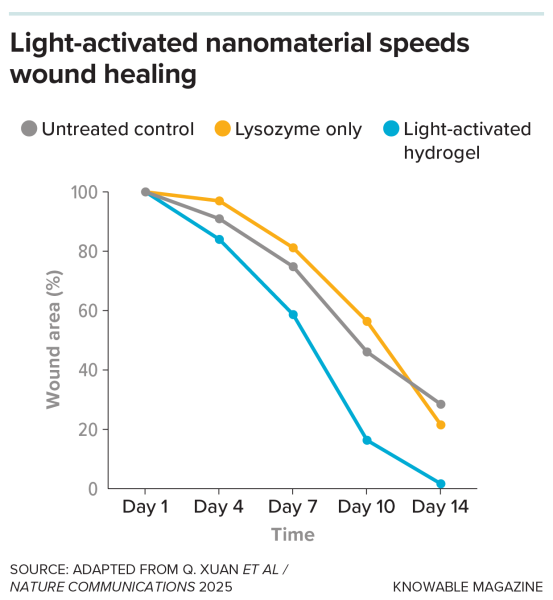
Light-responsive nanomaterials capable of releasing harmful compounds only when and where needed can aid in the eradication of wound infections while preventing damage to unaffected tissues. Illustrated here are mice with infections resistant to antibiotics treated with a hydrogel that liberates lysozyme, an antimicrobial protein, upon activation by light. Their wounds demonstrated faster healing compared to those of untreated mice or mice treated solely with lysozyme.
(Image credit: Adapted from Q. Xuan et al/Nature Communications and Knowable Magazine)
Given that bacterial biofilms are particularly persistent on the surfaces of medical implants—where they can instigate recurrent infections and occasionally necessitate repeat surgeries or even amputations—the team also evaluated their hydrogel on infected prosthetic joints in mice. They administered the gel around an infected implanted needle and directed near-infrared light through the skin. This intervention successfully eliminated biofilms and eradicated approximately 99 percent of the bacteria surrounding the implant, while concurrently preserving bone tissue.
In a separate recent investigation, scientists from Gannan Medical University and Shanghai University in China treated wounds utilizing a nanomaterial composed of gold nanoparticles and graphene-oxide “quantum dots,” which are minute, carbon-based semiconductor particles. When exposed to blue light, the gold particles absorb photonic energy and convert it into heat, while graphene oxide facilitates electron transfer across the material. This process enhances reactions that generate toxic, unstable molecules known as reactive oxygen species, which interact with bacterial membrane structures and cause their destruction.
Upon introduction of this material to a bacterial suspension and subsequent exposure to blue light for ten minutes, the mild heat and reactive oxygen species collectively induced the disintegration of bacterial membranes. Employing a stain that differentiated between dead and living bacteria, the researchers confirmed that the treatment had resulted in the demise of 97 percent of the bacteria.
Experiments with the nanomaterial in mice indicated that after nine days, wounds on treated mice exhibited 99 percent healing, whereas untreated mice showed only about 70 percent healing.
While these methodologies have shown promise in laboratory settings, additional research will be essential before their application to human subjects. “There is still a considerable distance to cover,” states Lars Kaestner, a biologist at Saarland University in Germany. For practical clinical utility, he notes, researchers would need to conduct extensive safety evaluations and reduce the manufacturing costs of the nanomaterials.
Related stories
- Humans heal 3 times slower than our closest animal relatives
- Why are scars permanent?
- ‘Zombie cells’ in the body tied to aging may actually help heal tissue damage
Nevertheless, the concept offers a beacon of hope for patients suffering from chronic wounds that resist conventional antibiotic treatments, particularly in light of escalating drug-resistant infections in healthcare facilities and challenges in diabetic care.
“It’s a commendable concept,” asserts Qin. “The challenges of wound healing and antimicrobial resistance are substantial. I believe any progress we can achieve in these domains would be highly beneficial.”
This article was originally published by Knowable Magazine, an independent nonprofit publication committed to disseminating scientific knowledge broadly. Subscribe to Knowable Magazine’s newsletter.