in News
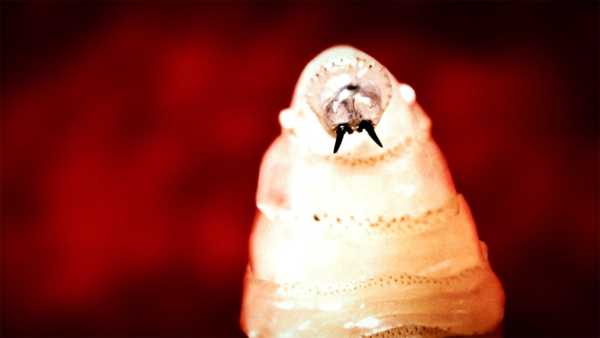
A close-up view of the New World screwworm, a parasitic pest posing a threat to livestock.(Image credit: Discovery Access via Getty Images)Share this article 0Join the conversationFollow usAdd us as a preferred source on GoogleSubscribe to our newsletter
A fly that deposits its parasitic, flesh-eating larvae inside cows has been identified in Texas for the first time in many years, the U.S. Department of Agriculture (USDA) announced on Wednesday, June 3.
Here’s what you need to know about the New World screwworm (Cochliomyia hominivorax), a pest that was successfully eliminated from the U.S. in the 1960s.
What is the New World screwworm?
New World screwworms are parasites that exclusively consume the living tissue of warm-blooded animals, according to the American Society for Microbiology (ASM). The screwworms themselves are the larval stage, or maggots, of the adult C. hominivorax flies.
These flies deposit their eggs in the open wounds or natural body orifices of animals, such as the eyes, ears, nose, mouth, or reproductive areas. Upon hatching, the maggots burrow into their host’s flesh, employing a twisting motion that gives the species its name. The maggots possess sharp mouth hooks that can inflict significant damage, deepening wounds and increasing the likelihood of secondary infections. Infestations can be agonizing, leading to swelling, bleeding, and emitting an offensive odor.
Following approximately a week of feeding, the maggots transition to their subsequent developmental phase and emerge from the animal, subsequently burrowing into the soil to undergo pupation and mature into adult flies.
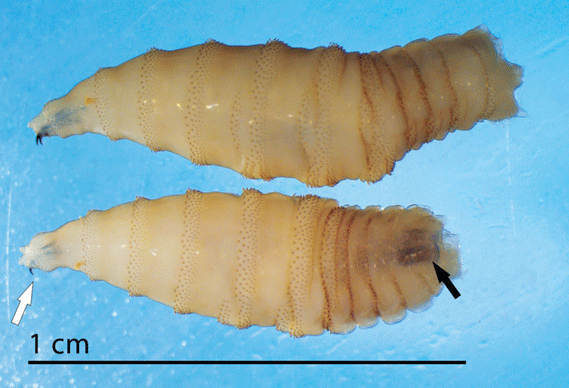
New World screwworms feature distinctive mouth hooks (indicated by the white arrow) used to tear into their hosts’ tissue.
(Image credit: Courtesy of the U.S. Centers for Disease Control and Prevention)
Broadly speaking, maggot infestations are termed myiasis, and myiasis caused by New World screwworms presents a substantial challenge to livestock agriculture. In regions where the fly species is endemic, or prevalent, the annual economic repercussions from this pest can reach billions of dollars each year. The flies predominantly affect hoofed livestock, including cattle, sheep, and horses. Less frequently, they can infest domestic dogs and wild animals such as deer, rabbits, opossums, and birds.
Can the screwworm infect humans?
Yes, New World screwworms can occasionally infect humans, though it is relatively uncommon. The flies have the potential to infest any warm-blooded creature, but livestock are the most frequently affected.
Individuals in endemic areas who work with livestock, possess compromised immune systems, sleep outdoors, or have open wounds—no matter how minor—face the highest risk of developing C. hominivorax infestations. Similar to infections in animals, these human infestations can be fatal, but they are treatable through the physical extraction of the maggots from the body.
Symptoms of an infestation include the sensation or visual evidence of maggots moving within a skin wound or sore, or within the ears, nose, eyes, or mouth; the development of painful skin wounds or sores that deteriorate over a few days; bleeding from sores; and a foul-smelling odor emanating from the site of the infestation.
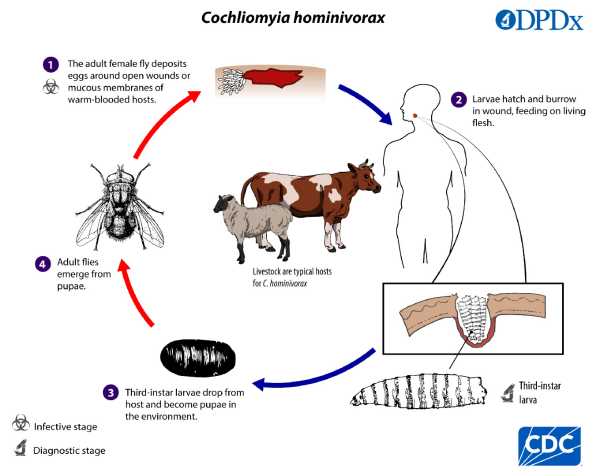
This graphic illustrates the life cycle stages of a New World screwworm.
(Image credit: Courtesy of the U.S. Centers for Disease Control and Prevention)
Screwworms do not transmit from infected animals to humans, nor do they spread from person to person. Infestations begin when a female fly deposits eggs within a wound or a bodily opening, such as the eyes.
In 2025, the U.S. recorded its first human case of New World screwworm infection in decades. The individual in question, located in Maryland, had recently returned to the U.S. after traveling to El Salvador, a country where the fly is endemic. The patient recovered following treatment.
Can infected livestock be treated?
Yes, livestock infected with New World screwworms can be treated using antiparasitic medications. Treatment also entails the manual removal of maggots from the flesh and the sterilization of wound sites. Prompt treatment is crucial, as an infestation can prove fatal to livestock within 10 days, according to the ASM.
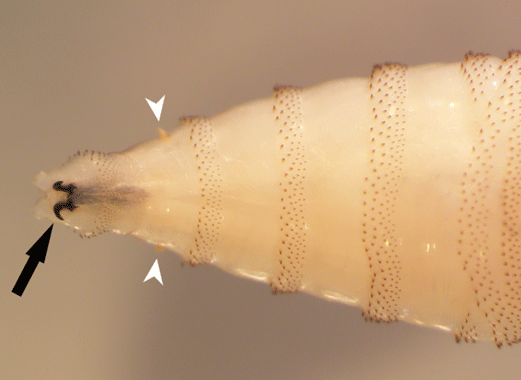
Here, the sharp, curved mouth hooks (black arrow) and spiracles (white arrowheads) – openings in their exoskeletons – of the screwworms are visible.
(Image credit: Courtesy of the U.S. Centers for Disease Control and Prevention)
Instead of culling entire herds—akin to practices for commercial flocks affected by avian flu—affected farms undergo examination for additional cases and are prohibited from moving animals off the premises during that period, as per USDA guidelines. Infected animals are treated and kept in quarantine until their wounds heal and they have gone several weeks without any indications of reinfestation. Euthanasia for individual animals may occasionally be necessary if the infestation is excessively severe.
Provided they meet all regulatory mandates, animals that have recuperated from screwworm myiasis are permitted to enter the food supply, the USDA states. Importantly, screwworms do not infest deceased meat; they exclusively target healthy, living tissue. Consequently, screwworms pose a risk to food production but not to food safety.
Is it a significant issue that it has been detected in Texas?
Screwworm outbreaks can be exceptionally costly if not contained promptly—there is a valid reason why the U.S. has invested substantial resources in eradicating this pest. Experts estimate that if a widespread outbreak were to occur in the state today, the Texas economy could face losses amounting to $1.8 billion due to disruptions in the livestock sector. Consequently, food prices would likely increase.
New World screwworms were declared eradicated from the continental U.S. in 1966, following a comprehensive initiative that involved releasing sterilized male flies into the environment to disrupt the species’ reproductive cycle. Despite this localized eradication, America continued to experience significant screwworm outbreaks originating from flies and infected animals entering the country from Mexico. A 1972 outbreak was the most severe recorded post-eradication, impacting numerous states and causing tens of thousands of cases in Texas alone.
A collaborative effort between the U.S. and Mexico was subsequently established to prevent similar outbreaks in the future, and the parasite was largely eliminated from Mexico by the 1980s. However, in recent years, there have been indications of a resurgence. Cases have been migrating northward from Central American nations, such as Panama and Costa Rica, since 2023. In response, the U.S. has implemented a strategy, spearheaded by the USDA, to curb the spread of these cases.
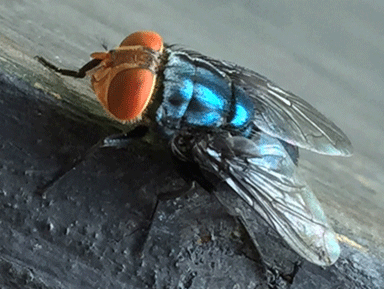
Adult screwworm flies deposit their eggs within animals’ bodies.
(Image credit: Image courtesy of United States Department of Agriculture Animal Plant Health Inspection Service.)
“All models indicated the New World Screwworm entering the country in 2025,” but these preventative actions have likely provided the nation with some additional time, according to the USDA’s statement on June 3.
Therefore, the identification of C. hominivorax in a 3-week-old calf in Zavala County, Texas, was not entirely unexpected but does necessitate swift intervention. The case occurred in Southwest Texas, approximately 50 miles (80 kilometers) from the U.S.-Mexico border. The maggots were observed around the calf’s umbilical region. With appropriate treatment, the calf is expected to recover, as stated by Agriculture Secretary Brooke Rollins to The Associated Press (AP).
Related stories
- 32 scary parasitic diseases
- Never-before-seen parasite is resistant to ivermectin
- Parasite lurking in woman’s brain caused mysterious ‘burning’ leg sensation
“The USDA implores residents to contact their veterinarian immediately if they notice any suspicious wounds, maggots, or infestations in their animals or herds,” the agency advised on X. “If you observe signs of maggot infestations in live or recently deceased wild animals, particularly in areas near the U.S./Mexico border, please call 866-4USDA-WS (866-487-3297) to report it to your local USDA Wildlife Services office.”
The agency is now implementing the strategies and actions detailed in the NWS Response Playbook to mitigate any potential danger in Texas. This includes establishing a quarantine zone around the location where the case was detected and restricting the movement of animals within that zone.
According to the AP, Secretary Rollins expressed confidence in the USDA’s preparations, stating that they believe “there is no threat of mass infestation.” She further added, “There is no reason to believe this incursion will result in the establishment of the pest in our country.”

