

In News
Researchers are investigating rare genetic conditions to enhance our comprehension of the brain.(Image credit: Knowable Magazine)Share this article 0Join the conversationFollow usAdd us as a preferred source on GoogleSubscribe to our newsletter
The wind whips dust from the dirt road one December afternoon as Jack van Honk drives into a disheveled settlement in Lambert’s Bay, situated on South Africa’s west coast. From a modest dwelling painted a pale sea green, a stout woman clad in a floral red sundress emerges. Her yard, adorned with numerous potted plants, many of them medicinal, is covered in ochre dirt. A broad smile transforms her face, etched with deep lines that lend a cherubic yet world-weary appearance despite her 47 years. “Doctor! I missed you,” she exclaims, her voice a low, husky whisper.
Maria possesses a rare genetic anomaly, virtually unknown outside of southern Africa. This condition has led to the calcification of a brain region known as the basolateral amygdala and has caused thickening and scarring of her vocal cords. A friend with the same affliction resides several hours inland, and they occasionally convene when van Honk facilitates their travel to Cape Town for medical imaging and further examinations. “It’s comforting to know I’m not by myself,” Maria shares.
By all everyday standards—managing employment, maintaining a household, and raising two teenage sons—Maria is capable and involved. “When you converse with her, you perceive no outward issues,” states van Honk, a social neuroscientist affiliated with the University of Cape Town. He notes that she and others he knows with Urbach-Wiethe disease are “naturally kind and gentle individuals.” In a kitchen interview, Maria finds it difficult to recall even a brief moment of distress, before admitting that she separated from her partner years ago due to his drinking habits.
However, when subjected to assessments and surveys designed to probe moral decision-making, Maria and other individuals with Urbach-Wiethe exhibit perplexing responses that challenge a long-standing tenet in neuroscience.

Maria lives with a rare genetic disorder that affects a portion of the amygdala—a brain region increasingly associated not only with fear but also with how individuals assess the needs of others.
(Image credit: Richard Stone)Fear factors
The amygdala, an almond-shaped brain region, has long been characterized—almost mythologized—as the brain’s fear center. This perception originated from early experiments with rodents that highlighted its role in defensive responses. “Numerous discoveries linked the amygdala to fear conditioning,” remarks Steve Chang, a neuroscientist at Yale University specializing in social cognition and decision-making in primates. These studies involved conditioning mice and rats to associate a neutral stimulus, like a tone, with a mild electric shock to their paws. Subsequently, the sound alone would cause them to freeze in anticipation, a learned fear reaction that ceased upon amygdala damage.
However, recent investigations in both animals and humans have revealed a more intricate picture. Instead of merely acting as a fear switch, the amygdala is now understood as a central hub in the brain: a complex network of specialized nuclei that assist in identifying what matters to us, thereby guiding our decisions, according to Elizabeth Phelps, a psychologist at Harvard University who examines the impact of emotions on cognition. The infrequent occurrences of Urbach-Wiethe disease in South Africa provide a distinct perspective into this neural network. As the condition appears to impair the basolateral amygdala while leaving other parts of the structure intact, it has aided in elucidating how different amygdala neural circuits interact with each other and with other brain areas—not just in fear learning, but also in social judgment and decision-making.
Van Honk “is effectively connecting his research with animal studies to develop a broader hypothesis,” suggests Phelps, who is not involved in the project. The emerging perspective is compelling, she notes, though not yet fully convincing to her: Van Honk and his associates now propose that the basolateral amygdala primarily functions as a form of social compass, instrumental in evaluating the needs and intentions of others and determining their significance to us.
Prior research had presented a simpler view. Scientists in the 1990s documented the remarkable case of a young woman with Urbach-Wiethe disease whose amygdala was almost completely calcified, aligning with the prevailing fear-amygdala model. Unfailingly cheerful like Maria, S.M. (identified solely by her initials) was unable to recognize fear in others’ facial expressions, as reported by neuroscientist Antonio Damasio and his colleagues in Nature in 1994.
As the scientists became better acquainted with S.M., she frequently disclosed her aversion to snakes and spiders and her efforts to avoid them. Yet, on one occasion, when they took her to an exotic pet store, she joyfully handled and petted a snake for three minutes, remarking, “This is so cool!” and had to be prevented from touching larger, more dangerous reptiles. She remained unperturbed in a haunted house attraction and unfazed by horror films. Damasio’s team concluded that S.M. exhibited “a profound and pervasive impairment in the induction and experience of fear.”
Like many in his discipline, van Honk, a junior researcher at Utrecht University in the Netherlands at the time, was captivated by S.M.’s account. “She must be the world’s most renowned living neurological patient,” he states. Then, in 2003, during van Honk’s inaugural visit to South Africa, clinical psychologist Helena Thornton of the University of Cape Town drew his attention to her endeavors to locate individuals with Urbach-Wiethe in South Africa. She recognized that the country offered a unique situation for neuroscientists: not just one notable patient, but an entire cluster of individuals living with a rare neurological disorder.
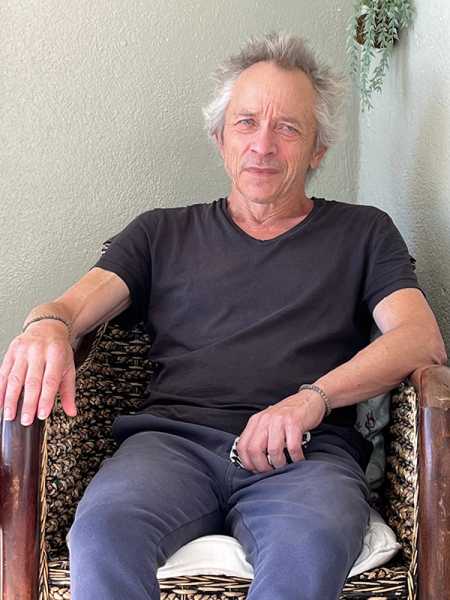
Social neuroscientist Jack van Honk has dedicated two decades to studying individuals with Urbach-Wiethe disease in South Africa.
(Image credit: Richard Stone)
Urbach-Wiethe disease, also referred to as lipoid proteinosis, was initially documented scientifically in 1929 by the Austrian medical researchers Erich Urbach and Camillo Wiethe. Subsequent medical investigations traced the disorder’s presence in South Africa to a sibling pair, Jacob and Else Cloete, who migrated from Cologne, Germany, in the mid-17th century. These individuals married into a community of Dutch settlers. Around the start of the 19th century, a descendant of the Cloete family transmitted a gene for the trait into the mixed-race populace of Namaqualand, the arid highlands in the Northern Cape, near the Namibian border.
Urbach-Wiethe is a recessive condition, meaning individuals must inherit two copies of the affected gene from both parents to manifest the disorder. It has been linked to at least three dozen distinct mutations, all occurring within a gene responsible for the ECM1 protein, which is vital for the skin’s connective tissue. Those carrying the mutation often present with fragile, inflamed skin and vocal cord abnormalities. They may exhibit varied patterns of calcification within brain regions, primarily the amygdala, and in severe instances, can experience epilepsy, paranoia, or other psychological disturbances.
Thornton and her colleagues identified 34 individuals with Urbach-Wiethe disease, predominantly situated across the rugged desert landscapes of Namaqualand. The number of affected individuals had decreased since the era of the Dutch colony—”a small, isolated community that suffered from inbreeding,” van Honk explains. Without the continuation of marriages between close relatives, the condition was gradually fading. However, with fewer than 100 known cases globally, Namaqualand still represented the highest concentration worldwide.
The implications were remarkable: a rare opportunity to investigate how selective damage to the amygdala influences behavior. In 2005, the University of Cape Town organized another research expedition to Namaqualand. Van Honk joined the team, later enlisting Utrecht social neuroscientist David Terburg, who was then a student. “We embarked on this research with the fundamental premise that the amygdala is the fear center, anticipating we would encounter fearless individuals, akin to S.M.,” Terburg recalls. “However, our findings were entirely contrary.” While individuals with Urbach-Wiethe disease in the Northern Cape appeared composed and amiable, behavioral assessments indicated heightened fear responses and elevated anxiety levels.
Scientists pondered how this could be, given the compromised state of the brain region believed to govern fear. Initially, these discoveries seemed to contradict the iconic case of S.M. and were met with skepticism from peers. “It took us five years to get those initial findings published,” Terburg notes. One potential explanation for this apparent paradox was that the individuals in Namaqualand carried a unique Cloete mutation, not observed on other continents. Another significant clue emerged in 2007, following the acquisition of a powerful 3 Tesla MRI scanner at Stellenbosch University near Cape Town. “We were the pioneers in its utilization,” states van Honk. It was at this point that the team discovered the damage was concentrated in the basolateral amygdala. “Nothing of this nature had been previously documented,” van Honk asserts—at least not in humans. Researchers had previously induced selective lesions in this and other amygdala regions in rats.
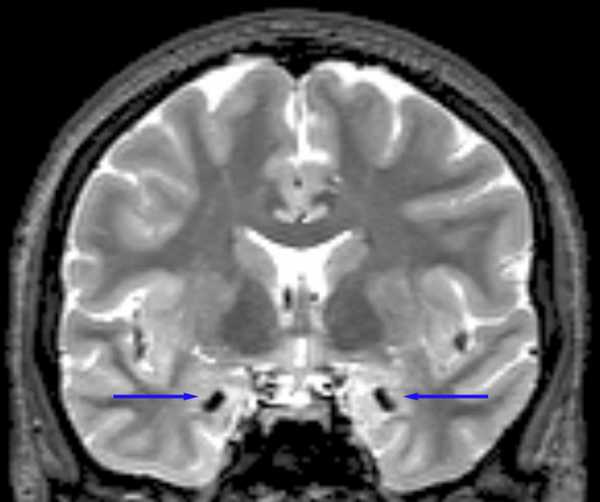
MRI scan of an individual with Urbach-Wiethe disease. Arrows indicate bilateral calcification within the basolateral amygdala, a brain region involved in fear learning and social decision-making.
(Image credit: David Terburg)
Rats are social animals, and studies involving these lesioned animals demonstrated that the basolateral amygdala assists them in weighing potential outcomes and consequences; conversely, the central-medial amygdala is more closely associated with rapid defensive reactions, such as freezing or fleeing from peril. It occurred to van Honk that the individuals in South Africa with Urbach-Wiethe disease served as a form of Rosetta Stone for determining if findings in rats applied to humans. Perhaps, he hypothesized, distinct amygdala circuits might also drive human behavior in opposing directions.
Personal stakes
The brain had long captivated van Honk, partly due to his personal history. In his early adulthood, following the tragic death of his elder brother in a motorcycle accident, he experienced significant mental health challenges. This experience profoundly influenced his interactions with the Urbach-Wiethe patients he later encountered—individuals whose hoarse voices and visible skin alterations often set them apart within their communities—and strengthened his resolve to unravel this living neurological enigma.
In 2008, after studying Urbach-Wiethe disease from a distance, van Honk secured a visiting professorship within the University of Cape Town’s Department of Psychiatry and Mental Health. He relocated from the Netherlands with his wife and young children. He carefully selected his study participants with Urbach-Wiethe, excluding individuals with co-occurring conditions such as alcoholism to ensure that the observed effects were exclusively attributable to the genetic mutation. This process narrowed their subject pool to a small group of women, including Maria.
Subsequently, to delve deeper into their behavior and cognitive processes, van Honk and his colleagues employed methodologies borrowed from economics and moral philosophy: straightforward games and hypothetical scenarios designed to reveal how individuals evaluate risk, reward, and accountability. Classical economic theory posits that humans rationally calculate costs and benefits. However, decades of behavioral research suggest a different reality: decisions are frequently influenced by intuition, impulses, and social predispositions that diverge from strict self-interest.
In a commonly utilized experiment known as the trust game, participants are provided with a sum of money and instructed to decide how much to invest with an unfamiliar individual, without any assurance of a return on their investment. Most individuals adopt a cautious approach. The women with Urbach-Wiethe, however, did not. Repeatedly, they made substantial investments with unknown partners. In terms of their financial decisions, their choices were imprudent. To van Honk and his colleagues, this behavior indicated a diminished capacity to flexibly weigh uncertainty, self-interest, and the intentions of others—the kind of precise adjustment they believe an intact basolateral amygdala normally facilitates.
A distinct pattern emerged in moral quandaries. A well-known thought experiment is the “trolley problem,” which presents a scenario where an out-of-control trolley could result in the deaths of five people; however, intervening would necessitate actively causing the death of a single individual. When asked about their actions in variations of this scenario, the women with Urbach-Wiethe disease consistently declined to endorse sacrificing a life, even as the number of potential casualties—should they fail to act—increased dramatically. “It is commendable to refuse to sacrifice a person, but if such a large number of people were to perish, it seems rather peculiar,” van Honk comments. “There appears to be a computational breakdown.” The women grasped the potential outcomes but were unable to bring themselves to intervene. Some explained to the researchers that causing harm, even for a greater good, “is too painful.”
Intrigued, psychologist Tobias Kalenscher from the University of Dusseldorf in Germany took a sabbatical in 2023 to collaborate with van Honk in South Africa. Kalenscher’s team had previously identified significant behavioral alterations in rats with lesions in their basolateral amygdala. Typically, when a rat is presented with two choices—receiving a treat solely for itself, or the identical treat for itself and another rat—it often favors the mutually beneficial option. Rats with brain lesions displayed indifference towards other rats, suggesting that the basolateral amygdala plays a role in assessing the social value of a decision.
Rodent social behavior serves only as a rudimentary model for humans. “Generosity is a truly human characteristic that necessitates study in humans,” Kalenscher states. He and van Honk instructed the Urbach-Wiethe women in the Northern Cape to contemplate individuals in their lives—those closest to them and those progressively more distant, extending to an anonymous stranger. For each person, the women were asked to specify the amount of money they were willing to share. A control group of women without the disease received the same inquiries. Generosity diminished with social distance for everyone, but among the Urbach-Wiethe women, this decline was significantly more pronounced, as the team reported in PNAS in 2025. The researchers noted, “It appears they are incapable of balancing their own interests against the interests of others.”
“It appears that they can’t trade off their own benefit versus the benefit of others.”
Tobias Kalenscher, psychologist at the University of Dusseldorf
The pair suspected that the women’s behavior reflected an impaired ability to reconcile self-interest with concern for others, rather than a fixed inclination towards either generosity or selfishness. Consequently, beginning in November 2025, they conducted a modified version of the experiment that eliminated the need to divide resources. They asked Maria and other participants to squeeze a handheld device called a dynamometer. Applying greater pressure would yield more money for individuals at varying social distances. In such tests, individuals without amygdala lesions exhibit consistent behavior: “They exert significantly more force for people they love or feel close to than for strangers,” Kalenscher observes. In contrast, the women with Urbach-Wiethe exerted equal pressure for strangers and loved ones—indicating that they were not adjusting their actions based on social proximity.
Across responses to perceived threats, moral judgments, and social decision-making, a striking pattern emerges. The women with Urbach-Wiethe experience difficulties in modifying their decisions as circumstances fluctuate. This suggests that the basolateral amygdala enables us to conceptualize the outcomes for others and weigh them against our own when making choices. “This is what we do, and I believe what the Urbach-Wiethe patients are unable to do,” Kalenscher states.
In essence, while earlier hypotheses primarily characterized the amygdala as a danger detector—a mechanism that activates or deactivates fear—emerging evidence points to a more extensive role for this brain region in behavioral calibration. Van Honk and his colleagues propose that the basolateral amygdala integrates emotional signals with potential consequences, allowing us to balance personal gain against potential harm or benefit to others. The women with Urbach-Wiethe disease exemplify the consequences when this calibration system is disrupted: they face challenges in reconciling competing considerations during decision-making. “It appears they are unable to balance their own benefit against the benefit of others,” Kalenscher concludes.
One plausible explanation for this impairment lies in the interaction between the basolateral amygdala and the ventromedial prefrontal cortex, a region involved in evaluating rewards and guiding decisions. In a healthy brain, these two areas collaborate, integrating self-interest with concern for others into a unified signal that directs behavior. When the basolateral amygdala is damaged, this communication pathway may falter, leading decisions to be governed by simpler, unaffected neural circuits. While this hypothesis remains speculative, Kalenscher notes, it aligns with current understanding of how these brain regions interact.
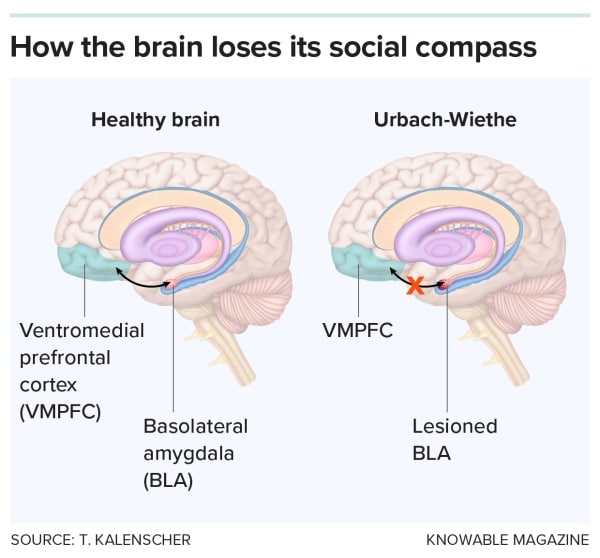
Scientists hypothesize that the communication between the basolateral amygdala and the ventromedial prefrontal cortex aids individuals in balancing self-interest with consideration for others during social decision-making.
(Image credit: Knowable Magazine)
Translating the women’s experimental behavior into real-world actions presents a challenge. However, Kalenscher observes indications in Maria’s conduct. During a January visit, she was observed caring for two orphaned children who were apparently unrelated to her. Based on his brief observations of Maria’s daily life, Kalenscher believes her computational deficit may manifest as an extreme form of altruism: a readiness to assist others without the typical contextual filtering. This makes her a dependable individual, he suggests, but also potentially vulnerable to exploitation. Echoing Maria’s commendable actions is an observation about S.M. reported in 2018: S.M. recounted to researchers how she once gave her only coat and scarf to a homeless man she encountered under a freeway overpass during the depths of winter.
An enduring riddle
Each expedition to the Northern Cape seems to unveil another concealed peculiarity of Urbach-Wiethe disease. While conversing with his research participant, Maria, at her kitchen table in Lambert’s Bay, van Honk interacted with her as if she were a longtime companion—and indeed, they have known each other for over 15 years. As their meeting concluded, he inquired about her sense of smell. “Yes, it’s very acute,” she responded without hesitation. She spoke fluidly about cooking and her ability to discern when food had spoiled. Nothing in her demeanor suggested any impairment.
Later, van Honk presented unpublished findings from a smell test he and his colleagues recently conducted with Maria and other individuals affected by Urbach-Wiethe disease. While their fundamental odor detection capabilities remained intact—they could perceive smells effectively—the women encountered difficulties in identifying those smells, a pattern the researchers termed olfactory amnesia. “They recognize the smell of fish and coffee. However, other scents they struggle to differentiate,” van Honk explained. More notably, the women were unaware of this deficit, a phenomenon known as olfactory anosognosia.
RELATED STORIES
- ‘It could revolutionize, completely, the way we treat depression’: Researchers are exploring promising immune therapy for treating psychiatric symptoms
- ‘This is largely uncharted territory’: Scientists reveal the brain’s ‘fear circuit’ works differently than we thought
- The brain’s memory center doesn’t start as a blank slate, study suggests
In rodent models, the basolateral amygdala plays a crucial role not in detecting odors but in learning their significance—associating a smell with a memory or a consequence. When this region is damaged, animals can still sense odors but fail to learn that a particular scent predicts danger or reward. The data from Urbach-Wiethe patients suggest a comparable mechanism, according to the scientists. Smell, one of the most primitive sensory systems, appears to depend on the same neural pathways that enable humans to learn from experience and update their internal world models.
Despite the challenges they face due to the steady, irreversible degradation of their basolateral amygdala, the women with Urbach-Wiethe in the Northern Cape demonstrate remarkable resilience and adaptability, qualities that deeply impress van Honk. As they navigate their lives, they offer science a unique insight into how subtle alterations in the brain can reshape our experience of fear, influence whom we trust, and define the extent of our concern for others.
This article was originally published by Knowable Magazine, a non-profit publication committed to making scientific knowledge accessible to everyone. Subscribe to Knowable Magazine’s newsletter.