

This small robot allows individuals with restricted movement to traverse complex areas where wheeled contraptions struggle.
(Image credit: Toyota/Japan Mobility Show 2025)Subscribe to our newsletter
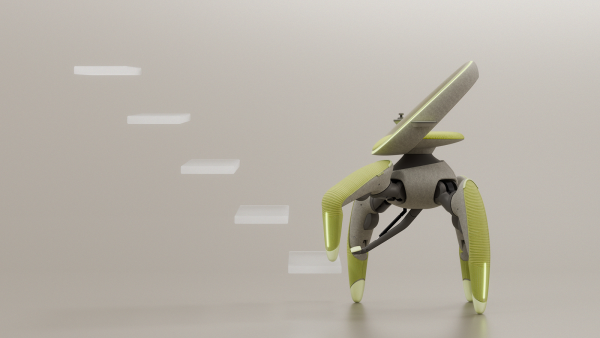
A robotic chair unveiled at the Japan Mobility Show 2025 can navigate challenging environments on its four adaptable legs.
Although the chair is currently a prototype, it is designed to enable users with reduced mobility to ascend stairs or overcome other barriers that conventional wheelchairs cannot manage. It also possesses the capability to elevate the user, allowing them access to vehicles or platforms that are at a higher level.
Toyota’s “Walk Me” Wheelchair Walks on Legs and Climbs Stairs – The Future of Mobility Is Here – YouTube
Watch On
The legs operate completely independently, each capable of bending, elevating, or retracting to enhance maneuverability. When not in use, the legs can be folded neatly underneath the robot, facilitating easy stowing in a car or luggage for convenient transport. The system can also deploy and stabilize itself without external help.
This “autonomous wheelchair” is equipped with numerous features that enable it to traverse difficult terrain by emulating the locomotion of quadrupeds like crabs. These include LiDAR systems that employ laser light for precise distance measurement, generating highly accurate, detailed 3D maps of surroundings and objects, which the robot uses to avoid obstructions or manage uneven ground.
When ascending stairs, the unit initially gauges the height with its front legs before propelling itself upward with its hind limbs. It also incorporates built-in collision detection systems to prevent impacts with individuals or objects.
Furthermore, the Walk Me is fitted with integrated weight sensors to ensure the user maintains a stable, seated posture. Toyota’s engineers meticulously studied human stair navigation and weight distribution patterns when moving over or around obstacles. In instances of detected imbalance, the robot can adjust both its legs and the inclination of the seat to guarantee the user’s comfort and security.
Manual control options are also available. The seat is fitted with handles allowing the user to direct the robot’s path. Alternatively, a digital interface offers specific controls for precise movement management. The Walk Me can also process voice commands for preset locations, such as “living room,” and speed adjustments, like “slower” or “faster.”
The unit is powered by a battery discreetly housed behind the seat, providing power for a full day’s operation. The battery is recharged by connecting it to a standard wall outlet overnight.
The Walk Me was showcased as part of a broader collection of products by Toyota at the Tokyo Mobility Show, which also featured an autonomous, self-driving vehicle for children and a robust, all-terrain wheelchair variant. According to Top Gear, the wheelchair concept was inspired by Toyota’s chairman, Akio Toyoda, who, at 69 years old, desires the ability to “drift, do donuts, and race off-road into his retirement.”
Sourse: www.livescience.com