

in News
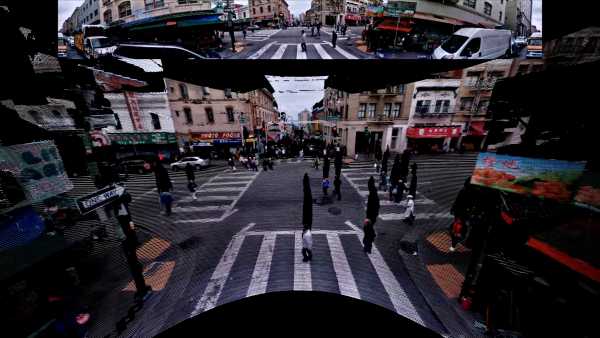
Rev8 senses both ambient light, akin to a camera, and laser light, indicating object proximity.(Image credit: Ouster/YouTube)Share this article 0Join the conversationFollow usAdd us as a preferred source on GoogleSubscribe to our newsletter
A technology firm headquartered in California has introduced the world’s inaugural mass-produced, native color light detection and ranging (lidar) sensor, capable of simultaneously capturing 3D spatial and colorimetric data.
Previously, autonomous vehicles and robots depended on distinct sensors for each data stream. However, the new devices, designated “Rev8,” have the potential to enhance safety, according to Ouster representatives, by enabling robots to more rapidly perceive the 3D and color characteristics of their surroundings.
The next generation of lidar
Standard lidar sensors operate by emitting laser pulses and measuring the return time of reflected signals. This process allows them to precisely determine the distance to objects within their environment and acquire physical attributes, such as surface reflectivity.
A specialized lidar processing chip transforms the returning laser signals into points on a 3D map, subsequently transmitting this data to the host computer for decision-making. If color perception was also required, it would necessitate a separate camera lens, and its data would need to be synchronized with the lidar sensor’s output.
The distinguishing feature of Ouster’s new Rev8 sensors is their capacity to detect both laser light for depth analysis and ambient light for color capture. The integrated “L4 Ouster Silicon” chip constructs a 3D map from the laser returns and associates the corresponding color information with each 3D point as it is generated.
REV8 OS1 MAX with Native Color Freeway Drive – YouTube
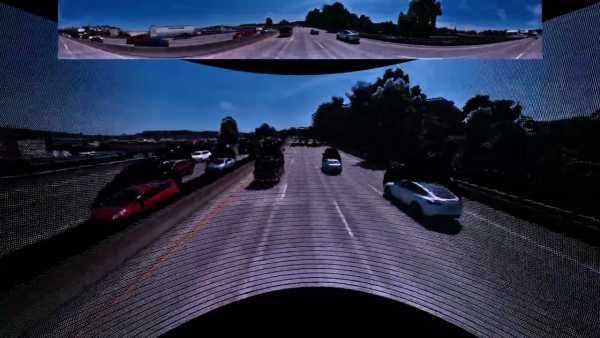
Watch On
These sensors achieve this through the use of single-photon avalanche diodes, which can analyze all incoming light at an exceptionally high resolution, as each photon initiates an “avalanche” of electrons, producing a robust electrical signal.
Indeed, the Rev8 sensor series is capable of detecting up to 20 trillion photons per second with picosecond timing accuracy, as reported by Ouster representatives. A typical commercially available LiDAR sensor processes detections at a rate of merely a few million photons per second.
The Rev8 sensors offer megapixel-level resolution, comparable to that of a smartphone camera, but their 48-bit color depth provides substantially superior color fidelity. According to Ouster, the OS1 Max, the most sophisticated sensor in the Rev8 line, possesses a detection range extending up to 1,640 feet (500 meters) and a 45-degree field of view.
The Rev8 sensors also exhibit 116 decibels of dynamic range, which quantifies the ratio between the faintest and brightest light signals they can capture, thus indicating their resilience to extreme lighting conditions. In comparison, the Nikon D850 DSLR camera has a dynamic range of 11.5 f-stops, or approximately 69 dB.
Why lidar is crucial to the future of robotics
The primary advantage of a single sensor capturing both 3D and color data is that the two are intrinsically aligned upon reaching the chip, bypassing the time-consuming and computationally intensive calibration process. This eliminates the need for a separate camera system, thereby reducing manufacturing expenses and conserving valuable device space.
Eliminating the calibration step also diminishes the potential for errors in interpreting the distinct data streams. This enhancement could lead to safer autonomous vehicles, according to John Molloy, an expert in autonomous sensing and AI safety at the University of York in the U.K.
“Native color lidar enables the potential for faster and more efficient perception systems that possess a superior grasp of their surroundings, while simultaneously decreasing the size, complexity, and potentially the cost of autonomous sensing configurations,” Molloy, who was not involved in the introduction of the new devices, informed Live Science via email. “This could prove especially beneficial in facilitating safer, more economical, and more broadly implementable autonomous mobility.”
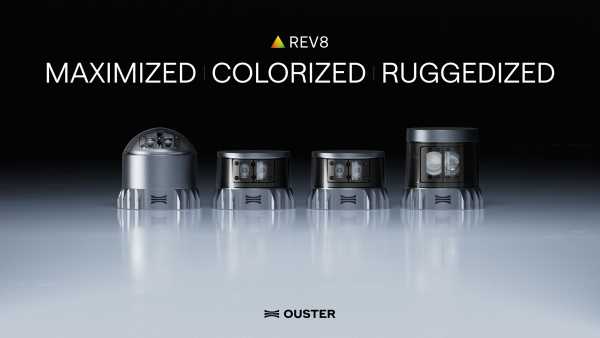
The Rev8 sensor family is capable of detecting up to 20 trillion photons per second with picosecond timing precision.
(Image credit: Ouster)
Rev8 enables sensors to gather superior 3D color data essential for constructing “world models” for embodied AI systems, as explained by Ouster representatives in their statement. Scientists contend that these world models—neural networks utilizing real-world data points—are imperative for training systems such as humanoid robots or self-driving cars to navigate and interact with their environment.
The demand for cutting-edge lidar sensors is escalating, with Ouster’s sensors already integrated into autonomous systems manufactured by companies like Google and Volvo.
Related stories
- A novel electric vehicle motor invention could reduce future vehicles’ weight by 1,000 pounds, enhancing their efficiency and range.
- The covert X37-B space plane will evaluate a quantum navigation system, which scientists anticipate may eventually replace GPS.
- The debut of the first flying taxis is anticipated to occur in 2026.
Waymo has deployed its autonomous taxis in major U.S. cities and intends to commence operations in London this year. Humanoid robots are projected to assume an increasing number of roles in education, healthcare, and eldercare, while industrial robot installations have more than doubled since 2004.
Ouster is not the sole entity aiming for a significant share of the robot sensor market. In April, Hesai, a China-based company, revealed a new lidar sensor that also processes color and 3D depth information directly on the chip. However, unlike Rev8, it has not yet entered mass production.
Sensor technology for autonomous vehicles has progressed to even more advanced stages in research laboratories. Last summer, researchers from the University of Rochester and the University of California unveiled their coin-sized laser capable of emitting 20 quintillion light pulses per second and accurately identifying objects moving at speeds up to 89 mph (143 km/h).
Sourse: www.livescience.com