in News
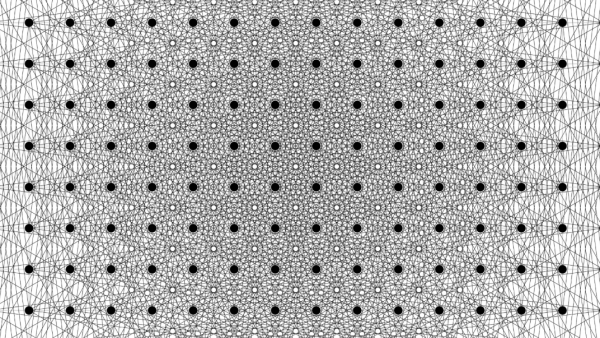
How many unit distances can you fit on a single piece of paper? OpenAI says one of its models knows.(Image credit: OpenAI)Share this article 0Join the conversationFollow usAdd us as a preferred source on GoogleSubscribe to our newsletter
An artificial intelligence (AI) model has resolved an 80-year-old mathematical puzzle, a development celebrated as a significant achievement for AI’s computational capabilities.
The planar unit distance problem, initially proposed by Hungarian mathematician Paul Erdős in 1946, poses a seemingly straightforward inquiry: What is the maximum number of pairs of points that can be situated one unit apart on a two-dimensional plane? Erdős hypothesized that this number would grow marginally faster than the quantity of dots.
The most precise upper boundary established by humans for this problem was first defined in 1984. However, last week, OpenAI revealed in a blog post that an internal AI model has cracked the case — discovering a configuration of arrangements that surpassed the limit previously set by Erdős.
More significantly, perhaps, the AI lab asserted that the general-purpose reasoning model employed was not specifically trained for this particular problem, nor was it trained in mathematics at all.
“This proof represents a crucial juncture for the mathematics and AI communities. It signifies the first instance where a prominent unresolved problem, central to a segment of mathematics, has been tackled autonomously by AI,” stated company representatives in the post.
The successful input provided to the company’s internal model can be examined in the accompanying research paper. Within it, OpenAI researchers indicated that their model utilized a completely original methodology to supersede a prevailing theory typically associated with the planar unit distance problem.
“These concepts were widely known among algebraic number theorists, yet it was quite surprising that these ideas hold relevance for geometric inquiries,” OpenAI representatives further commented in the post.
OpenAI indicated that this outcome represents the inaugural instance of AI independently resolving an open challenge in a specific field. However, possibly in reaction to previous public apprehension regarding the technology’s potential to supplant human roles, the company also emphasized that the technology is designed to augment the work of mathematicians rather than replace it. External human mathematicians were consulted to review and validate the findings, and they authored a supplementary paper to provide context on how the AI arrived at its conclusion.
“While the initial proof generated by the AI was entirely valid, it underwent substantial refinement by the human researchers at OpenAI and the numerous other mathematicians involved in the current paper,” remarked Thomas Bloom, a mathematician at the University of Manchester and custodian of the Erdős problems website, in the companion paper. “The human element remains indispensable for discussing, comprehending, and enhancing this proof, as well as exploring its implications.”
RELATED STORIES
- AI is solving ‘impossible’ math problems. Can it best the world’s top mathematicians?
- AI could soon think in ways we don’t even understand — evading our efforts to keep it aligned — top AI scientists warn
- This 180-year-old graffiti scribble was actually an equation that changed the history of mathematics
Nevertheless, the reception from mathematicians to this outcome has been predominantly positive. “There is no question that the resolution of the unit-distance problem is a landmark achievement in AI mathematics; had a human authored the paper and submitted it to the Annals of Mathematics, and I were asked for a prompt assessment, I would have recommended its acceptance without reservation,” wrote Tim Gowers, a mathematics professor at the University of Cambridge, in the companion paper. “No prior AI-generated proof has approached this level.”
OpenAI’s blog post suggested that this accomplishment extends beyond the planar unit distance problem alone, serving as a demonstration of concept that AI can be applied more broadly to “frontier research.”
Whether this potential will be realized remains to be seen. In October of the previous year, OpenAI representatives, including manager Kevin Weil and executive Sebastien Bubkeck, asserted that GPT-5 had solved 10 previously unresolved problems identified by Erdős in mathematics and made advancements on 11 others. Bubkeck later retracted this statement and deleted his initial post after experts, including Bloom, pointed out that these problems had already been addressed by human mathematicians.
Sourse: www.livescience.com

