

in News
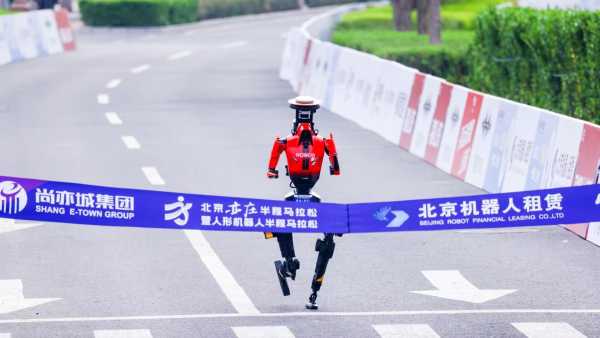
Honor’s autonomous robot conquers the half-marathon world record.(Image credit: Andalou via Getty Images)Share this article 0Join the conversationFollow usAdd us as a preferred source on GoogleSubscribe to our newsletter
A self-operating humanoid robot developed by the tech company Honor has significantly surpassed the human half-marathon record.
This robotic creation, named the Honor Robotics D1, a mechanical marvel in a striking red exterior, traversed the 13.1-mile (21.1 kilometers) distance in an impressive 50 minutes and 26 seconds at the 2026 Beijing E-Town Humanoid Robot Half-Marathon. This performance eclipses the prior human benchmark of 57 minutes and 20 seconds, established by Ugandan athlete Jacob Kiplimo in March.
Furthermore, a different robotic unit, unveiled by Honor representatives at Spain’s MWC Barcelona (previously known as Mobile World Congress) in March, achieved an even faster completion time of just 48 minutes and 19 seconds. However, this particular humanoid machine was disqualified from winning due to being remotely operated, rather than fully autonomous, incurring a 20% time penalty.
This achievement is particularly noteworthy when contrasted with the previous year’s event, where the leading model finished in 2 hours and 40 minutes. Both the second and third place finishers in this year’s competition were also Honor robots, crossing the finish line at approximately 51 minutes and 53 minutes, respectively.
Honor’s initial robot, showcased at MWC Barcelona, stands at 5 feet, 3 inches (1.6 meters) tall, weighs 176 pounds (80 kilograms), and possesses 20 degrees of freedom, complete with human-like five-fingered hands. In contrast, the D1 was engineered for optimal aerodynamics, featuring streamlined, blade-like appendages.
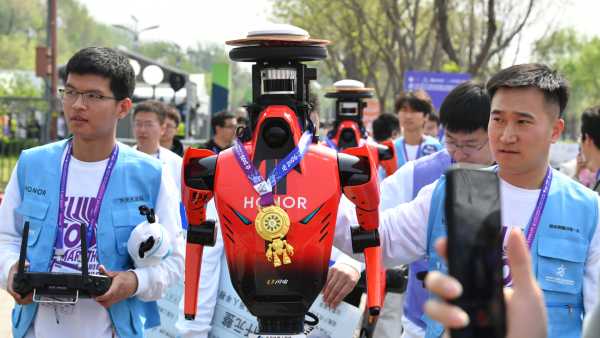
Honor’s robot proudly displays its gold medal post-event.
(Image credit: VCG via Getty Images)
While the MWC robot had a maximum speed of 2.5 mph (4 km/h), the D1 achieved a remarkable average velocity of 15.6 mph (25.1 km/h) in Beijing.
A crucial element enabling the D1’s sustained high speed over extended distances is a robust liquid-cooling system, largely developed internally. This self-engineered closed-loop liquid-cooling system draws inspiration from Honor’s smartphone technology. A network of tubes surrounds critical heat-generating components, particularly the joint motors, utilizing two high-speed micro pumps that circulate water at a flow rate of up to 6 liters per minute.
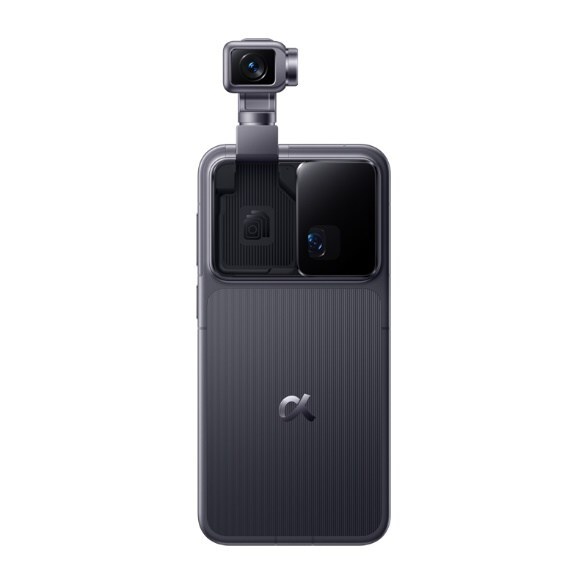
A detailed view of Honor’s Robot Phone.
(Image credit: Honor)
Honor has a history of integrating compact cameras, sensors, and artificial intelligence (AI) chips into its electronic products, though these advancements have primarily been geared towards the company’s smartphones. The connection to humanoid robots becomes most evident in another technology Honor introduced at MWC: the Robot Phone.
The Robot Phone merges embodied AI interaction with robotic movement and advanced cinematic imaging capabilities. It features a retractable camera that functions as the device’s “head,” and it can mimic movements to music, track objects, and distinguish sounds.
Related stories
- This humanoid robot handles all your household chores — and its creators claim it’s ready for home deployment
- Witness the surprisingly agile Chinese humanoid robot showcasing its dance moves
- Humanoid robots exhibit impressively eerie martial arts skills during China’s Lunar New Year festival
The D1, which participated in the Beijing race, is equipped with autonomous perception and navigation systems, along with an internally developed high-dynamic motion system. Company spokespeople stated in a release that it is capable of providing real-time interactive feedback during movement. This capability is amplified by illuminated strips and distinct gestures, and Honor plans to deploy it for events such as urban night races and street sports.
In contrast, the robot Honor presented at MWC is positioned more as a personal assistant. Honor representatives indicated that this robot can fulfill various daily support functions, including assisting with shopping or conducting workplace inspections, or serving more broadly as a “supportive companion.”
In context

In contextKeumars Afifi-Sabet
April has proven to be an extraordinary month for shattering marathon running world records. The success of the D1 humanoid robot in the half-marathon demonstrates the rapid progress these machines have made in a brief period. While we are accustomed to seeing viral videos of humanoid robots struggling with basic household tasks, mechanical advancements are accelerating at an unprecedented pace.
Firstly, this achievement indicates a substantial increase in actuator power density, enabling sustained high-speed operation over multiple miles, coupled with thermal management systems capable of handling prolonged high-intensity activity.
It also validates that autonomous navigation is sufficiently reliable for outdoor environments without predefined paths at running speeds, and that Honor has successfully integrated advanced battery energy density to support over 50 minutes of continuous, maximum-power operation. With a threefold improvement in completion times between last year’s competition and the current one, we eagerly anticipate the future performance of these humanoid robots in 2027.
TOPICS
Sourse: www.livescience.com