


Video Ancient Christian tomb complex discovered under rubble in Syria
A contractor clearing debris beneath a ruined dwelling in Syria’s Idlib province unearthed an ancient Christian burial site estimated to be 1,500 years old. (Credit: AP)
NEWYou can now listen to Fox News articles!
Israeli archaeologists have unearthed a 2,100-year-old sling projectile in Israel, bearing an inscription with a pointed message directed at opposing forces.
The artifact was found by researchers in a burial ground situated along an old route at Hippos, a city that was once a significant ecclesiastical center during the Byzantine era. During the Hellenistic period, from 323 B.C. to approximately 31 B.C., the city was known as Susita.
The missile, which experts date to the second century B.C., was inscribed with the Greek word “Learn,” as stated in a press release provided to Fox News Digital.
A photograph of the ancient, oval-shaped lead projectile reveals faint imprints of the Greek writing.
Michael Eisenberg, an archaeologist from the University of Haifa who recently published their findings with colleague Arleta Kowalewska in the journal PEQ, suggests the phrase was a “sarcastic” insult, he commented.

The ancient projectile, discovered at Hippos (left), dates back to the second century B.C. and features the Greek word “Learn.” A representation of a Hellenistic battle is shown on the right. (Dr. Michael Eisenberg, University of Haifa; Stock Montage via Getty Images)
“At Hippos alone, 69 similar projectiles have been identified to date, but this is the first globally to carry the inscription ‘Learn,'” Eisenberg stated, according to the March release.
“This reflects the local, witty humor of the city’s defenders, who intended to impart a lesson to their adversaries with a knowing nod: ‘Learn your lesson!’”
The object measures approximately 3.2 centimeters in length and 1.95 centimeters in width, with a weight of 38 grams.
Excavators noted evidence of impact damage on the projectile, indicating it likely originally weighed 45 grams.
The projectile was probably “launched by the city’s defenders from the ramparts towards the enemy advancing to lay siege to the city,” officials reported.
“To find a sling bullet with an inscription is exceptionally rare; discovering this Greek word on a sling bullet is a world-first.”
Lead projectiles were regarded as an economical yet deadly form of armament during that period.
“Sling bullets were manufactured by casting lead in stone molds through a relatively straightforward process that could be undertaken even during a military campaign,” the release elaborated.
Officials mentioned that “numerous projectiles were embellished with the name of a military leader, the name of a city, facetious remarks akin to ‘Catch!’ or symbols intended to bestow power, such as a trident, lightning bolt, or scorpion.”
This artifact represents an uncommon and unparalleled discovery, according to Eisenberg.
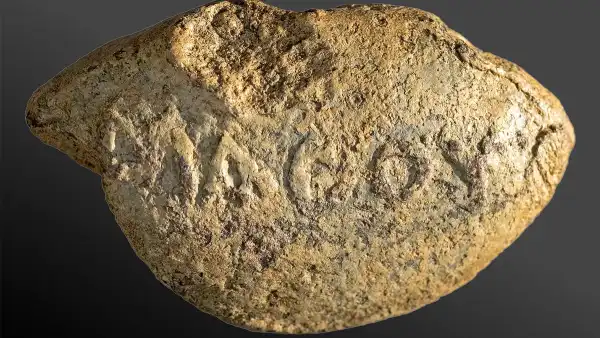
The Greek inscription “Learn” on the projectile, shown above, is interpreted as a sarcastic or derisive message aimed at enemy soldiers during a battle near Hippos. (Dr. Michael Eisenberg, University of Haifa)
“To find a sling bullet with an inscription is exceptionally rare; discovering this Greek word on a sling bullet is a world-first,” Eisenberg informed Fox News Digital.
“We are aware of comparable mocking or sarcastic humor directed at adversaries, but this particular instance was previously unknown and highlights the humorous local inclination among the Hellenistic defenders of Hippos.”
He also emphasized the importance of its discovery location, which strongly suggests it was discharged during a siege.
“The bullet’s proximity to the ancient main road below the city’s defenses, coupled with the impact mark on the bullet, facilitates a vivid reconstruction of the defenders firing the projectile towards the besieging forces advancing on the city,” Eisenberg stated.

The projectile is an ancient sling missile found at Hippos featuring a taunting inscription. Above, a general depiction of a Greek siege is displayed. (Universal History Archive/Universal Images Group via Getty Images)
This finding adds to the increasing number of significant archaeological discoveries made at Hippos.
Last year, excavations at Hippos revealed a 1,600-year-old Christian facility for the care of the elderly, potentially the oldest nursing home globally.
Additionally, last year at Hippos, archaeologists located a cache of antique jewelry and gold coins, aided by the use of metal detectors.