News
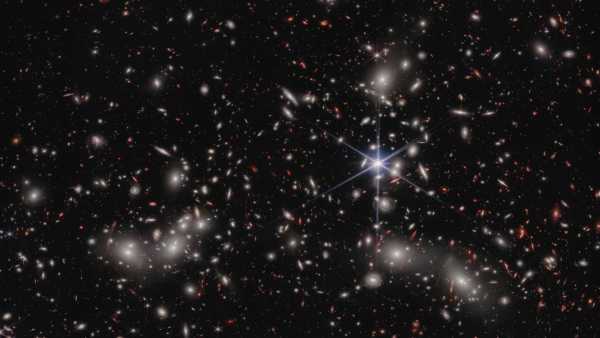
The galaxy cluster Abell 2744, as captured by the James Webb Space Telescope, acts as a cosmic lens, amplifying the faint light from some of the most distant galaxies and black holes within the observable universe. New research is now shedding light on the mysteries surrounding one such black hole.(Image credit: NASA, ESA, CSA, I. Labbe (Swinburne University of Technology), R. Bezanson (University of Pittsburgh), A. Pagan (STScI)Share this article 0Join the conversationFollow usAdd us as a preferred source on GoogleSubscribe to our newsletter
Scientists have identified an unprecedented instance of a black hole’s mass vastly exceeding that of its host galaxy, potentially offering insights into the formation of the supermassive black holes observed in the early cosmos.
A recent study involved the direct measurement of a black hole’s mass residing within a “little red dot” dating back to when the universe was only 700 million years old. The findings indicate that the black hole is disproportionately massive compared to its host galaxy, suggesting it might have formed prior to the galaxy’s own development.
Little red dots (LRDs) represent an enigmatic category of celestial objects detected in the nascent universe. The specific LRD under examination, designated Abell2744-QSO1 (or simply “QSO1”), was first observed in images from the James Webb Space Telescope (JWST) in 2023. It appeared compact and was heavily lensed—meaning its image was distorted and magnified, appearing three times in the picture due to intense gravitational effects—and exhibited characteristics of a black hole actively consuming matter. Previous indirect estimations of its mass, based on spectral characteristics, relied on assumptions derived from the local universe and have been a subject of considerable debate. Some researchers propose that the unusual nature of little red dots defies standard cosmological assumptions and might involve novel physical phenomena.
In the new research, published on May 27 in the journal Nature, astronomers employed a more direct methodology by mapping the rotational velocity of gas at varying distances from the object’s core to ascertain the black hole’s mass. The discoveries suggest that the techniques used to study black holes in our cosmic neighborhood may be equally effective for these nascent red dots.
“As far as we know, this is the first measurement of its kind within a Little Red Dot,” Ignas Juodžbalis, a doctoral candidate at the Kavli Institute for Cosmology at the University of Cambridge and the lead author of the study, stated in an email to Live Science.
When the “stars” aligned
Earlier estimations had suggested that black hole QSO1 possessed a mass of approximately 40 million solar masses—an exceptionally high figure for such a compact and young system. The greater the black hole’s size relative to its surroundings, the larger its sphere of influence—the zone where its gravitational pull overrides that of the surrounding stars, gas, and dark matter. Consequently, a more massive black hole facilitates the detection of its gravitational impact on the movement of nearby gas.
Furthermore, the galaxy cluster Abell 2744, situated between Earth and QSO1, is so substantial that its gravity acts as a cosmic magnifying glass. Through this phenomenon, known as gravitational lensing, astronomers are able to observe QSO1 appearing six times brighter and stretched spatially by a factor of 3.5.
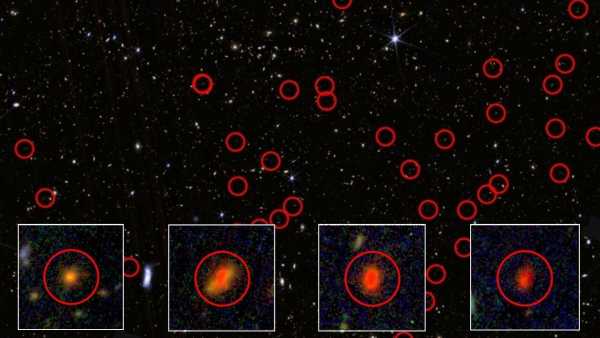
The James Webb Space Telescope has identified numerous peculiar ‘little red dots’ in the early universe. The current research suggests that some of these might be ancient black holes that coalesced even before galaxies formed around them.
(Image credit: Bangzheng “Tom” Sun)
In summary, these conditions were conducive to achieving the measurement the researchers sought.
The measurement technique was based on the principle that gas revolving around a black hole accelerates as it draws nearer. By charting the speed of gas at different radial distances from QSO1’s center, the team was able to extrapolate and compute the mass of the central object.
The team utilized JWST’s Near-Infrared Spectrograph to generate maps of hydrogen emission line gas, tracing the parts of QSO1 moving towards us and those receding. However, the object’s diminutive size and extreme distance meant that the rotational signature in the inner regions fell below JWST’s direct observational capabilities.
Consequently, they employed spectroastrometry, a method that detects minute positional shifts in the light emitted by glowing gas across various wavelengths. This technique can retrieve spatial information beyond the telescope’s standard resolution limit. “This allowed us to reconstruct the rotation curve below JWST’s instrumental resolution,” Juodžbalis elaborated.
Not too exotic
The resultant data were then fitted using various mass models. A point mass, where all mass is concentrated at a single point like a black hole, provided a good fit for the data. In contrast, a compact yet dispersed mass distribution, such as a densely packed star cluster, yielded a poor match. As an independent verification, co-author Cosimo Marconcini, pursuing a doctorate in astronomy and physics at the University of Florence, processed the entire dataset through a 3D framework he developed, which models both gas dynamics and the telescope’s instrumental effects. His analysis produced the same outcome. Juodžbalis indicated that this independent confirmation lent significant weight to the findings.
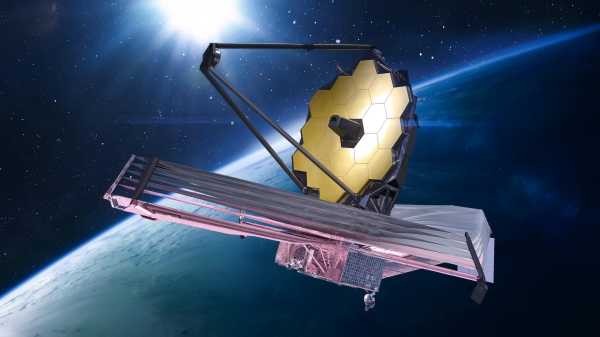
The James Webb Space Telescope’s infrared instruments possess the capability to detect light sources farther and fainter than any previous observatory.
(Image credit: NASA)
The analysis indicated that the observations are best accounted for by a black hole approximately 50 million solar masses in size. The research team expresses “considerable confidence” that this object is indeed a black hole, ruling out other possibilities. Juodžbalis noted that attempting to explain the observations with a star cluster having a defined edge would be significantly more unconventional and harder to justify than postulating a black hole.
Notably, the new measurement closely aligned with the earlier indirect estimation. Juodžbalis cautioned that findings from a single object cannot be generalized to an entire population. Nevertheless, the result suggests that the conventional indirect methods for measuring black hole mass, developed for the local universe, might also be applicable to little red dots. “It may not be necessary to invoke highly unusual phenomena to comprehend the characteristics of Little Red Dots,” he remarked.
“Naked” black hole
The team established an upper limit for the stellar mass of the host galaxy at roughly 20 million solar masses. This implies that the black hole substantially outweighs its entire host galaxy. Astronomers refer to such entities as “naked” black holes, and QSO1 appears to be the most massive example of this category ever discovered.
Given its immense black hole and its nearly non-existent host galaxy, QSO1 resembles a massive black hole seed caught in the earliest stages of development, prior to the formation of its surrounding galaxy. This discovery challenges the prevailing model wherein black holes co-evolve with their host galaxies over billions of years.
Related stories
- Mysterious ‘little red dots’ discovered by James Webb telescope may be the first stars in the universe on the verge of collapse
- James Webb telescope zooms in on a black hole that could reveal the truth about ‘little red dots’
- The James Webb telescope found hundreds of ‘little red dots’ in the ancient universe. We still don’t know what they are.
The researchers considered two unconventional origin theories for this black hole: direct collapse black holes, formed when vast clouds of primordial gas collapse directly into a black hole without prior star formation, and primordial black holes, which would have originated within the first second after the Big Bang.
“Both scenarios are unusual, and current data and theory are not yet sufficient to differentiate between them,” Juodžbalis stated.
The team intends to leverage upcoming ground-based observations to investigate the black holes within analogous objects discovered in the local universe.
Test your knowledge of black holes with our black hole quiz!
TOPICS
Sourse: www.livescience.com

