in News
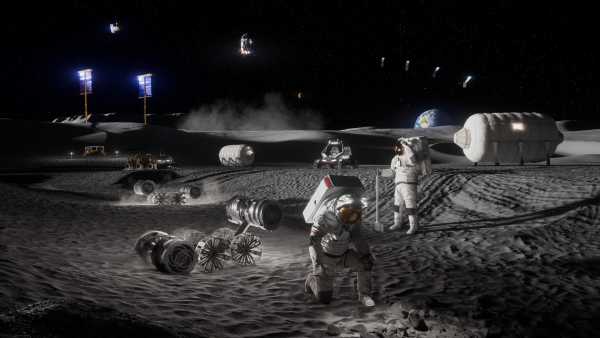
Artist’s impression of astronauts, habitats, rovers, power systems, and cargo operations supporting sustained human activities at a future Moon Base.(Image credit: NASA)Share this article 0Join the conversationFollow usAdd us as a preferred source on GoogleSubscribe to our newsletter
NASA has unveiled the subsequent phases of its strategy for establishing humanity’s inaugural lunar settlement, with three uncrewed expeditions to the moon scheduled for later this year.
These expeditions, detailed by the U.S. space agency during a press briefing on Tuesday (May 26), represent the initial efforts in a series of missions designed to lay the groundwork for a permanent lunar base. NASA anticipates this base will ultimately facilitate human journeys to Mars.
“America is returning to the moon, and this time with the intention to remain,” stated NASA Administrator Jared Isaacman during the press conference.
NASA has been contemplating concepts for a lasting lunar presence since the 1950s and has alluded to establishing a “sustainable lunar presence” since the inception of the Artemis program in 2019. However, the agency solidified these aspirations at its Ignition event on March 24 of this year, where it announced its $20 billion blueprint to construct a Moon Base intended as a center for scientific and technological research, development, and surface exploration.
“The Moon Base will serve as America’s and humanity’s pioneering outpost on another celestial body,” Isaacman remarked in a declaration following Tuesday’s press briefing. “Every mission, whether crewed or uncrewed, will provide a learning opportunity as we venture back to the lunar surface, erect the necessary infrastructure for sustained presence, and acquire the expertise crucial for living and operating in one of the most challenging and hazardous environments conceivable.”
The base, which NASA aims to establish in proximity to the lunar South Pole, could eventually evolve into an expansive settlement, as indicated by Moon Base program manager Carlos García-Galán at the press conference. “Our vision for the moon base is an area spanning hundreds of square miles, with various components contributing to the overarching goal of a permanent lunar presence on the moon.”
The first three missions
During Tuesday’s event, the space agency detailed its initial actions towards realizing this outpost.
- Moon Base I, slated for launch potentially as early as autumn 2026, will transport NASA payloads to the lunar surface. This will encompass instruments to investigate the interaction of thrusters with the moon’s regolith and technologies for enhanced tracking of lunar objects by orbiting spacecraft.
- Moon Base II, projected for launch later this year, will deploy lunar rovers and other mobility systems for surface traversal.
- Moon Base III, also anticipated for launch this year, will carry payloads from NASA, in addition to contributions from several other space agencies. Its primary objective will be to analyze the temporal changes of the lunar surface and the resilience of various materials under its extreme conditions.
These three missions are integral to NASA’s Phase I Moon Base initiative, which aims to establish the initial physical presence for a base on the moon. Phase II, scheduled between 2029 and 2032, intends to transition towards semi-permanent infrastructure and preliminary habitation. Phase III, planned from 2032 onwards, focuses on scaling operations to achieve a self-sustaining human presence.
In the press conference, the agency also announced that the inaugural mission would be executed by Jeff Bezos’s aerospace company, Blue Origin, utilizing the company’s Blue Moon Mark 1 Endurance lander to deliver the specified payloads. Blue Origin emerged as a significant beneficiary of the recent announcements, securing contracts valued at $468 million.
Nevertheless, a considerable number of experts express reservations regarding the viability of NASA’s ambitious schedule, coupled with the unproven nature of much of the technology included in the contracts. (For instance, Axiom Space has been selected as a rover partner despite its late development of space suits potentially causing substantial delays to the Artemis program; and both Astrobotic and Intuitive Machines, chosen for payload delivery, experienced failures in their prior lunar missions.)
While Isaacman emphasized that scientific discovery is the primary driver for these missions, NASA also faces considerable political impetus to return humans to the moon. China is consistently achieving “major milestones” in its own plan to land astronauts on the moon by 2030, and a September 2025 report from the Commercial Space Federation warned that China could soon surpass the U.S. in the “new space race.”
Despite the recent success of Artemis II, NASA’s Artemis program—which aims to land humans on the moon by 2028—is exceeding its budget and falling behind schedule; the agency had originally intended to land humans on the moon by 2024.
RELATED STORIES
- Can NASA and SpaceX truly construct a moon base within the next decade?
- New report cautions that China might surpass the US as the leading spacefaring nation — potentially within “5-10 years,” according to an expert
- 73 lunar landings? NASA’s ‘Moon Base User’s Guide’ reveals the agency’s ‘most ambitious space project’ will be fraught with challenges
Citing these impediments, Simeon Barber, a Lunar Scientist at The Open University, commented to BBC News: “It would not be surprising in the least if China reaches the moon first.”
Barber further added: “It appears to me that [NASA] feels compelled to announce their plans. Consequently, I believe there is significant political motivation behind this initiative.”
However, NASA maintains an optimistic outlook. “We are developing the Moon Base for all the knowledge we will gain, the innovation that will enhance life on Earth, the inspiration for future generations of explorers, and to master the capabilities required for our inevitable next destination…Mars,” Isaacman conveyed in a post on X. “The Golden Age of lunar exploration has commenced.”
TOPICS
Sourse: www.livescience.com

